



Treat every sentence of your opportunity statement as a hypothesis that might be wrong, not a description of what you know. Before designing a single interview question, read your opportunity statement through the lens of what you could be mistaken about — which barriers might be misidentified, which triggers might be misattributed, which desired outcomes might be your projection rather than your customer’s reality. The opportunity statement defines the boundaries of what you’re investigating; it does not validate the contents. Ground every downstream element — persona, journey map, interview script — in the discipline of treating the statement as a starting hypothesis rather than an established foundation.
Build an inventory of explicit assumptions from all three documents before drafting interview questions. Extract assumptions from your opportunity statement, persona, and journey map, organized by type: behavioral, emotional, economic, operational, decision-authority, and frequency. Assign each assumption a risk level based on how much commercial damage it would cause if proven wrong. High-risk assumptions — those on which your entire value proposition depends — require multiple probing questions from different angles. This inventory transforms your interview design from a brainstorming exercise into a targeted validation program, and it prevents the most common mistake in customer discovery: writing questions that explore rather than test.
Design behavioral questions that ask for specific past experiences rather than opinions, self-assessments, or hypothetical responses. For every assumption you need to test, formulate a question that invites the customer to recount a concrete incident — ‘Tell me about the last time...’ or ‘Walk me through what happened when...’ rather than ‘Do you ever...’ or ‘Would you...’. Customers are unreliable narrators of their own behavioral patterns in the abstract, but they can describe specific moments with remarkable accuracy. Behavioral framing is what separates data that validates assumptions from data that merely confirms them.
Conduct your interview stages in the sequence your journey map describes, and validate each stage before moving to the next. Don’t jump from awareness triggers directly to implementation challenges, and don’t introduce solution concepts before validating the current-state experience. Each stage builds context for the next — what customers learn during consideration shapes their decisions; what they anticipate during decision-making shapes their experience of implementation. Skipping stages produces fragmented data that can’t tell you how the customer actually moves through the problem space, which is exactly what you need to know.
Treat contradictions between your materials and interview findings as the most valuable output of the process, not anomalies to explain away. When customers describe triggers that don’t match your journey map, emotional experiences that don’t match your persona, or barriers that don’t appear in your opportunity statement, the system is working correctly — you’re learning where your understanding diverged from reality before you built a solution on that divergence. Update your assumption inventory after every round of interviews. Revise your journey map. Refine your persona. The goal isn’t to validate your existing understanding; it’s to build an accurate understanding, which sometimes requires dismantling what you thought you knew.
Introduction: The Translation Problem
Here’s something we see repeatedly in customer discovery workshops and classroom critiques.
A team has done the conceptual work. They’ve read the companion piece on assumption typology. They can identify behavioral assumptions, economic assumptions, emotional assumptions, decision-authority assumptions — the whole taxonomy. Ask them to inventory what their opportunity statement assumes, and they’ll produce a credible list.
Then we ask them to design their interview script.
The questions they write have almost no relationship to the assumptions they just articulated.
What are your biggest challenges with healthy eating? How important is nutrition to you? Would you be interested in a simpler way to plan meals?
The assumption inventory disappears. The questions float. And the interviews they run will produce data that can’t validate a single hypothesis they’ve constructed.
We call this the translation problem. Teams learn what assumptions exist. They can name the categories. What they struggle with is converting a named assumption into a specific behavioral question that actually tests whether the assumption holds. This article exists to close that gap.
From Assumptions to Evidence: Are Your Interview Questions Doing the Right Job?

Your interview script is a diagnostic instrument, not a confirmation device — its job is to surface truth, not to generate enthusiasm. The goal of customer discovery is not to leave every interview feeling validated. It is to understand, with increasing precision, what is real about the problem you are trying to solve and what remains an assumption. Scripts designed to confirm are structurally incapable of doing this work.
The Difference Between This Article and Its Companion
Our previous piece on assumption typology asked: What kinds of assumptions are you making? It offered a framework for excavating the explicit claims, implicit bets, behavioral premises, emotional hypotheses, economic expectations, and operational dependencies buried in your customer discovery materials.
This article asks a different question: now that you’ve named your assumptions, how do you test them?
The answer isn’t intuitive. Most teams, when told ‘your assumption needs testing,’ generate a question that asks customers whether the assumption is true. ‘Do you experience decision fatigue around meal choices?’ That’s not testing. That’s polling. Customers will tell you what they think you want to hear — or what they believe about themselves — which rarely matches what they actually do.
Behavioral questions work differently. They ask customers to recount specific experiences: particular moments, actual decisions, real sequences of events. The distinction sounds subtle. The practical difference is enormous.
We’ll demonstrate the complete translation process using Healthy Hannah, a composite teaching persona we’ve refined across multiple cohorts representing busy working professionals struggling with nutrition habits. We’ll move from opportunity statement through persona development and journey mapping, pause at the critical step most teams skip — building an explicit assumption inventory — and then show exactly how each assumption type transforms into a question designed to surface behavioral evidence.
This is not a checklist. It’s a workflow. Follow it, and your interviews will test what you actually believe about your customer. Skip it, and you’ll collect a lot of data that confirms nothing.
Step 1: Read Your Opportunity Statement as a Document Full of Bets
Before a team can build a validated interview script, they need a sharp opportunity statement. Not because the statement is the deliverable — it isn’t — but because every word of it represents a claim that needs testing.
Most teams write opportunity statements as descriptions. They document what they believe about their target customer, the problem the customer faces, the barriers they encounter, and the outcomes the customer seeks. The statement feels like an analysis. It reads like a summary.
Treat it differently. Read every sentence as a hypothesis you might be wrong about. Every named barrier could be wrong. Every stated trigger could be something you invented rather than discovered. Every desired outcome could be what you assume customers want rather than what they’ve actually told you.
Here’s the opportunity statement we use to anchor the Healthy Hannah teaching example:
Opportunity Statement for Healthy Hannah Busy working professionals (ages 32–45) struggle to maintain consistent healthy eating habits despite wanting to improve their health and energy levels. When juggling demanding work schedules and family responsibilities, they experience decision fatigue around daily meal choices, lack the knowledge to evaluate nutritional quality quickly, and find meal planning overwhelming and time-consuming. This prevents them from achieving their desired outcomes of sustained energy throughout the day, better long-term health markers, and the confidence that they’re nourishing their bodies properly. Current barriers include limited time for planning and preparation, conflicting and overwhelming nutrition information, difficulty breaking established convenience-food habits, and minimal support for behavior change in high-stress periods. Potential enablers include growing awareness of the health consequences of poor nutrition, increasing availability of healthy food options, widespread smartphone usage for tracking and guidance, and the desire to model healthy behaviors for family members.
Read that paragraph and count the assumptions. Decision fatigue is real and experienced as such. The primary barrier is time, not skill. Customers want sustained energy specifically, not just weight loss or improved health markers. Nutrition information feels conflicting rather than simply absent. Family modeling serves as a genuine motivation, not a rationalization. Each of those claims could be wrong.
Writing the opportunity statement is Step 1. The work that enables good interview design happens when you treat this document as an enumeration of hypotheses, not a summary of facts.
From this point forward, treat every artifact—statement, persona, and journey—as a hypothesis generator, not a conclusion.
Opportunity Framing Re-imagined: Harnessing the Behavioral Thread for Entrepreneurial Success

1. Craft a comprehensive opportunity statement that goes beyond surface-level problem descriptions. Include specific target customers, their context, desired outcomes, and key behaviors required for success. Identify barriers customers face and existing enablers that can be leveraged. Outline potential benefits and features of your solution that address these factors. Regularly revisit and refine your opportunity statement as you gather more customer insights and market data.
Step 2: Let Your Persona Reveal What You’re Betting On
Your persona does more than humanize your target customer. It encodes assumptions about the behavioral patterns your venture depends on. Each characteristic you describe — each goal, challenge, motivation, and daily-reality detail — represents a claim about who this person is and how they operate.
This specificity is what makes persona development consequential rather than cosmetic. Weak personas describe demographics. Strong personas describe behavioral dispositions, and every behavioral disposition embedded in the persona needs validation through interviews.
Here’s how we’ve developed Healthy Hannah for our courses:
Healthy Hannah: B2C Customer Persona
Demographics
Age 32–45, working professional (mid-level manager or specialist), suburban location, may have young children or aging parents, sufficient income but budget-conscious.
Behavioral Characteristics
1. Experiences energy crashes mid-afternoon that affect work performance
2. Makes food decisions reactively throughout the day rather than proactively
3. Starts each week intending to meal prep, but abandons the plan by Wednesday
4. Relies heavily on convenience foods during high-stress work periods
5. Feels guilty about food choices but is uncertain how to change patterns sustainably
Goals
Improve eating habits without adding a significant time burden. Increase energy levels to handle work and family demands. Achieve better health outcomes (lower cholesterol, stable weight, reduced inflammation). Feel confident about nutritional choices rather than constantly second-guessing.
Challenges
Time constraints, juggling work deadlines, and family responsibilities. Lack of comprehensive nutrition knowledge to evaluate options quickly. Difficulty breaking established unhealthy habits formed over the years. Overwhelming and conflicting health information from various sources. Limited support system for maintaining behavior change during stressful periods.
Motivations
Desire for a healthier lifestyle before health problems become serious. Concerns about the long-term health consequences of current eating patterns. Wanting to set a positive example for family members. Possible recent health scare or doctor’s warning creating urgency.
Context and Daily Reality
Mornings involve a rushed breakfast during the commute or while getting ready for the family. Lunch decisions happen during back-to-back meetings with limited nearby options. Evening meals compete with work emails, family activities, and exhaustion. Weekends offer more time but also bring social commitments involving food. Stress triggers a return to familiar comfort foods, regardless of health intentions.
Notice what this portrait contains beyond demographic data: a claim that Hannah makes reactive rather than proactive decisions (behavioral assumption), that meal prep abandonment happens specifically around Wednesday (behavioral specificity requiring verification), that guilt rather than indifference characterizes her emotional state (emotional assumption), and that knowledge gaps compound time constraints (two distinct problem sources, not one). Each of those warrants scrutiny. Interviews might reveal that the customer has time but lacks confidence — or that guilt is absent and indifference is the actual emotional signature of the problem. The persona says one thing. Reality might say another.
Step 3: Map the Current-State Journey as a Testable Hypothesis
Now we map the journey — with a discipline most teams struggle to maintain. We’re charting how customers navigate the problem space right now, before any solution exists. Not how they’d use a product. Not what an improved experience might look like. The present-state reality: messy, uncertain, emotionally complicated.
Four stages organize Hannah’s journey: Awareness, Consideration, Decision, and Post-Decision Implementation. Each stage carries five elements requiring documentation: triggers that initiate movement into the stage, thoughts and feelings experienced, behaviors exhibited, outcomes that result, and barriers that impede forward progress.
Here’s the complete Healthy Hannah Journey Map:
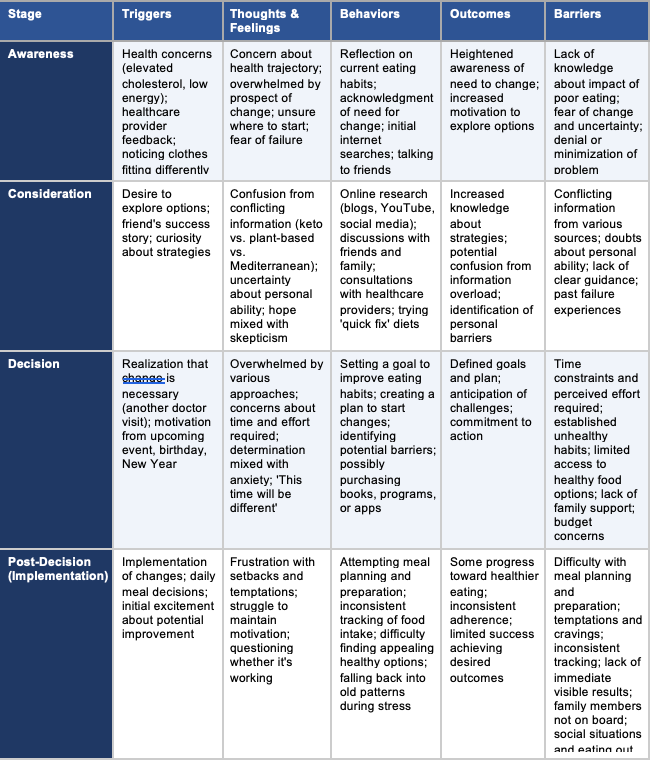
The crucial mental shift: read every cell of that table as a hypothesis, not a finding. The awareness stage doesn’t document that healthcare provider feedback triggers recognition — it hypothesizes that it does. The consideration stage doesn’t establish that conflicting information creates confusion — it proposes that it does. The implementation stage doesn’t prove that mid-week meal prep abandonment follows from stress — it advances that claim for testing.
Your journey map is the fullest articulation of what you believe about your customer. It is not yet knowledge. That distinction is exactly why the next step matters so much.
Step 4: Extract the Assumption Inventory Before You Write a Single Question
Here’s the step that separates teams that conduct genuine validation from those that have expensive conversations that merely confirm their existing beliefs.
Before writing any interview questions, pause. Go back through your opportunity statement, your persona, and your journey map. For each document, extract the embedded assumptions, organized by type. Our companion piece on assumption typology defines the categories. We’ll apply them now to the Healthy Hannah materials.
Healthy Hannah Assumption Inventory
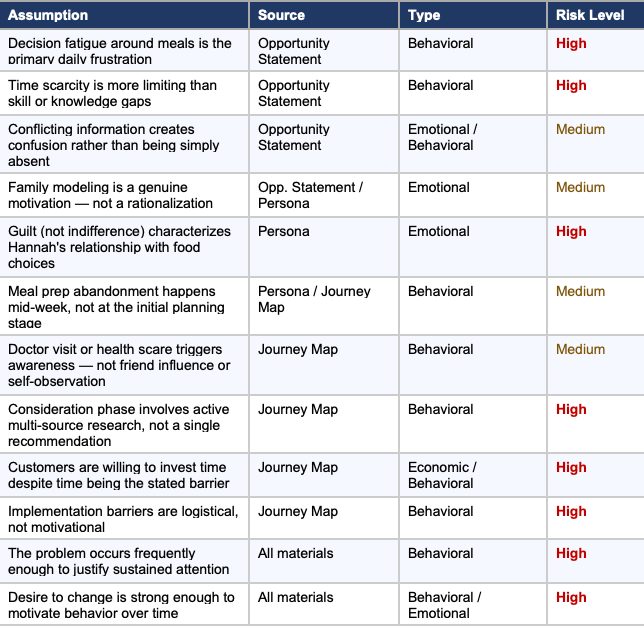
This inventory is the missing link most teams never build. It converts a journey map from a narrative document into a validation agenda. Each row represents something you need to test. Without it, you’ll write questions that sound relevant but don’t target the assumptions that matter most.
High-risk assumptions deserve multiple questions probing from different angles. Medium-risk assumptions warrant at least one direct probe. The inventory also reveals which assumptions carry the most commercial weight. For Hannah’s opportunity, the highest-stakes bet is this: that the problem is frequent, emotionally significant, and strong enough to sustain motivation for behavioral change. If customers experience this as an occasional annoyance rather than a persistent source of frustration, the business case collapses. That assumption demands the most rigorous scrutiny your interviews can provide.
Build this inventory before you draft a single question. It takes twenty to thirty minutes. It will save you from conducting interviews that generate interesting conversation but validate nothing.
Step 5: Build Questions That Put Each Assumption on Trial
Now we design the interview script. The discipline here is non-negotiable: every question must trace back to a specific assumption in your inventory if you can’t identify which assumption a question tests, cut the question.
Opening: Confirm You’re Talking to the Right Person
Start by verifying segment fit. The interview only produces usable validation data if your participant actually matches your target persona. Questions about their work situation, household composition, and current relationship with food accomplish this without telegraphing what you’re looking for. If the person describes meticulous Sunday meal prep that they love, stop the interview early. They’re not Hannah.
Stage 1 Validation: Awareness — Testing Triggers and Emotional Signatures
The awareness stage carries two clusters of assumptions: what triggers recognition that the problem exists, and what emotional signature accompanies that recognition. Your inventory flagged the doctor-visit trigger as medium risk. Test it directly — but with story-based framing:
“Can you tell me about a time when you first realized your eating habits were something you wanted to change? What was going on in your life then?”
→ Tests: Which trigger types actually initiate awareness
“What specifically made that moment feel like the right time to think about it — rather than other moments you’d probably had before?”
→ Tests: Whether triggers are discrete events or cumulative drift
“When that realization landed, what did you feel? Walk me through your headspace.”
→ Tests: Emotional assumption — guilt, overwhelm, fear, or something else entirely
“What did you do next? Not what you planned to do — what you actually did in the day or two after that moment?”
→ Tests: Whether awareness leads to the behaviors the journey map predicted
Notice the framing: ‘Can you tell me about a time when...’ not ‘Do you ever feel...’ The first invites a story. The second invites self-report, which is far less reliable. Customers can’t accurately describe their behavioral patterns in the abstract. They can describe specific moments with remarkable accuracy.
Stage 2 Validation: Consideration — Testing Whether Research Actually Happens
Your inventory flagged active multi-source research as a high-risk behavioral assumption. Many customers skip this stage entirely — they act on a single friend’s recommendation and never enter a research phase. That would contradict the journey map fundamentally, which is exactly why we test it:
“Walk me through how you went about figuring out what to try. Where did you start?”
→ Tests: Whether a consideration phase exists at all
“How many different sources or approaches did you look into before you settled on something? What were they?”
→ Tests: Depth and breadth of the consideration phase
“As you were researching, what confused you? What felt contradictory?”
→ Tests: Whether conflicting information creates confusion or whether customers filter it effectively
“Tell me about a moment when you found information that seemed helpful — and then another source said something completely different. What happened internally?”
→ Tests: Emotional signature of the consideration phase; whether confusion frustrates or informs
If most customers skip research and act on a trusted recommendation, your consideration stage needs significant revision. That’s not a failed interview. That’s the system working correctly.
Stage 3 Validation: Decision — Testing Commitment Formation and Economic Willingness
The decision stage sits at the intersection of your behavioral and economic assumptions. The journey map hypothesizes that an external event triggers commitment. It also assumes customers are willing to invest time, energy, and possibly money, despite time being the stated barrier. Both deserve scrutiny:
“Tell me about the moment you decided to actually commit to making a change — not just think about it, but do something. What triggered that?”
→ Tests: Whether external events drive decisions, or whether it’s more gradual
“What did ‘committing’ actually look like in practice? What did you do?”
→ Tests: Whether commitment formation matches the journey map’s description
“Before you started, did you think about what it was going to cost you — in time, money, effort? Walk me through that.”
→ Tests: Economic and behavioral assumptions about willingness to invest
“What convinced you this approach was worth your time, given how busy you already were?”
→ Tests: The economic assumption that time-scarce customers will invest in something time-consuming
That last question is particularly important. If Hannah’s primary barrier is time, how does she ever commit to something that requires time? Either the assumption is wrong, the customer has found a time-efficient solution, or the commitment is weaker than it appears. The interview should resolve which.
Stage 4 Validation: Implementation — Testing Where Theory Meets Reality
Implementation carries the highest assumption density — and the widest gap between belief and reality. This stage determines whether your solution needs to address logistical barriers or motivational ones. That distinction should shape your entire design approach:
“Walk me through a typical week of trying to eat the way you intended. What actually happened — day by day?”
→ Tests: Whether implementation looks like the journey map predicted
“Tell me about the last time it fell apart. Not in general — specifically. What day, what happened, what did you do instead?”
→ Tests: The behavioral assumption that mid-week abandonment is the dominant failure pattern
“When you slipped from the plan — what were you feeling in that moment? Frustrated? Relieved? Something else?”
→ Tests: Emotional assumptions about the implementation experience; whether guilt or indifference characterizes failure moments
“What’s the hardest part about implementation that you didn’t anticipate when you started?”
→ Tests: Whether barriers are logistical (time, preparation, options) or motivational (willpower, social pressure, habit strength)
The implementation section also carries your highest-risk commercial assumption: that the problem is frequent and painful enough to justify sustained behavior change. Probe that directly:
“In the past few weeks, how often would you say this comes up in a meaningful way — where it actually affects how you feel or what you get done?”
→ Tests: Frequency assumption
“Compared to other challenges you’re managing right now — where does this one sit?”
→ Tests: Emotional intensity assumption; whether this is a dominant pain or a background concern
Closing: The Earned Right to Look Forward
After systematically validating each journey stage, you’ve earned the right to ask forward-looking questions about desired outcomes and solution requirements. What would an ideal resolution feel like? What would Hannah’s life look like if this problem were solved?
These questions produce useful design input — but only after you’ve confirmed that the problem is real, frequent, and emotionally significant. Ask them first, and you’ll get polite speculation. Ask them after a thorough behavioral exploration,n and you’ll get grounded desire-lines rooted in experience.
“If this challenge were completely resolved — what would your day actually look like differently?”
→ Surfaces the customer’s true desired outcome, not a reaction to your proposed solution
“What would that resolution be worth to you, in terms of time you’d invest, money you’d spend, effort you’d put in?”
→ Tests economic willingness to pay in a non-leading, behavior-anchored way
“Is there anything about your experience that I didn’t ask about that you think matters for understanding this?”
→ Surfaces blind spots your journey map didn’t capture — often the richest insights of the session
That last question routinely produces the most unexpected and valuable insights in any interview. Customers know what’s important to them. Sometimes they need the full arc of a conversation to get there.
Mastering Behavioral Interviews: Unlocking Deep Customer Insights for Innovation

1. Ground your behavioral interviews in foundational documents like the opportunity statement, Business Model Canvas, customer profile, and journey map. Use these elements to identify key behaviors, decision points, and assumptions to explore during interviews. Craft questions that align with your innovation goals and challenge your existing understanding. Remain open to unexpected insights that may reshape your view of the customer. Continually refine these foundational documents based on interview findings to ensure your innovation efforts stay customer-centric.
Where This Process Breaks Down
We can predict the failure points before teams even conduct interviews, because the patterns across cohorts are remarkably consistent.
The most common breakdown is skipping the assumption inventory. Teams read their journey map, feel satisfied that they understand the customer, and jump directly to drafting questions. Without the inventory, they write questions that explore the journey rather than test it. ‘Walk me through your typical week’ surfaces behaviors, but doesn’t test whether the behaviors match what the map predicted. The questions feel relevant. They produce interesting conversation. But they confirm or disconfirm nothing.
The second breakdown is asking assumptions directly rather than behaviorally. ‘Do you experience decision fatigue around meal choices?’ is an assumption being put to a customer as a question rather than being tested with behavioral evidence. Customers will often say yes — not because they experience decision fatigue but because the question frames that as the expected answer. Behavioral questions mitigate social desirability bias by anchoring responses to specific past events. ‘Tell me about the last time you had to figure out what to eat when you were exhausted and rushed’ elicits evidence. The direct question elicits endorsement.
The third breakdown is front-loading. Teams introduce their solution concept before validating the customer’s current experience. The moment a solution enters the conversation, customers shift into evaluation mode. They’ll assess the concept, suggest improvements, and tell you it sounds interesting. None of that tells you whether the problem is real, frequent, or painful enough to warrant a solution.
The fourth — and most commercially dangerous — breakdown is failing to probe high-risk assumptions with sufficient depth. When a customer confirms your highest-risk assumption in a sentence, teams check the box and move on. The commercial viability of your venture may hinge on that assumption being correct. One sentence of confirmation isn’t enough. Probe it from multiple angles. Ask for specific examples. Ask what triggered specific instances. Ask how long those feelings persisted and what the customer did in response.
Conclusion: From Assumptions Named to Assumptions Tested
Our companion piece gave you the taxonomy. This piece gives you the process.
Name your assumptions by category — behavioral, emotional, economic, operational. Extract them from each document you’ve built: opportunity statement, persona, journey map. Build the inventory. Assign risk levels. Let that inventory drive every question you write.
The workflow we’ve demonstrated with Healthy Hannah applies whether you’re working on a consumer wellness app, a B2B enterprise platform, or a social impact initiative. The persona changes. The journey changes. The assumption categories and the discipline stay the same.
Your interview script is a validation instrument. Each question should test a specific hypothesis embedded in the materials you’ve constructed. When the hypothesis holds — when customers confirm the trigger, describe the emotion, exhibit the behavior, and name the barrier you anticipated — you proceed with greater confidence. When the hypothesis fails — when customers describe something different, contradict your map, or reveal that the problem isn’t what you thought — you revise. That’s not failure. That’s the system working.
Build the assumption inventory. Design questions that target each item. Run interviews with the discipline to follow contradictions wherever they lead. Update your materials when the evidence demands it. Repeat.
Your customers know the truth about their experience. Your job is to ask questions sharp enough to surface it.