

M8 | Your Launch
Module Eight: Your Launch
Chapter Introduction
Launching a new venture is an exhilarating milestone for any entrepreneur. After months or even years of hard work conceptualizing, developing, and validating your business idea, it’s finally time to bring your vision to life. However, the path from concept to launch is replete with critical decisions and actions that can make or break your startup’s success.
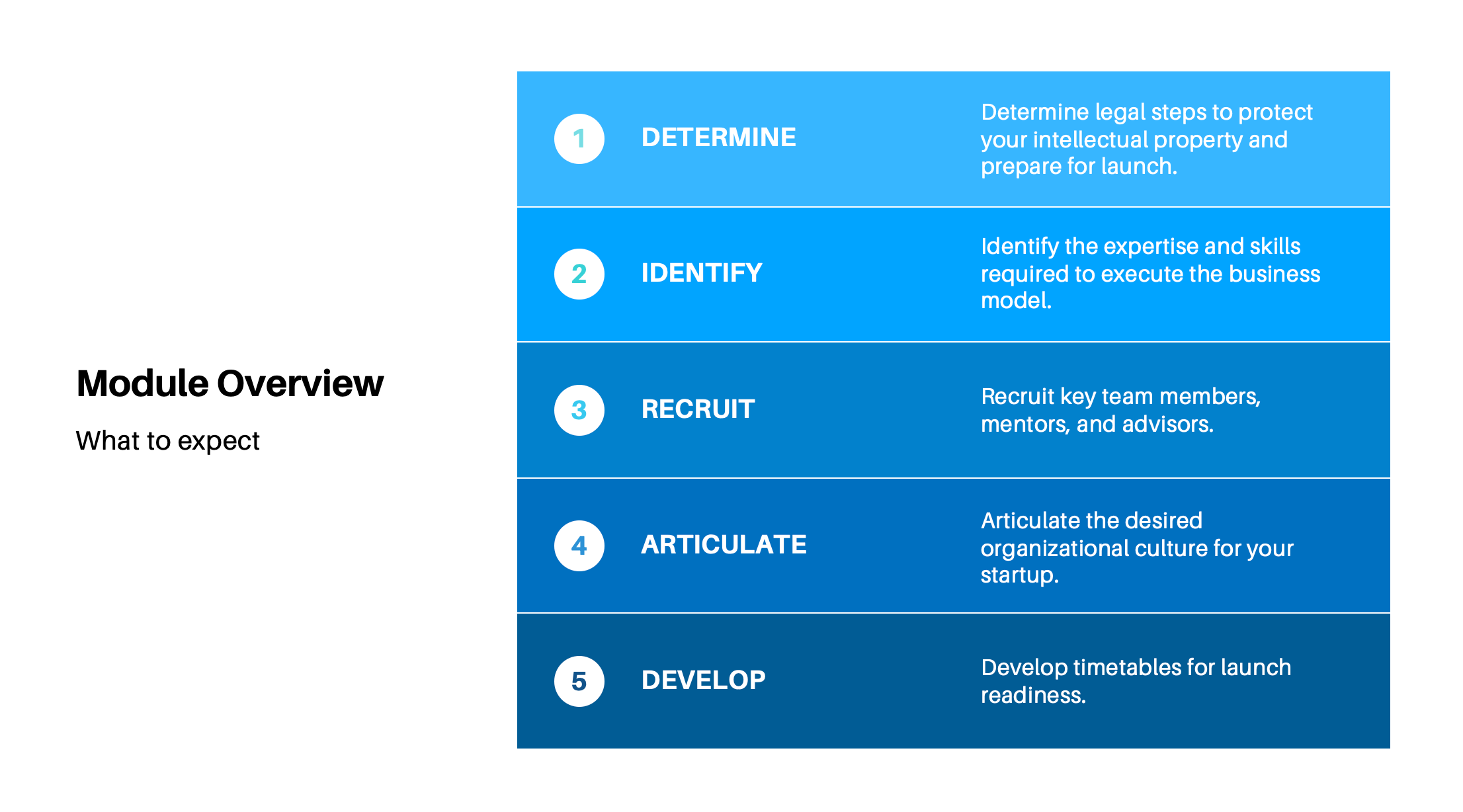
This chapter will guide you through the essential steps to prepare for a successful launch. We’ll examine the essential legal requirements and considerations for establishing your business entity, protecting your intellectual property, and ensuring compliance with relevant regulations. Next, we’ll explore recruiting your dream team, including identifying the skills and expertise needed, fostering a strong company culture, and leveraging advisors and partnerships.
Finally, we’ll provide a comprehensive checklist for assessing your startup’s launch readiness. From evaluating market knowledge and product-market fit to securing funding and defining key performance indicators, this checklist will help determine if you have the foundation to leap. We’ll also discuss strategies for preparing yourself personally for the transition to entrepreneurship.
By the end of this chapter, you’ll have a clear roadmap for navigating the legal, organizational, and strategic aspects of launching your startup. With careful planning and execution, you’ll be well-positioned to realize your entrepreneurial dreams.
Section One: Determining Legal Requirements
Section Introduction
Entrepreneurs can quickly become overwhelmed by the many actions required to establish their new venture as a legal entity that meets all local and federal regulations. In many countries, the regulatory hurdles can be a barrier of entry in their own right. So, here are some clear priorities to help you decide what actions to take first.
As this chapter makes clear, the legal structure you choose for your new venture will impact registration requirements, taxes, and personal liability. Each legal structure has advantages and disadvantages, and your decision will be driven by your enterprise’s short—and long-term goals.
Important Starting Point: Soliciting guidance from a lawyer and an accountant is advisable. While there are certain activities, you might be able to accomplish on your own, having expert advice ensures you avoid significant mistakes that may impact future personal and financial circumstances.
Selection Your Corporate Structure
As a founder with much on the plate and limited resources, you may ask, do I have to incorporate at all? The answer depends on the status of the venture. You can probably wait until the earliest concept state when you are considering the opportunity. One of the earliest triggers is taking on a co-founder or partner. Even in the earliest stages, this is an essential step with several legal consequences. At this point, we suggest you seek advice from a lawyer, focusing on incorporation and partnership agreements at a minimum. Other critical milestones include hiring employees or independent contractors, the need to protect intellectual property, opportunities for grants or early investments, and, of course, once you are ready for customer transactions. Most of these critical moments require that the startup be a separate legal entity from individual founders.
There are a couple of immediate benefits to incorporating at this stage. First, founders limit their liability against several potential issues. For example, if the company fails to make money and goes bankrupt, the legal responsibility to pay back debts is on the company and not the founders as individuals. As a founder, you want to protect your finances and assets if the enterprise fails. A second immediate benefit is the capacity to offer shares in the company. While different types of incorporation have various restrictions, the non-incorporated venture cannot share ownership in the form of shares. With this ability, you can attract outside investors. In general, founders need to be more expansive in what they can do and how they can operate before incorporating.
With that in mind, the legal structure for your new venture will impact registration requirements, taxes, and personal liability. Each legal structure has its advantages and disadvantages, and your decision will depend on your enterprise’s short- and long-term goals. Founders must carefully consider the legal form of their business to ensure that the form chosen best meets the short‐term and long‐term requirements and the significant tax and non-tax differences. Most importantly, the various legal entities have substantial tax and non-tax differences. So, it is vital to consider the differences and the impact on personal and company finances.
Spoiler Alert: Before describing the different types of structuring options, if you are a startup founder, the most common choice for most startup situations is a limited liability corporation (LLC) versus a “C-Corporation.” If you jump to those two sections, you can consider the advantages and disadvantages of each. If you plan to operate a closely held, small business and do not seek substantial outside investors, then an LLC may be your best choice. An LLC structure provides the liability protection founders need with tax advantages and governance flexibility. On the other hand, if you have plans to actively solicit external funding from investors and issue various stock classes to co-founders, employees, and investors, then the C-Corporation is the best choice.
With all this in mind, let’s look at the various structuring options for startup founders. Entrepreneurs have several legal business forms, including sole proprietorship, partnerships, LLC, C‐corporation, S‐corporation, and B-corporation. Entrepreneurs should determine which business form best suits their short‐term and long‐term needs. In choosing a form of ownership, entrepreneurs must remember that there is no single “best” form; what is best depends on the individual’s circumstances.
Sole Proprietorship
A sole proprietorship is a form of business in which a single owner does business themselves and requires only that the company registers with the local State government entity. Sometimes, a business or sales license is also required, and founders should check on regulations. If the proprietorship is to do business under a trade name, a Certificate of Doing business under an Assumed Name must be filed with the State and county where the company will operate. The fee for filing the certificate is usually nominal. Acquiring this certificate involves conducting a name search to determine that the term used still needs to be registered as the name of another business or as a trademark or service mark for another company.
The sole owner has the right to make all the decisions for the business. However, the owner is personally liable for all company debts and contracts. Because there is no distinction between personal and business debts, the creditors can sue to collect from the owner’s assets if the business cannot pay its bills. In matters dealing with taxes, profits, and losses, the business flows directly to the owner and is taxed at individual income tax rates on the owner’s tax return. If the owner does not plan to take a salary, income is the business’s profits.
Sole proprietorships are popular because they have two attractive features. First, one of the most attractive features of sole proprietorships is how fast and straightforward it is to begin operations. If a proprietor wishes to operate the business under their name, one obtains the necessary license(s), if any, and begins operations. In a sole proprietorship, the proprietor is the business. It is easy to start a proprietorship in a single day if the company is simple. Secondly, the proprietorship is generally the least expensive form of ownership. Typically, the proprietor goes to the appropriate State or county government office and states the nature of the new business in their license application. The government assesses the proper fees and license costs. Once these fees are paid, the owner is allowed to conduct business.
The bottom line is that sole proprietorship is only for some, as you see below under disadvantages. But if those disadvantages don’t concern you, it is a simple structure.
Advantages and Disadvantages
As a solo founder-owner, you have total decision-making authority. Because the sole proprietor is in complete control of operations and can respond quickly to changes, this becomes an asset in rapidly shifting markets. The freedom to set the company’s course of action is another primary motivation for selecting this ownership form. For the individual who thrives on seeking new opportunities and modifies the business as needed, the free, unimpeded decision-making of the sole proprietorship is an enticing proposition.
Secondly, the proprietorship is the least regulated form of business ownership. There are minimum legal requirements and reporting obligations. Founders must ensure they provide local and federal governments with all proper tax reporting. When government requests for information seem never-ending, this feature has many merits.
Finally, all financial outcomes go to the founder-owner. The proceeds minus taxes go directly to the founder of your startup, which earns a profit. That said, you are personally liable for all debts and obligations, which is one of the significant disadvantages.
As advantageous as the sole proprietorship form of ownership is, it does have three major disadvantages:
The most significant disadvantage of a sole proprietorship is unlimited personal liability; that is, the sole proprietor is personally liable for all business debts. The proprietor owns all the business assets. If the business fails, these assets can be sold to cover debts. If unpaid debts exist, creditors can seize and sell the owner’s assets to cover the remaining debts. Failure of the Business can ruin the owner financially. Because the law views the proprietor and the business as the same, the business’s debts are the owner’s. Laws protecting an individual’s assets to some degree may vary from one State to another. Most states require creditors to leave the failed business owner a minimum amount of equity in a home, a car, and some personal items. The new Federal Bankruptcy Law protects retirement assets from creditors. Bankruptcy may be needed to protect a failed business owner. Because laws vary, picking the proper jurisdiction to do business is critical.
A sole proprietor generally needs financial resources for a business to grow and expand. Many proprietors put all they have into their companies and often use their personal resources as collateral on existing loans. In short, if they have great personal wealth, proprietors find it easier to raise additional money while maintaining sole ownership. The business may be sound in the long run, but short‐term cash flow difficulties can cause financial headaches. Most banks and lending institutions have well‐defined formulas for borrower eligibility. As a result, a proprietor may be unable to obtain the funds needed to operate the business, especially in difficult times.
Lack of continuity is inherent in a sole proprietorship. If the proprietor dies or becomes incapacitated, the business automatically terminates. Unless a family member or employee can effectively take over, the company’s existence could be jeopardized. In some circumstances, creditors can petition the courts to liquidate the dissolved company’s assets and the proprietor’s estate to pay outstanding debts.
Partnerships
A partnership is an association of two or more people as co-owners of a business for profit. There are typically two types of partnerships. The first type, a general partnership, requires that each partner participates in all profits and losses equally or to some previously agreed‐upon ratio. Typically, a general partner has unlimited liability, which includes personally owned assets outside the business association. A partnership can be created by a formal agreement or an oral understanding (though I don’t recommend the latter). In addition, it must be banded together for profit-producing motives and is generally not considered a legal entity separate from the partners. A general partnership may not sue or be sued in the firm’s name. Each partner shares potential “joint and several” liabilities. The second type of partnership, a limited partnership, limits the liability of the partners to the extent of their capital contributions. A limited partnership must have at least one general partner, so at least one person or entity’s assets must be at stake. The general partner is often a corporation, so only the corporate assets are at stake.
Advantages and Disadvantages
Like the sole proprietorship, the general partnership is easy and inexpensive to establish. The partners must obtain the necessary business license and submit a few forms. In most states, partners must file a Certificate for Conducting Business as Partners if the business operates under a trade name. Limited partnerships require registration to be official.
There are no restrictions on distributing profits as long as they are consistent with the partnership agreement and do not violate the rights of any partner. For this reason, a legal partnership agreement must exist that outlines how profits, benefits, and assets are divided. Secondly, partnerships have access to a larger pool of capital. The partnership form of ownership can significantly broaden the pool of capital available to the business. Each partner’s asset base improves the ability of the company to borrow needed funds. Therefore, each individual has more to contribute to equity capital, and their assets will support a larger borrowing capacity. Additionally, a partnership can attract investors who, with limited liability, can still realize a substantial investment return if the business thrives. Many individuals find investing as limited partners in high‐potential small companies very profitable.
Finally, a partnership itself is not subject to federal taxation. Its net income is distributed directly to the partners as personal income, on which they pay taxes. General partners are allowed to use partnership losses on their returns. The partnership, like the sole proprietorship, avoids the double taxation applicable to the corporate form of ownership.
The major disadvantage of a partnership structure is that at least one partner must bear the brunt of unlimited liability. At least one member of every partnership must be a general partner. The general partner has unlimited personal liability. Most general partners play an active role in the company’s operations. Often, one or more general partners will be designated as managing partners. General partners act on behalf of the company regarding legal and financial considerations. However, they also have unlimited liability. So, if the company acquires debt or other liability, it passes it on to the general partners. If you set the structure up as a limited partnership, then only one owner is designated as a general partner, and they alone have unlimited liability.
Secondly, although partnerships are superior to proprietorships in attracting capital, they are generally not as effective as the corporate form of ownership. This condition exists because partnerships usually have limitations and restrictions on raising capital.
As stated earlier, partnership agreements must detail all financial and operational responsibilities among all partners. Friction among partners is inevitable and difficult to control. Disagreements over what should be done or what was done have dissolved many partnerships. One of the areas of potential conflict resides in the restrictions on disposing of one’s shares in a partnership. Most partnership agreements restrict how partners can dispose of their business shares. It is expected to find that partners must sell their interests to the remaining partners. But even if the original agreement contains such a requirement and delineates how to determine the current value, there is no guarantee that the other partner(s) will have the financial resources to buy the seller’s interest. When the money is unavailable to purchase a partner’s interest, the other partner(s) may be forced to either accept a new partner who purchases the partner’s interest or dissolve the partnership, distribute the remaining assets, and begin again. The partnership automatically dissolves when a general partner dies, becomes incompetent, or withdraws from the business, although it may not terminate. Even when there are numerous partners, if one wishes to disassociate their name from the company, the remaining partners will probably form a new partnership.
Limited Liability Company
An LLC blends some of the best characteristics of corporations, partnerships, and sole proprietorships. First, it is a separate legal entity like a corporation. Second, it can be treated as either a sole proprietorship or a partnership for tax purposes, depending on whether there are one or more members. Therefore, it carries with it the “flow‐through” or “transparent” tax benefits corporations do not have. Third, it is very flexible and straightforward to run. As long as the terms of the operating agreement are adhered to, the LLC may be operated more like a sole proprietorship or a partnership than a corporation. The owners are called members, individuals (residents or foreigners), corporations, other LLCs, trusts, pension plans, etc.
An LLC is formed by filing an Article of Organization form with a secretary of State and signing an LLC operating agreement. Most states require that an annual report be filed to keep them apprised of the LLC’s current status. The LLC is not a tax‐paying entity. Instead, profits, losses, and the like flow directly through and are reported on the individual members’ tax returns unless the members make an election to be taxed as a corporation.
Advantages and Disadvantages
As noted above, the LLC has several advantages. First, formation is relatively straightforward. Owners are considered members and file articles of organization with the local state government. Formation does not require filing corporate documents, appointing a board of directors, or distributing stock. Owners have quite a bit of flexibility in running the business with minimum regulation.
Secondly, the LLC provides owners with limited liability protection against most business debts and obligations. In case of a lawsuit, only the business assets are at risk. Owners’ assets, such as bank accounts and real estate, are protected.
One of the significant advantages of this legal form is how profits and taxes are handled. All profits or losses are attributed to the owners. What is sometimes called a “pass-through,” as profits and losses are directly reported on the owner’s tax returns. The LLC owners use a Schedule C to report all profits, losses, and deductions on their individual IRS tax returns. If there are multiple owners, each files their returns separately. When there are numerous owners, they can also choose to be taxed as a corporation.
The most significant disadvantage of an LLC compared to a corporation is the difficulty of securing outside financing. LLCs must refrain from issuing stock to outside investors, thus making it challenging to entice investors and limiting future exit strategies. Additionally, it is impossible to grant stock options to managers and employees as one can in a corporation.
While no restrictions exist on the number or class of LLC members, transferring ownership is restricted. Requirements are different per local government regulations. Again, this situation may hinder specific exit strategies.
C‐Corporation
C‐corporation is a common form of business ownership, especially for growing and raising company funds. Publicly traded companies use this format. A corporation is a separate legal entity from its owners and may engage in business, issue contracts, sue and be sued, and pay taxes. The owners of a corporation hold stock in the corporation. Each share of stock represents a percentage of ownership. Directors and officers conduct the actual business.
When a corporation is founded, it accepts the regulations and restrictions of the State in which it is incorporated. It also accepts the rules and conditions of every State where it conducts business. When they conduct business in another state, that State considers their foreign corporations. Corporations formed in other countries but do business in the United States are foreign corporations. How a company incorporates impacts its ability to operate and tax liability. Also, a corporation may be taxed in every jurisdiction where it is incorporated or doing business.
Generally, the corporation must file annually in its state of incorporation and in every state where it is doing business. These reports become public records. If the corporation’s stock is sold in more than one State, the corporation must comply with federal and State regulations governing the sale of corporate securities. For most small businesses, selling stock will not involve registering the stock as a security. However, the law may require filing reports showing a registration exemption.
A corporation has three primary sections: the stockholders, the board of directors, and the officers. Therefore, it is essential to understand the specific functions of each section.
Advantages and Disadvantages
The corporation allows investors to limit their liability to the total amount of their investment in the corporation. They must adhere to the terms of the Certificate of Incorporation and bylaws. A corporation cannot just be set up and run as a sole proprietorship. The officers must conduct business in the name of the board of directors. Using books and records separate from those of the shareholders. This legal protection of personal assets beyond the business is of critical concern to many potential investors. Because startup companies are risky, lenders and other creditors often require the owners to guarantee loans made to the corporation personally. By making these guarantees, owners are risking their assets (just as in a sole proprietorship), despite choosing the corporate form of ownership. However, limiting the scope of a guarantee is possible, so not all personal assets may be at risk.
Based on limited liability protection, the corporation has proved to be the most effective form of ownership in accumulating large amounts of capital. Limited by only the number of shares authorized in its charter (which can be amended) and subject to the laws on registration of securities, the corporation can raise money to begin a business and expand as opportunity dictates. Professional or “institutional” investors such as venture capitalists demand this incorporation.
Unless limited by its charter, the corporation as a separate legal entity can continue indefinitely. The existence of the corporation does not depend on any single individual. Additionally, suppose stockholders in a corporation are displeased with the progress of the business. In that case, they can sell their shares to another individual, subject only to restrictions on the transfer of shares. Stocks can be transferred through inheritance to a new generation of owners. If any person wishes to own shares in a firm and there is someone who would like to sell their interest in that firm, an exchange is possible. During all this change of ownership, the business continues.
There are two main disadvantages of C-Corporations. First, corporations can be costly and time-consuming to establish. In some states, an attorney must handle the incorporation, but in most cases, entrepreneurs can complete the requirements. However, suppose an entrepreneur is concerned about the complexity of the requirements. In that case, they may feel more comfortable employing an attorney even in states where one is not required, so one does not go afoul of the legal and registration requirements. Failure to properly register and follow the corporate form may cause a loss of the ability to limit shareholder liability.
For federal tax purposes, corporation profits are taxed and reported on the corporation tax return. Current federal rates range up to 21 percent due to 2017 tax cuts. Any after-tax profits distributed to shareholders as dividends are taxed again and are reported by the shareholders on their tax returns. This condition is commonly referred to as double taxation.
S‐Corporation
The S‐corporation, often called a sub‐S‐corporation, is a corporation that elects under federal and State tax laws to be taxed like a partnership. Its profits and losses are recognized for tax purposes at the individual shareholder level. The shareholder are responsible for reporting the profits or losses on their individual income tax returns. This type of corporation works well for startups or small companies anticipating net losses for a substantial period. In this case, the owner can use the loss to offset other income, or the owner is personally in a lower tax bracket than the corporation, thus saving money in the long run.
Several restrictions are inherent in this type of corporate entity, which makes it challenging to entice external financing. For example, S-Corporations can only issue one class of stock to individuals and certain trusts. In addition, the number of shareholders is limited to one hundred.
Advantages and Disadvantages
The S‐corporation retains all the advantages of a regular corporation, such as continuity of existence, transferability of ownership, and limited personal liability. However, the most notable provision of the S‐corporation is that it avoids the corporate income tax (and the resulting double taxation) and enables the business to pass operating profits or losses on to shareholders. In effect, the tax status of an S‐corporation is similar to that of a sole proprietorship or partnership.
S‐corporations have restrictions on the use of losses and tax recognition on sales of their assets, which are different from those of a C‐corporation. These may be disadvantages to the owners. Thus, although one may face double taxation as a C‐corporation, the loss of flexibility on the sale of assets or stock of the corporation may require one to remain a C‐corporation and ultimately gain the most profit upon the sale of a business. In addition, if the entrepreneur intends to raise capital from third parties, such as venture capitalists, the company will have to be restructured into a C‐corporation before this can occur.
Benefit Corporation
A recent addition to the founders’ choices for incorporation is a Benefit Corporation, not to be confused with a “B-Corporation,” which is awarded certification based on an assessment by a non-profit called B-Lab. Benefit corporations are state-registered and operate for profit but emphasize social and environmental impact.
A Benefit Corporation differs from a traditional corporation because it has a broader perspective by expanding the concepts of purpose, governance, transparency, and accountability concerning a more comprehensive range of stakeholders beyond standard stockholders. For example, benefit corporations must commit to producing a general public benefit and operating responsibly and sustainably in addition to financial performance. In other words, social impact objectives must be as important as economic outcomes. In addition, from a governance perspective, a board of directors must consider the interests of a wide range of stakeholders, including supply chain partners, employees, local communities, and the environment. Finally, social impact and financial performance must be communicated to all shareholders and the public.
Advantages and Disadvantages
The Benefit Corporation has many of the same advantages as other corporations. First, these entities are taxed similarly to other for-profit organizations. There is no separate IRS classification for a benefit corporation. As a benefit corporation, owners can elect to be taxed as either a C corporation or an S corporation.
B corporations, like other corporations, have limited liability protection, which sometimes extends to cover shareholder lawsuits for failure to meet social impacts. That said, Benefit Corporations still are at risk of shareholder lawsuits in some states. Thirdly, there may be a brand benefit to being seen as a company that pursues profits and social good. While far from proven, many stakeholders, including customers, employees, and investors, find B Corporations attractive.
As of 2022, over 30 US states offer benefit corporation status. It is still too early to tell if such designations improve a venture’s brand reputation, financial performance, or social impact. Advocates believe that customers tend to purchase from a company recognized as having a social mission over one that does not. These outcomes are far from proven, but there are still many ethical and business reasons to opt to meet higher social and environmental performance standards, transparency, and legal accountability.
Key Legal Actions for Startups Preparing to Launch
When preparing to launch a new venture officially, entrepreneurs must navigate a variety of legal requirements to establish the business and meet regulatory obligations properly. While the specific steps vary based on location and business type, the following legal actions are important for most startups:
1. Choose a legal structure. Options include sole proprietorship, partnership, LLC, C-corp, S-corp, B-corp, and 501(c)(3) nonprofit. Consult a lawyer and accountant to select the structure that best aligns with your short and long-term goals.
2. Register the business name and entity. File necessary paperwork like articles of incorporation with state and local authorities. Secure any required business licenses and permits.
3. Obtain tax IDs. Apply for a federal Employer Identification Number (EIN) and any needed state/local tax IDs. These enable you to pay employees, withhold taxes, and file business tax returns.
4. Open a business bank account. Keep business and personal finances separate for liability protection and legal compliance. You’ll need your entity formation documents and tax IDs to open an account.
5. Establish founder agreements. Put key understandings in writing, such as equity splits, IP assignments, non-compete/non-solicitation terms, and roles and responsibilities. Consider setting up a stock option plan.
6. Protect intellectual property. File trademarks, patents, and copyrights as applicable. Have all parties sign confidentiality and invention assignment agreements. Establish trade secret protocols.
7. Comply with regulations and laws. Understand and adhere to all relevant industry regulations and employment laws. Secure necessary insurance coverage.
8. Implement good business practices. Set up a bookkeeping system, register with tax authorities, and document agreements with vendors and contractors.
For a basic startup legal package covering key documents like entity formation, founder agreements, employee/contractor paperwork, and IP protection, costs typically range from $1,000-$5,000, excluding government filing fees. Online legal services can be a cost-effective option. Invest time in understanding the legal fundamentals so you can work efficiently with legal counsel to establish a proper foundation for your new venture.
Section Conclusion
Startups need to take many legal steps as they move toward launch. Deciding on the legal form of the business is a critical early step that impacts taxes, liability, and growth potential. Beyond entity formation, founders must attend to regulatory requirements, intellectual property protections, and good governance practices.
Engaging the services of legal and financial professionals is advisable as one navigates the legal landscape. While certain activities can be handled independently, expert guidance ensures major mistakes are avoided that jeopardize the venture’s viability. The costs of proper legal guidance are minor compared to the risks of noncompliance.
By methodically addressing the key legal actions outlined in this section, founders set their startups on firm footing as they prepare for launch. Checking these boxes provides peace of mind and a stable foundation to grow the business. Pay attention to the legal fundamentals in the rush to get to market.
Section Two: Recruiting Your Startup Team
Section Introduction
Human resources play a critical role in the success of any organization, and this is especially true for early-stage startups. As a founder, one of the most significant decisions you will make is who to bring on board as part of your team. The right team can propel your startup to success, while the wrong team can quickly derail your efforts. However, managing human resources in a startup environment presents unique challenges, such as limited resources, rapidly changing needs, and the pressure to scale quickly.
In this chapter, we will explore strategies for effectively managing human resources in the early stages of your startup. We will discuss selecting the right team members, identifying the required expertise and skills, and fostering a strong company culture. By the end of this article, you will better understand how to build and manage your dream team, setting your startup up for long-term success.
Selecting the Right Team
The first step in managing human resources in your startup is selecting the right team members. This process involves identifying the skills and expertise needed, assessing cultural fit, and making critical hiring decisions.
When identifying the skills and expertise needed for your startup, it’s essential to consider your organization’s current needs and potential future requirements as your company grows and evolves. Early on, you may need generalists who can wear multiple hats and adapt quickly to changing demands. As your startup matures, you may require more specialized roles to support specific functions like marketing, finance, or product development.
Assessing cultural fit is as important as evaluating a candidate’s skills and experience. Your startup’s culture is the foundation upon which your team will collaborate, communicate, and innovate. Look for individuals who align with your company’s mission, values, and work style. Consider how potential hires will contribute to the overall team dynamic and whether they have the flexibility and adaptability needed in a startup environment.
When hiring, founders must also consider the different roles and expectations for co-founders versus employees. Co-founders are typically more invested in the company’s long-term success and may have a more significant say in strategic decision-making. Conversely, employees are often hired to fill specific roles and may have more defined responsibilities.
To avoid common hiring mistakes, take the time to vet candidates thoroughly and don’t rush the hiring process. Be cautious about hiring friends or family members without objectively assessing their fit for the role. Finally, while having clear job descriptions and responsibilities is essential, maintain flexibility and be open to adapting roles as your startup grows and changes.
Required Expertise and Skills
As a founder, it’s crucial to have a clear understanding of your strengths and weaknesses. Conduct an honest self-assessment to identify the skills and expertise you bring to the table and any gaps that need to be filled. This gap analysis helps you determine what types of team members you need to recruit to complement your abilities and ensure that all essential functions are covered.
Several vital hires can help set your startup up for success in the early stages. These may include a solid technical lead overseeing product development. This marketing expert can help define your brand and reach your target audience, or a financial strategist managing budgets and forecasting growth. The specific roles you need will depend on your industry, product, and goals.
When building your team, it’s essential to balance specialists and generalists. While specialists bring expertise in specific areas, generalists are often more adaptable and can fill multiple roles. In a startup environment with limited resources and constantly evolving needs, having team members who can wear multiple hats can be invaluable.
As your startup grows and evolves, so will your team’s skill requirements. What worked in the early stages may need to be improved as you scale. It’s essential to continually assess your team’s strengths and weaknesses and proactively fill gaps. Actions may involve providing training and development opportunities for existing team members and bringing in new hires with specialized skills.
Managing Startup Culture
Your startup’s culture is the foundation for your team’s growth and development. As a founder, it’s your responsibility to define and communicate your company’s mission, values, and expectations. Cultural facilitation involves more than just writing a mission statement; it requires consistently modeling and reinforcing these values in your actions and decisions.
Leading by example is one of the most effective ways to build a strong startup culture. You must embody those qualities if you want your team to be collaborative, communicative, and innovative. Encourage open communication by actively seeking feedback and ideas from your team members. Foster collaboration by breaking down silos and promoting cross-functional teamwork.
Providing growth opportunities and incentives is another crucial aspect of managing startup culture. Your team members are likely motivated by the opportunity to learn, grow, and make an impact. Offer training and development programs and clear paths for advancement within the company. Consider implementing performance-based bonuses, equity options, or other incentives to reward hard work and dedication.
As your startup scales, maintaining your culture can become more challenging. It’s essential to preserve the core values and behaviors that define your company, even as you bring on new team members and expand into new markets. Activities may involve creating formal onboarding programs, regularly reinforcing your mission and values, and being selective about the individuals you bring into the company.
Leveraging Advisors and Partnerships
In addition to building a robust internal team, early-stage startups can benefit significantly from leveraging external advisors and strategic partnerships. An advisory board can provide valuable guidance, mentorship, and industry expertise to help navigate the challenges of starting and growing a business.
When selecting advisors, look for individuals who bring complementary skills and experience to your team. This mix may include experts in your industry, seasoned entrepreneurs who have successfully scaled startups, or professionals with specialized knowledge in areas like legal, financial, or marketing. Advisors can help fill knowledge and skill gaps, provide objective feedback and advice, and open doors to new opportunities through their networks.
In addition to advisors, strategic partnerships can be a valuable resource for early-stage startups. Partnering with established companies, suppliers, or distributors can provide access to resources, infrastructure, and expertise that would otherwise be out of reach for a small startup. For example, a partnership with a larger company may provide access to their distribution channels, while a partnership with a supplier may offer favorable pricing or terms.
Setting clear expectations and boundaries is essential when forming advisor and partner relationships. Define the scope of the relationship, including the specific areas where you need support and the level of involvement you expect from your advisors or partners. Be transparent about your goals and timeline, and ensure everyone has the desired outcomes.
It’s also essential to regularly assess and manage these relationships over time. As your startup grows and evolves, your needs may change, and you may need to bring on new advisors or partners to support your next growth stage. Ensure that you consistently communicate with your advisors and partners, provide updates on your progress, and seek their input and feedback.
Section Conclusion
Managing human resources in an early-stage startup is a critical but often overlooked aspect of building a successful company. By putting the “human” back in human resources, founders can create a strong, engaged, and adaptable team that can weather the challenges of the startup journey.
Optimal strategies involve intentionally selecting the right team members, identifying and filling skill gaps, fostering a strong company culture, and leveraging external advisors and partnerships. It also requires continuously assessing and adapting your team as your startup grows and evolves.
Investing time and effort into building your dream team can create a competitive advantage for your startup. A strong team can help you innovate faster, navigate challenges more effectively, and ultimately achieve your goals. As a founder, it’s up to you to lead the way and create an environment where your team can thrive.
Section Three: Assessing Launch Readiness
Section Introduction
Launching a new venture is always a significant step for entrepreneurs, but many are now at this point after pursuing startup dreams during the pandemic. With remote work options, low code platforms, and new financing vehicles like crowdsourcing, the barriers to building a business are lower than ever.
However, the path from idea to official launch is winding for most founders. You want to set your new venture up for success, not failure. Timing matters. In this updated blog post, I’ll provide a checklist of key considerations to evaluate your launch readiness. Asking yourself tough questions about the market, your capabilities, product readiness, financing, and legal foundations will prepare you for a successful launch.
Assessing Marketplace Knowledge & Access
Before launching, you need a deep understanding of your target market. Who is your ideal customer? What problem are they trying to solve? How significant is the addressable market opportunity? You also need to evaluate your go-to-market strategy. Can you reach and convert enough of the right customers cost-effectively? Gauging market knowledge and access upfront sets you up to focus your positioning and messaging. It also helps ensure you have adequate resources for effective customer acquisition. This section will cover the fundamental questions about your market intelligence and your ability to reach it. Vetting your market opportunity helps save efforts down the road. You want to ensure customers will enthusiastically respond once you promote your solution.
First, do you know enough about the market to launch? This knowledge includes clearly understanding your most passionate customers, the problem they urgently hope to solve, and what they want from an effective solution. It would help if you validated that your solution solves this problem, addresses their critical pain points, and does it better than the current solutions in the marketplace.
Have you segmented your market best for your venture’s early entry? Founders often resist focusing on a single customer segment. However, concentrating on your marketing allows you to enter the market quickly and build a solid foundation. Targeting multiple segments early risks suboptimal use of limited resources. This strategy leads to a product that doesn’t fully address segments’ needs or increased marketing costs to broaden your reach.
Thirdly, founders need to evaluate their current customer access honestly. A vital element is estimating how many customers you will reach in the early years. Review your promotional strategies and potential to move customers through the sales cycle from awareness to purchase to advocacy to determine what’s possible. Of course, much depends on your marketing budget throughout the sales cycle.
Finally, founders should evaluate their marketing budget needs. Do you have enough resources to acquire customers aggressively? It would be best if you ramped up promotions to move customers through the sales cycle. You will still test extensively to optimize marketing spend. Customers need to learn about and purchase your solution. Relying solely on word-of-mouth marketing is unlikely. Even with an extensive network, conversion rates are typically low. For example, more than 10,000 social media followers may be required.
You should budget to spend on marketing and establish a go-to-market strategy that allows for quick experiments to see which channels and approaches attract the most customers. As you identify effective channels, increase spending and eliminate poor-performing activities quickly. Set minimum targets for cost per acquisition to allocate marketing resources effectively.
Set minimum targets for cost per acquisition to allocate marketing resources effectively. This tactical approach helps you allocate resources effectively and ensures that your marketing efforts yield a reasonable return on investment. By understanding your industry’s average customer acquisition cost, you can set realistic goals and make informed decisions about your marketing strategies and budget allocation. This approach also allows you to monitor your marketing performance and adjust as needed to optimize customer acquisition efforts.
Evaluating Product Market Fit
Before launching, founders need to validate both problem-solution fit and product-market fit. Problem-solution fit means your product solves a critical customer problem or pain point. Product-market fit is when you have proven you can deliver a solution customers want at a price they are willing to pay in a market with sufficient size. Validating problem-solution fit focuses on building the right product. Validating product-market fit involves testing all business model aspects, including pricing, go-to-market, and customer experience. Many founders need to declare product-market fit more prematurely when they have only proven problem-solution fit. Be rigorous in testing all your assumptions before the full launch.
It would be best to have confidence that your product or service solves your customer’s most pressing needs. Validating problem-solution fit is a prerequisite. But you must also ensure your overall product offering and business model align with market expectations. This section explores critical questions around minimum viable product (MVP) testing, evaluating product-market fit, managing development timelines, and anticipating future innovation needs. Rushing to launch before thoroughly testing and iterating on your MVP risks disappointment later. You want to be sure your product delivers tangible value that customers can only live with. Take the time upfront to prove your assumptions and get customer feedback to set your solution up for success. This process focuses on validating problem-solution fit through rigorous MVP testing with customers.
Before launch, you should address whether your product solves the customer’s problem they want and need. Have you tested your product with enough target customers to demonstrate that they cannot live without it and eagerly anticipate it? Fundamentally, it would be best if you answered these questions affirmatively before moving forward.
When unpacking the customer experience, are their pain points identified? How severe are the pain points? To what degree does the customer value a solution that minimizes or eliminates these pain points? There is a difference between problem-solution fit and product-market fit. These early questions respond to the former. More due diligence is required to validate the latter.
Next, to validate product-market fit, you must show you can deliver value to the customer with your business model. Once confident your solution solves the customer’s problem as they desire, zoom out and evaluate the entire transaction. A repeatable, scalable business model considers your go-to-market strategies, channel management, resources, and economics. It would help if you had a solid handle on these before launch. The entrepreneur validates product-market fit during later MVP iterations focused on channel efficacy, purchasing behavior, delivery, and service logistics. Many things can go wrong during these tests, so ensure each customer transaction element performs as expected. Your launch quality is critical for your early brand identity. Manage expectations carefully at launch by being clear on the offer status and not over-promising.
The rise of no-code and low-code development platforms provides greater accessibility for non-technical founders to build MVPs on existing technology. Tools like Bubble, Webflow, and Appian allow you to bypass intensive coding to construct web and mobile apps. Leveraging these visual development platforms can significantly accelerate your product testing and validation timelines pre-launch. No-code also allows more flexibility to modify and refine your digital product based on user feedback. However, founders should still partner with technical experts to evaluate if custom-coded solutions may be required as product complexity and users grow.
As they expand their customer base, founders face many decisions about product development timing, testing, and transitioning to ever-advancing tech solutions. There will be signs that existing technologies are reaching their limit with your growth. You won’t time these transitions perfectly, but watching for indications like product delays or quality issues is essential.
Building Organizational Capabilities and Resources
As you prepare to launch, honestly assess your team’s capabilities. Do you have the skills and capacity needed for this stage of the business? Or are there gaps to fill? Examining your team composition, technology stack, and processes ensures you can execute on delivering value to customers. Making sure core activities are appropriately resourced at the outset reduces growing pains. You can expand capabilities as you scale, but get the foundation right.
First, ask yourself if you have formed the best team for your venture’s start and early growth. Does the team have the right mix of domain expertise, industry knowledge, passion, and character strengths to do what is needed?
Many entrepreneurs identify an opportunity requiring a new solution, with little or no expertise in critical technical or knowledge areas needed to develop the proposed solution. Though starting and operating a new business requires many skills and hard work, some areas need expertise.
Sidebar | Building Remote Teams. The rise of remote work and distributed teams creates opportunities and challenges when building an early-stage venture. Positively, tapping into global talent provides greater access to specialized skills and reduces hiring costs. Virtual collaboration also allows for more flexible work schedules. However, a lack of physical proximity can negatively impact team cohesion, knowledge sharing, and onboarding of new hires. Founders must proactively foster connections and transparency across distributed teams to minimize productivity losses.
Once you evaluate in-house capabilities, determine what is needed and hire or contract it externally. There are advantages and disadvantages either way. Hiring core team members can provide the necessary knowledge and skills. You gain more control over strategic decisions and execution. However, you also make a substantial financial commitment. The person must be an excellent fit to maximize value to the customer. A poor fit risks tension and turnover costs. Outsourcing specific functions creates some execution control. But you can test fit, making changes as needed. Realistically, though, terminating any critical relationship disrupts progress.
Many founders use a combination of internal and external resources. Striking the right balance is essential. For core activities required to deliver customer value, maximize control. Inventory these critical activities and your resources. What do you have internally vs. needing externally? External sources include hiring vendors or establishing strategic partnerships. As with your business model canvas, decide on key activities and associated resources, then ensure you can cover them internally or externally.
Turning to partnerships, collaborating with larger, established companies can provide startups with critical resources. Rather than building in-house, partnerships allow startups to leverage existing infrastructure, distribution channels, industry expertise, and cash flow. Strategic alliances also bolster credibility when approaching investors. However, carefully weigh giving up too much equity or control for early partnerships. Balance accelerating growth with flexibility.
Fundraising Timelines and Traction
Funding your startup’s launch and early operations is a significant hurdle for most founders. Before leaping, gain visibility into capital requirements. Examine projected expenses and map out funding needs for 1-2 years. This section focuses on strategies to extend your runway, like bootstrapping and when to engage investors. Evaluating options and timing upfront avoids a cash crunch. Wait to launch before securing an adequate runway to hit milestones. Balance frugality with funding to maximize success.
When considering an upcoming launch, evaluate whether you have access to suitable investors for the required amount. Generally, select investment types after projecting the capital needed to operate and meet growth estimates. Investors like seeing entrepreneurs complement their money with other resources. Learn to capitalize on early startup financing. As part of your launch decision, explore all early funding sources, from bootstrapping to crowdfunding.
Securing pre-seed and seed funding is crucial but can be lengthy. Founders should realistically budget the time required for each fundraising stage. This planning ensures you secure the capital necessary for growth.
The fundraising timeline is tricky. Consider when you need money, then work backward to start the funding search. Evaluate whether your venture will attract investors. Relevant traction like customer acquisition, revenue, and product innovation milestones matter. For example, gaining a few paying customers triggers a jump in company value. Overall, consistent progress and delivering on goals make your venture attractive. The further a startup progresses before seeking capital, the higher its value.
Typical milestones that can trigger a jump in the company’s value include:
Developing a working prototype.
Gaining a few paying customers.
Having a patent awarded.
Receiving a government grant.
Signing up a larger company to test the results of the development.
Getting some paying customers.
When assessing personal readiness, determine how long you can manage with limited income. Generally, examine the capital needed to support operations and yourself. Scenarios range from adequate capital for both to only enough to sustain yourself while requiring business funds. Many entrepreneurs balance income risks by working part-time while ramping up their venture. There are options to mitigate risks, and identifying an approach is part of the decision process.
Many entrepreneurs find ways to balance the income risks by working on their venture part-time while employed in a full or part-time position. Sometimes, if there are two co-founders, one works on the venture full-time, with some part-time employment, while the other does the opposite. There are many options to balance the risks, and finding what works for you is an integral part of the decision process.
Remember, managing personal finances and well-being amidst startup uncertainty is vital. Some tactical steps include being diligent about tracking expenses, setting up family budgets or shared savings goals, and reviewing needs vs. wants when making major purchases. Maintain an emergency cash reserve and keep health insurance in place. Openly communicate with family about the financial rollercoaster of entrepreneurship. Make prudent trade-offs where possible, like downsizing housing or transportation needs. Anticipating irregular income, padding savings, and sticking to a wise household budget helps weather the fiscal realities of launching a venture.
Navigating Legal and Compliance Considerations
Remember to consider legal foundations when preparing to launch. You need proper legal structure, protections, and agreements in place from the start. These actions avoid headaches down the road. Though tedious, don’t scramble to put safeguards in place after starting. Take time upfront to consult experts and establish a compliant framework. It’s easier to change course early on.
It is essential to solicit guidance from a lawyer and accountant. While you can accomplish some tasks independently, having expert advice prevents mistakes.
Start by reviewing intellectual property protections. Check brand elements to ensure you can use them without litigation risks. For example, can you incorporate the venture name? Is it available to trademark? Do you own associated digital assets like domain names and marketing content? Before launch, ensure you can hold the brand.
Consider protections around your solution. Is your offering unique enough to warrant a patent application? There are specific criteria to evaluate. If a patent seems feasible, immediately seek legal advice given precise timetables. Don’t delay.
Also, key legal agreements should be established to protect intellectual property and the venture. For example, founders and employees can assign all IP created during employment to the company. These agreements are critical and a priority. You risk funding if you cannot prove company ownership of all IPs. Note: Review any employment agreements to ensure employers don’t own your startup IP. Have this discussion early.
Secondly, founders must consider the best legal structure for their venture before they launch. There are several issues to consider beyond the scope of this chapter. However, the legal structure for your new venture will impact registration requirements, taxes, and personal liability. Each legal structure has advantages and disadvantages; your decision depends on your enterprise’s short- and long-term goals. Limited liability companies (LLCs) have surged in popularity for early-stage ventures because of their flexibility and limited personal liability. LLCs allow single founders to operate solo before bringing on partners. Most investors will expect the conversion to a C-Corp later on, though.
Before collecting or spending money, open a business bank account to stay legally compliant and protected. You can open an account once you have documentation, tax IDs, and permits. Most importantly, banking provides liability protection by separating business and personal funds.
Online services like LegalZoom, Rocket Lawyer, and ZenBusiness assist with business formation, EINs, and bank account setup. They provide efficient standard templates and filing to establish compliance and avoid delays.
Defining Milestones and Key Performance Indicators
Before launching, establish clear goals and milestones to track progress. Define the KPIs that are most vital to startup success. These metrics include customer acquisition costs, churn rates, conversion, and adoption. In this section, we’ll discuss setting measurable goals, balancing flexibility with focus, and tracking data providing indicators of viability and sustainability.
Having clear milestones and actionable metrics allows quick correction when needed. It also demonstrates progress to stakeholders if you later seek funding. Launch when metrics show product-market fit, not just when capital runs out. While revenue growth is critical, metrics like retention rate, lifetime value, and net promoter score also indicate fit. If customers consistently renew and refer your product, you deliver ongoing value. Monitor loyalty metrics in addition to sales.
There are several questions to ask yourself at this point of the assessment:
Do you have an established plan with clear priorities and timetables but enough flexibility to pivot when required?
Can you demonstrate a history of goal achievement using KPIs to measure and monitor progress?
Have you identified the 1-2 key metrics that matter the most - the milestones you must meet to survive?
As a founder, providing a detailed plan and timeline focused on critical activities like customer acquisition, product development, hiring, and funding needs is crucial. Regularly tracking progress against milestones helps validate launch timing.
Classifying Your Venture for Launch Context
Classify your startup using established frameworks before diving into the launch readiness checklist.
This exercise helps align expectations and identify any capability gaps to fill. Here are some common typologies to apply:
Venture Realization Status - Assess the current stage from the idea phase to early revenue. This evaluation indicates readiness and remaining steps. For example, determine if you are at the idea stage, conducting customer discovery, prototyping an MVP, or already generating early revenue.
Startup Aspirations - Define what you want to be. Options range from lifestyle business to scalable startup to acquisition target. For instance, you may be a small business startup focused on providing family income more than massive growth.
Launch Context - Will you operate solo or within an existing company? Identifies resource needs. For example, are you launching as a solopreneur or from within an established corporation that provides existing infrastructure?
Review your founding teams’ experience against venture-type needs. A buyable startup focused on acquisition will require different capabilities vs. a social startup chasing public service goals. Classify your aspirations and ensure you have the talent to match.
Categorizing guides planning. A solo founder prototyping an MVP likely has different considerations than an internal corporate venture already doing market testing with a product. Use frameworks to customize checklist factors like market access, legal needs, funding, and milestones. Not all require equal diligence based on your context and goals. Classify your venture to assess and prioritize launch readiness.
Preparing for Personal Transition to Entrepreneurship
Deciding to leap into entrepreneurship from a stable job brings challenges and change. While exciting, this career transition entails navigating personal and professional uncertainty. Preparing mentally and strategically smooths the path. Holistic preparation covers common hurdles founders face and how to transition from employee to entrepreneur.
Leaving a stable job brings financial uncertainty. Prepare for an irregular income path, and consider extended job search costs when budgeting. Explore going part-time or consulting at your current role during the initial launch. These strategies provide income while getting started. Also, build emergency savings to cushion the transition.
Entrepreneurship requires adapting to ambiguity. Creating order amid uncertainty tests resolve. Define work hours and rituals to stay focused. Build in personal time to prevent burnout. Make detailed financial projections and cash flow statements to manage the unknowns. Continually update these.
Entrepreneurship can be isolating, and lacking team interaction. Avoid burnout by overworking. Stay connected to family/friends and build a peer founder network. Proactively schedule check-ins with mentors, family, and friends to combat isolation.
Developing new skills enables entrepreneurial success. Identify capability gaps, then relentlessly build knowledge through courses, mentors, and experience. Take advantage of free business resources like SCORE and Small Business Development Centers. Remain disciplined in allocating time and effort for continual growth.
Coping with setbacks and stress requires resilience and support systems. To maintain motivation, make celebrating small wins a habit. Incorporate self-care through exercise, meditation, or community service. Remember, all entrepreneurs face struggles. With the right mindset and network, you can develop inner strength.
Reflecting on challenges allows you to build support and financial plans. With eyes open to risks and intelligent preparation, you can avoid pitfalls on the startup road. Stay confident in your vision, and be patient.
Section Conclusion
In conclusion, assessing your startup’s launch readiness is critical in ensuring a successful debut in the market. By carefully evaluating your market knowledge and access, product-market fit, team capabilities, and funding requirements, you can confidently determine the optimal timing for your venture’s launch. This comprehensive checklist serves as a valuable framework for identifying strengths and gaps in your startup’s readiness, allowing you to make informed decisions and minimize preventable risks. As you embark on this exciting journey, remember that flexibility and adaptability are essential for any entrepreneur. Continuously monitor your progress, learn from your experiences, and be prepared to pivot when necessary. By doing so, you’ll be well-equipped to navigate the challenges and opportunities ahead, ultimately setting your startup on a path to success.
Chapter Conclusion
Launching a startup is a momentous achievement that reflects your hard work, dedication, and entrepreneurial vision. By methodically addressing the legal, organizational, and strategic considerations outlined in this module, you’ve laid a solid foundation for your venture’s success.
Remember, launching is just the beginning of your entrepreneurial journey. As you transition from founder to CEO, you must remain adaptable, resilient, and focused on continuous improvement. Keep refining your product based on customer feedback, optimizing your marketing and sales efforts, and investing in your team’s growth and development.
Don’t hesitate to seek guidance from mentors, advisors, and peers in the startup community. Entrepreneurship can be lonely sometimes, but remember that you’re not alone. Surround yourself with supportive individuals who believe in your vision and can offer valuable insights and encouragement.
As you embark on this exciting new chapter, embrace the challenges and opportunities. Celebrate your milestones, learn from setbacks, and stay true to your mission and values. You can transform your startup into a thriving, impactful business with perseverance, agility, and an unwavering commitment to creating value for your customers.
Module 8 Posts
Determining Legal Requirements
Selecting a Legal Structure for Your Startup
Essential Intellectual Property and Trademark Strategies for Startups
Beyond Legal Protection: How Smart Patent Strategy Drives Startup Success
Leading Your Startup Team
Innovation Leadership: A Framework for Entrepreneurial Success
Innovative by Design: How Founders Shape Cultures That Disrupt
Team Diversity in Entrepreneurial Innovation: A Path to Breakthrough Solutions
Building Your Dream Team: HR Strategies for Early-Stage Startups
The Adaptive Advantage: Developing Cognitive Flexibility as an Entrepreneurial Strength
Resilience in Innovation and Entrepreneurship: A Comprehensive Framework
The Founder's Inner Game: Mastering the Psychology of Entrepreneurial Leadership
The New Founder Playbook: Shared Leadership as Your Competitive Edge
Assessing Launch Readiness
The Alignment Tax: How Hidden Misalignment Drains Your Growing Team
The Hidden Enemy of Innovation: How Imposter Syndrome Sabotages Startup Founders
Is Your Startup Ready for Launch? A Comprehensive Guide for Entrepreneurs
The Startup Reading Deck: Your Blueprint for Communicating Business Viability
The Innovation Imperative: Why Startups Must Make Innovation a Strategic Priority


