

M7 | Your Financial Plan
Module Seven: Your Financial Plan
Chapter Introduction
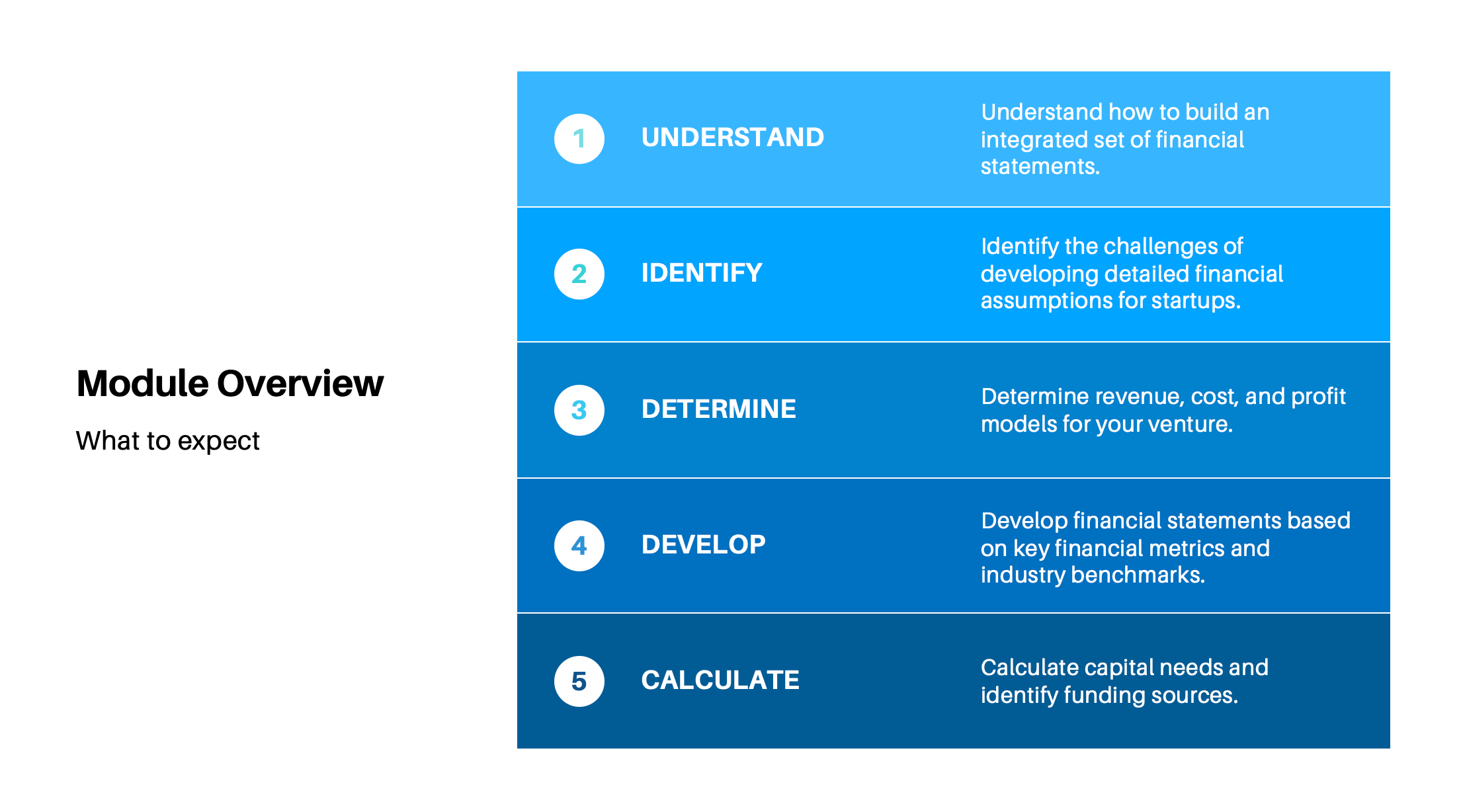
In the dynamic world of entrepreneurship, a well-crafted financial plan is the backbone of a successful venture. Understanding the intricacies of financial planning is crucial to navigating the challenges and opportunities that lie ahead. This chapter delves into the essential components of creating a robust financial plan for your startup.
We will begin by exploring the art of forecasting financial performance, where you will learn how to project revenues, estimate costs, and create pro forma financial statements. These projections will provide a roadmap for your venture’s financial journey and help you make informed decisions.
Next, we will tackle the critical task of determining your startup’s capital requirements. By assessing your venture’s financial needs at various stages, you will be better equipped to identify the appropriate funding sources and develop a strategy to secure the necessary capital.
Finally, we will dive into the world of funding sources, both non-equity and equity-based. From bootstrapping and crowdfunding to government grants and venture capital, you will gain insights into the advantages and considerations associated with each funding option. By understanding the funding landscape, you can make strategic decisions that align with your venture’s goals and values.
This chapter will emphasize the importance of financial discipline, adaptability, and strategic thinking. By mastering these skills and applying the knowledge gained from this chapter, you will be well-positioned to create a financial plan that supports your venture’s growth and helps you navigate the ever-changing entrepreneurial landscape.
So, let’s embark on this financial planning journey together, exploring the key elements that will empower you to build a thriving and sustainable venture.
Section 1. Forecasting Financial Performance
Section Introduction
Forecasting financial performance is a critical skill for every entrepreneur. It involves projecting revenues, estimating costs, and creating pro forma financial statements that depict your venture’s future. In this section, we will dive into the process of crafting accurate and realistic financial projections.
We will begin by discussing the importance of understanding your business model and its impact on your financial projections. From there, we will walk through the steps of projecting revenues, including identifying your target market, assessing your pricing strategy, and estimating sales volume. You will learn how to create a bottom-up sales forecast considering your marketing efforts, sales cycles, and customer acquisition rates.
Next, we will tackle the challenge of estimating costs. From startup expenses to ongoing operational costs, we will guide you on identifying and quantifying the various expenses your venture will incur. You will learn how to create a detailed budget that accounts for fixed and variable costs, as well as how to monitor and adjust your expenses as your venture grows.
Finally, we will introduce you to the world of pro forma financial statements. These essential documents, including the income, balance, and cash flow statements, provide a comprehensive view of your venture’s economic health. We will walk you through creating these statements and highlight the key metrics and ratios that investors and stakeholders will use to evaluate your venture’s potential.
By the end of this section, you will have a solid foundation in forecasting financial performance. The content equips you with the tools and knowledge to create realistic projections, monitor your venture’s economic health, and make data-driven decisions supporting your growth and success.
The Challenges of Projecting Startup Financials
Crafting financial projections for a new business comes with inherent challenges. With no historical data to reference, founders must make assumptions and estimates across all statement elements. Estimating revenues and costs without existing customers requires researching target segments, the competitive landscape, and industry benchmarks. Founders may lack access to reliable market data, particularly for innovative products. They must avoid inherent optimism bias when assessing demand and growth potential.
On the operational side, anticipating required investments and expenses involves much guesswork. Founders may underestimate the salaries needed to acquire top talent or the costs of R&D and product testing. Unforeseen costs always emerge pre-launch and post-launch. Additionally, founders struggle to integrate statement elements across revenue forecasts, cost estimates, and cash flows. Ensuring smooth connections between statements is imperative for accurate planning. With a dedication to continuous research, founders can create reasonable projections while remaining agile to modify based on real-world data.
As with many venture realization activities, we always try to make the steps as simple as possible for founders. Creating a new enterprise from scratch requires searching for a great deal of further information about the problem to be solved, your target customer, and the marketplace. And if this is not enough, you are challenged to create a business model and translate it into a robust set of financial statements.
Startup financial projections are important as they reflect the underlying business model in a standard quantitative language that all stakeholders can understand. Creating these financial projections requires founders to consider each element of their business model in an internally consistent manner. We think of it as a transaction between the venture and the customer, looking at each relationship aspect translated in quantitative terms. It facilitates an understanding of the feasibility of the business model in terms of its repeatability and sustainability. Detailed financial modeling allows the founder to assess the strengths and improvement areas of the venture’s business model.

Three Basic Steps
We break the basic steps to building robust startup financial projections into three stages: revenue forecasts, cost estimates, and pro forma financial statements. Several elements require research, assumptions, and underlying estimations with each step. So, let’s work through each step and essential elements.
Step 1: Revenue Forecasts
We suggest that founders start the planning process by tackling what many consider the most challenging aspect of startup financial planning - the sales forecast. In other words, estimating the amount of sales dollars your business model generates each month over a specified period.
You make several decisions before you can forecast your venture’s revenues. These include selected revenue models, sales cycles, pricing, customer acquisition rates, and operational capacity. As you will see, you need all this information to conduct a bottom-up analysis for your revenue projections.
From experience, estimating anticipated revenues for a new business is highly challenging. So, it is understandable that these early forecasts could be more complex. However, founders can mitigate these challenges in revenue forecasting by solid due diligence about the customer’s purchasing behavior, including how long it takes to decide to buy a product from initial interest.
Your sales forecasts should take several things into account. These include: how your marketing strategy will drive customers to your business, the typical conversion rate from customer interest to the actual purchase, the efficacy of your distribution channels, and customer acceptance of price based on the value placed on a solution. Without this understanding, you can easily underestimate the time it takes to generate revenues or overestimate the pace of customer acquisition and sales.
It is important to remember that your revenue models will change and probably expand as your business grows. Successful ventures rarely stick with one revenue model without modification or expanding to multiple revenue streams. For example, many e-commerce ventures begin revenues directly from the sales of their products. The web presence will become more attractive for potential third-party advertisers, affiliate programs, and e-mail list rentals as their customers grow. Founders are encouraged to think ahead about how their revenue models will change and encourage them to consider how these changes will affect future financial outcomes.
When you are ready to start building the revenue side of your financial model, you can follow these five steps. First, discuss your revenue model and pricing strategies, then research outlining the sales transaction process in detail and ascertaining benchmarks for customer acquisition and retention rates. Then, you should have enough information to build a monthly revenue forecast.
Select revenue model
Determine pricing strategies.
Visualize the sales process and sales cycle.
Estimate customer acquisition and retention rates.
Calculate revenues: bottom-up method.
Revenue Model Selection
Let’s start with selecting the revenue model that best fits your product and customer. There are many considerations when choosing what the transaction between your business and the customer will look like. First, you want to determine your customer’s current purchase behavior related to existing solutions as a starting point. As stated in earlier chapters, you can evaluate customers’ current behavior during customer discovery. What do they do now, and what are they used to regarding similar products? Market research will also provide important information about what competitors currently apply revenue models.
Revenue models come in many forms, from traditional transactions, such as paying a one-time charge for a product or service, to digital transactions, such as a monthly or annual subscription to a software application. As stated above, your choice of revenue model will depend on several circumstances, and your eventual selection will significantly rely on the customer’s current purchasing behavior and standard practices in the marketplace. In the worksheet below, you will find many common categories of revenue model transactions. But founders should not just check a box. Instead, you may choose several models or a hybrid of transactional approaches. For example, you may charge a one-time, upfront fee for a product and then provide payment options for additional services, extended maintenance, or warranties.
While there are several revenue models, don’t be afraid to innovate. Creating a new or hybrid revenue model can differentiate your offer from what is currently in the marketplace. In addition, testing a new approach during early market testing can help validate if the customer finds the model attractive and of better value than the competition.
Pricing Decisions
You should determine your pricing strategy in conjunction with selecting your revenue model. How much will you charge the customer for your product and service? Additionally, how will the customer pay, and within what time frame? Will they pay the whole amount at the time of the transaction? Or will customers be able to pay over a certain period? For a software product, will the subscription be monthly or annual? Will they get a discount if they pay upfront instead of monthly?
As you start considering various pricing strategies, you must consider what value customers will derive from your product. Startups must stay focused on the value they provide to the customer no matter what other objectives they hope to achieve through pricing. You are trying to accomplish different goals through pricing. For most startups, the primary aim is reaching breakeven and becoming cash-flow positive. Customer acquisition rates may often be key if you engage with outside investors. If you offer something new, you will want to build market share quickly to be first to market. The business objectives may vary, but customer value is always the priority. Your final pricing decisions are driven by what the customer is willing to pay based on perceived value.
As a starting point, startups want to balance two pricing methods - Cost-plus and value-based pricing. The cost-plus approach is determined by considering the costs to produce your product and then adding a sufficient margin to offset fixed costs. I encourage knowing your unit economics. Startups must understand how much an individual transaction contributes to the venture’s profits. Focusing solely on product costs for determining price is a significant mistake. The principal argument against this approach is that it leaves the customer out of the equation.
Value-based pricing is more challenging, but the process necessary to calculate it is priceless. The process begins by quantifying the value you are providing to the customer. Once you determine the dollar amount of the customers’ gains, you will charge a certain percentage of the value amount. How do you come up with the value amount? During customer discovery and MVP testing, you have many opportunities to assess the value while engaging your customers. For example, you should be inquiring how much they believe they are saving using your product during these engagement points. In a B2B context, you want to learn how much the enterprise values your solution. They will be looking for at least a 5X to 10X return. If they pay $100 for your service and it enables them to sell $1000 of product to their customer, you know you have provided good value to the enterprise. The customer’s perceived value will determine how much risk they are taking upfront. For example, offering a subscription with cancellation provides less risk than paying the annual cost upfront.
There are other methods to determine the value placed on your offer by the customer. Your market research into available options in the marketplace will provide important comparative information. Learning how customers currently pay for solutions is a critical data point. In conjunction with this knowledge, understanding the degree of satisfaction with current options will add to your understanding of the value difference between your product and existing solutions.
Another factor in the value calculation is determining what different customer segments are willing to pay. Many founders are surprised to hear they can have different pricing strategies for different segments. While it takes research to learn these differences as you enter the marketplace, one segment is willing to pay more. Your primary target customer, the one you know who needs a solution and is extremely unhappy with all options, will be ready to pay a higher price. Your early enthusiasts and adopters are less sensitive to price because of need or passion. These early customers will help you determine the value of your offer while you continue to build and test your products. They can give you the traction to move towards more significant segments, where pricing sensitively increases, as does your marketing efforts.
Determining Sales Process | Sales cycle
Another critical step related to revenue and sales projections is determining the sales process and cycle. It is vital to map out your sales process and determine how long it takes from when you first engage a customer until the purchase is final. Start when the customer first becomes aware of your product as a solution to their problem. From this first awareness, how long does the customer gather enough information to buy the product? Finally, how is the final sale made, and how is the payment collected?
This step is crucial for B2B enterprises. There is much to consider to ensure you understand what it takes to complete a successful sales process. For example, we recently consulted with a B2B enterprise whose primary customers are large global corporations. In these corporations, every division had its own set of decision-makers and procurement processes, each with a different number of steps and timelines. One of the first things they did was build out a detailed step-by-step sales process. Then, we looked at each step in detail, examining how we could expedite the sales process, shorten the life cycle, and increase revenues. For example, one of the significant steps in the sales cycle was establishing a trial period where the customer would receive a free product for testing. By isolating a specific phase, we could brainstorm optional ways to expedite trial periods or charge for more extended trial periods. These ideas arise when you dissect the sales process, looking for new ways to deliver value to the customer while improving your business model.
From a forecasting point of view, founders need to know how long each sales process step takes to estimate the timing between marketing activities, booked sales, to payment. This information allows you to make credible estimates of how much new customers cost to acquire, when sales are acknowledged, and when payment will occur. Knowing when to expect payment is critical to projecting and managing cash flow.
Estimate Customer Acquisition & Retention Rates
The next task in your sales forecasting activity is to estimate the customer acquisition rate and, if applicable, retention rates. You must consider several factors to determine better the speed and cost of acquiring new customers. Understanding the sales cycle length includes understanding if the decision-maker differs from the user, the time from decision to purchase, and identifying potential obstacles that inhibit sales or payment.
Based on your understanding of the customer’s full-cycle usage of the product, you should be able to answer such questions as how customers determine that they need/want to purchase your product (change from the existing solution). How do customers find out about your product? How do they acquire your product? How will they pay for your product?
To estimate your customer acquisition rates, determine how many customers you need to hit your revenue goal. Next, calculate the revenue goal divided by average sales per customer for a specified period. Once you know how many customers you need to reach your revenue target, you can calculate how many potential customers you need to get via your marketing channels. Finally, by applying what is commonly called “sales funnel math,” you can estimate each sales channel. How many qualified leads do you need to achieve your sales goals? Necessary: Research the sales funnel conversion rates applicable to your industry, market, and product area.
Once you have determined how many customers you can acquire per marketing channel, you should create a promotional calendar, month by month. Along with your knowledge of the sales process, you can project a campaign’s impact on sales and when the transactions occur. Estimating the effect and timing of a marketing campaign comes with its challenges. You must create opportunities to experiment and test promotional channels during minimal viable product iterations.
While you are thinking about the impact that marketing has on customer acquisition, you should also consider any factors that influence customer retention. Customer retention can be essential to your success, depending on your revenue model. For example, if you offer your customers a monthly subscription model, you can expect attrition throughout the year. Sometimes, you can gather some early attrition data during customer discovery and product testing. Here is an excellent opportunity to apply industry retention benchmarks to your financial model.
Applying the Bottom-Up Method
There are two ways to approach revenue projections: top-down versus bottom-up. While we highly encourage you to analyze the bottom up, there is value in doing both.
The top-down analysis builds on market size and demand estimates. As discussed in an earlier chapter, you begin to determine the size of your market with a focus on your primary target customer segment. Your central emphasis will be on the available market you serve (SAM). The SAM is the number of potential target customers that meet the demographics and behavioral characteristics demonstrating their intense interest in having your solution combined with a deep dissatisfaction with current options. The top-down method adds value when the target market is well-defined. This approach proves less valuable if the market is fragmented or in the early stage of adopting a particular innovation.
The startup can begin to develop its go-to-market strategy to capture a portion of the SAM from this point. The capture rate or market share (SOM) will depend on several factors, including the marketing plans’ efficacy and the venture’s operational capacity. The transition from SAM to SOM is where you shift your analytic approach to bottom-up. The bottom-up approach asks the founders to realistically estimate how much product they can produce and sell during a given period.
The starting point for a bottom-up analysis is the definition of each sales unit. Some new ventures start with only one product to develop and sell. This situation makes the analysis more straightforward (though no less challenging). When will the product development be completed? What is the timing and capacity to produce the product? What is the promotional calendar and sales cycle? Answers to these questions will help determine the number of units sold daily, monthly, and annually.
Each revenue source should have its line in the income statement. There are many reasons for this practice. Each product will most likely have different pricing & discount strategies, costs of goods sold, launch dates, and growth rates. All these variables make estimating sales all the more challenging.
Determining growth rates is one of the more difficult factors to estimate. For this reason, one typically sees founders falling back on top-down estimates by using industry benchmarks to apply growth percentages to product sales. Unfortunately, this method does not consider your marketing plans or capacity to achieve this growth. Therefore, it is essential to identify your revenue drivers and do your best to invalidate the assumptions and estimates behind them.
Recently, funding for new ventures has stalled due to several economic factors ranging from rising interest rates to rapidly growing inflation. As a result, many significantly funded startups with historically high valuations need to meet growth targets. Additionally, they are experiencing unanticipated rising costs. Suddenly, it’s time for startups to embrace frugality and focus on breaking even.
Step 2: Cost Estimates
For a new venture, we break up the essential cost elements into startup costs, costs of goods sold, product development costs, customer acquisition costs, and other general administrative expenses required to operate the venture. Several cost estimates can be straightforward, such as specific startup or fixed administrative costs that you can quickly look up purchase details. For example, if you need a computer for your business, you can decide which one you need and research the best price to buy or lease it. However, some of the costs, especially variable expenses such as costs of goods sold and customer acquisition costs, are more challenging to estimate.
Startup Costs
Startup costs are expenses incurred before you officially launch your business for revenue generation. In my experience, most founders underestimate the potential resources required to build a business plan and prepare for subsequent market entry. Every company will have its own unique set of requirements to prepare for market entry. Ventures that require physical assets such as brick-and-mortar locations, large starting inventories, or extensive research and development activities will face significant resource needs and associated expenditures. Other ventures can navigate the pre-launch phase with minimal costs. In either case, planning for financial needs pre-launch facilitates a vital leadership discipline that serves founders well throughout the journey.
As you prepare to brainstorm all potential startup costs, you should consider categorizing them in various ways. First, you should remember that some costs count as “expenses” and others as “assets” acquired before the business opens. Additionally, you want to separately record startup assets (required to launch) and expenses for accounting purposes.
There are implications for taxes and potential ownership equity discussions. For example, expenses may be tax-deductible in the current year, while the purchase of assets may be accounted for differently. So, it is worth planning for and properly documenting these different transactions. The IRS guides founders on how to account for startup costs. Founders should make these decisions with advice from a certified public accountant.
It is also vital to divide it into one-time charges versus recurring expenses. Thinking about startup expenses helps founders plan for immediate versus longer-term cash needs. As part of your early financial planning, you will also consider how much cash is required as you open for business.
You can start this process by brainstorming all the items you will need before being able to implement your business model. Let’s begin with startup assets.
Startup Assets
The costs of startup assets are commonly tangible items acquired before launching your venture. Before launching your venture, the amount you should spend depends on the business. In some cases, there is a need for extensive capital expenditures, usually associated with either physical assets or product development.
You can subdivide startup assets into these categories:
Physical assets that pertain to land, buildings, leasehold improvements required to ready business space before launch, office furniture, store fixtures & signage.
Tangible assets pertain to manufacturing, such as the plant, machinery, and other equipment necessary for production.
Inventory-related assets, including starting product items and raw materials.
Essential vehicles such as trucks and automobiles
Office equipment and computers
Intellectual property acquired before launch.
Founders can delay the purchase of certain physical assets while they perform product and market tests. For example, we have worked with food and beverage startups that aspire to open a brick-and-mortar establishment. While we encourage them to work on plans regarding location and space design, the critical path task items are getting the product in the hands of the customers for taste testing, packaging reviews, pricing sensitivities, and distribution channel selection. These early activities can be done via pop-ups in existing establishments, from small grocery stores to campus building lobbies.
One of our student founders recently wanted to establish a unique space for tutoring and learning. In the early stages, the founder focused on the location and the type of space aligned with the proposed strategic mission. The founder could find a place to host a test learning environment for a nominal fee by brainstorming options. However, the projected capital requirements to meet the long-term vision were relatively high, and it was essential first to establish the validity of the product offering with minimal expenses. In this case, the costs of running the pilot are considered deductible expenses and not assets. If renovation of a new location is eventually required, the founder can amortize much of the costs.
Inventory requirements can be another critical challenge for founders. To project without historical data, estimating how much inventory you need depends on several complex factors. Securing initial stock for marketplace entry can be challenging, depending on the product category. For example, physical technology products are typically expensive, from design effort through producing prototypes to actual manufacturing for inventory. Each element is costly.
Working with a team who envisioned an innovative countertop composting product, early development started with simple drawings and 3D renderings to illustrate the design and look of the product. This effort was followed by laying out the product’s technical specifications to their ability. With technical specs, the next step is to approach manufacturing partners to validate design feasibility and provide estimated production costs. Once the founders validate that the design is workable and production costs are within the required margins, they can explore funding options like crowdfunding, corporate partnerships, and government funding pending the product to cover initial capital expenditures. Unfortunately, most startups never make it through all these phases before pivoting in another direction.
Consumer retail products are another category that typically requires inventory before the venture starts to generate revenues. Like other physical categories, consumer products must go through design - prototype - ready-to-sell phases, from fashion to food. Founders start with increasingly detailed designs for fashion items, usually culminating in tech packs. Tech packs contain detailed visual design sketches, required materials bills, and measurement specifications. With this information, founders, designers, and manufacturers can work together to create a cost sheet that includes materials and labor costs. This information will be the foundation of the startups’ costs of goods sold estimates. The tech pack’s cost depends on who drives the product design. I have worked with founders who designed their products and others who hired outside designers to create the final designs. Designers work in different ways, with some charging per hour while others charge a flat fee for a specific style. As a result, the cost can vary depending on the complexity of the design. From design to ready-to-sell inventory can be a costly proposition. Many consumer-driven products navigate some costs by applying a pre-selling model, whether via eCommerce sites or crowdfunding campaigns. These methods help to offset the initial pre-launch inventory costs.
You should be diligent about documenting any expenses related to starting inventory. Some elements of the early product preparation may be deductible as a startup expense as part of the current IRS cap of $5000. However, early inventory stock should be considered an asset, a balance sheet item. Once you start to sell products, the costs of producing the product will count as a cost of goods expense.
For startup assets, you should work with your accountant to decide which costs can be deductible in the current year under the $5000 cap and which may be amortized over a specific period. In the latter case, you will deduct a particular depreciation expense during each year of the amortization period.
Startup Expenses
You can break pre-startup expenses into the following areas:
Research and development costs
Fees such as installation fees, deposits, licenses, permits, legal fees, professional fees, insurance, office supplies
Pre-launch marketing materials, logo, brochures, website, and other promotional materials
Pre-operational training or labor costs
Additional miscellaneous costs specific to the nature of the business
Research and Development
This expense area that can be challenging for startups is the capital requirements for product development. Building early versions of the product requires extensive research and development for specific ventures. We cannot tell you how often founders despair over the forecasted costs of creating new technology. Sometimes, navigating the development costs can be tricky, especially when the hardware is involved. However, the founding team must plan development in cost-effective steps, whether it be software or hardware. Each stage focuses on increasing the fidelity of the product so you can build support for future innovation.
Typically, R & D startup expenses may include:
Hardware and supplies to build your prototype.
Costs of leasing computers used for R&D activities.
Fees to third-party contractors to support early product development.
Founders working in specific technological areas may be eligible for a US Research & Experimentation Tax Credit that allows you to deduct these expenses up to $250,000 if your startup qualifies.
Legal Fees
We find the percentage of founders who try to avoid spending funds on legal fees interesting. Of course, frugal behavior is essential at some level’s early stage of development. However, specific legal services are crucial to the startup’s long-term viability.
Founders should consider three categories of legal services and associated expenses before launching - incorporation, founder agreements, and intellectual property protections. From experience, founders can find lawyers that offer a basic startup legal package that includes filings for incorporation, basic founder agreements, and confidentiality agreements that apply to various business relationships. Founders can procure these services for around USD 5K, not including local and state fees.
You will spend more if you plan to apply for a patent or register a trademark for intellectual property protection beyond basic confidentiality agreements. I have worked with many startups that have applied for provisional patent or trademark registration. Provisional patents help founders create a short-term placeholder for their intellectual property, providing an inexpensive and relatively quick way to establish first-to-file status. While it allows for relatively no protection, it gives you time to complete the more detailed non-provisional patent application. Trademark applications protect your venture’s brand. Once you have decided on a company name and associated brand elements, it is worth doing due diligence early to ensure the name is not already protected. Provisional patents and trademark registration are two startup expenses well worth the investment.
Marketing & Branding
There are plenty of opportunities to spend on marketing and branding development during a startup’s pre-launch period. Fees range from paying designers and brand consultants as founders find their way to unique brand identity. You may pay for the initial website design, marketing collateral materials, and associated printing costs. Some founders are responsible for creating their early brand identity, while others find it worthwhile to solicit professional advice. Some startups find a balance between the two approaches to keeping these essential costs down to a minimum. Several students have successfully developed their branding elements using designer marketplaces and crowdsourcing platforms. Additionally, founders have many template-driven sources to support website design and marketing materials.
Founders should set aside funds for experimenting with different promotional channels starting early in the venture development process. Customer discovery and MVP iterations are optimal times to test and measure various marketing channels. Even small amounts such as USD 100 can provide insights into the effectiveness of a specific channel, such as Google or Facebook ads, for future customer acquisition strategies.
Customer acquisition costs are one of the most critical cost areas for new ventures. Typically, the marketing costs for a startup are one of the highest expenses, along with product development and human resources. One calculates Customer acquisition costs by determining all sales and marketing costs of acquiring a single average customer. Early experimentation and testing can ensure that founders spend these funds wisely.
Human Resources
Many startups have zealous, passionate founders who are okay with delaying compensating themselves until the enterprise is up and running. However, there are many situations when external experience and skillsets are needed, and compensation is required. In many cases, additional expertise is necessary for product development. Depending on the product category, you may need designers or software engineers. As mentioned earlier, we always push entrepreneurs to actively participate in their MVPs’ early design and testing as their skill allows. At some point, you may need technical expertise beyond the team’s capabilities. You can hire them as an early employee or as an independent contractor. In either case, these labor costs are inevitable.
Founders may sometimes need specific education or training before operations. These are typically one-time costs but are essential to running the business. For example, a couple of years ago, a founder required certification to become a drone operator pilot for the future aerial photography business. Required funds included training and licensing. Most pre-launch training costs qualify as startup expenses. Generally, there are many potential opportunities for founders to attend trade shows and industry conferences in pursuit of validating the feasibility of their venture opportunity.
Technology Support
You will be surprised how your technology needs can quickly add up. Of course, many of your technology needs will be recurring expenses. But in the pre-launch phase, you tend to test various technologies to see what works for you and your team. These technologies can include platforms that support everything from project management to tracking early customer relations.
The good news is that many of these technologies provide free options with limited features or trial periods to experiment with everything the service offers. While time-consuming (and you need some discipline), taking advantage of these trial versions allows you to learn what will work best for you and your team. I constantly test out new products for my venture or support student founders.
Start by focusing on critical performance areas and outcomes that require technical support. I suggest you constantly review technology use from an internal and an external perspective. Does a particular technology help the team to manage product development more efficiently? However, does the technology also provide proper customer engagement and communication support? Most times, technologies will have internal and external-facing interfaces, so stay focused on both.
Eventually, you will find the right mix of technologies to support your business. You will incur a growing annual expense as you use these technologies more comprehensively. Many of today’s products and services have recurring revenue models, and these monthly costs add up. My current technology stack costs around $2500 per year.
For many new ventures, the startup expenses can be minimal but are usually more than you first consider. Therefore, speaking with other startup founders to check some of their upfront costs is worthwhile to understand better what to expect.
Generally, we find some expenses to have well-defined, published costs. This situation is accurate for many technology platforms, government licenses & fees, and office supplies. But in many cases, founders must thoroughly investigate as costs for specific services may be less confident such as labor costs, professional services, and real estate prices. Researching similar items and services online and speaking directly to vendors and service providers to assess the actual costs is crucial.
It is essential to institute a financial discipline during the early stages of venture development. It is a balancing act between minimizing your expenses as best you can and not taking advantage of meaningful opportunities that may make a difference in your eventual success. No matter how much effort you put into these estimates, you will want to set aside additional funds for the unexpected.
Step 3: Financial Statements
With these foundational financial model inputs, you can now go to Step 3 and build your pro forma financial statements. The business has three primary financial statements: Income Statement, Cash Flow, and Balance Sheet. Look at each role in documenting and communicating a startup’s projected financial performance.
Important: We suggest that founders generate statements covering three years, month by month. However, it is best to begin by building a detailed financial model for the first 12 months. A detailed model includes the documentation of all basic assumptions and the associated estimations. Then, once you have a working model that can readily adapt to different scenarios, you can expand it to the entire 36-month period.
Income Statement
Entrepreneurs need to be able to plan operations and evaluate decisions using financial accounting information. Budgets, cash flow forecasts, and breakeven analyses are not only essential management tools but also usually required information for potential investors or lenders.
Once you have completed a thorough bottom-up analysis of projected revenues and costs, you can integrate these estimations into a proforma profit and loss statement. The proforma income statement summarizes anticipated sales revenues and expenses for a specified period.
Preparing an Income Statement Forecast
Purpose
There are two main objectives in generating a proforma income statement. The first reason is to project and capture performance in terms of sales, such as the percentage of increased sales or new business. Most enterprises measure success by increased customer acquisition rates and resulting sales volume. However, if the expectation is that additional sales mean higher profits, which may not always be the case, certainly increasing sales is part of the financial plan. But there is much more to it than sales performance.
The second reason for the income statement focuses on measuring profits: the difference between revenues and expenses. Sales must be profitable for the venture to succeed. A firm can determine the profitability of either products or customers. But, in the end, the enterprise must be profitable for long-term viability.
Now let’s look at the critical elements of an income statement.
Revenues. Sales revenue is the total proceeds or gross income from sales to customers. Remember, detailed statements should include the various revenue streams from individual products and service offerings.
An integral part of estimating revenue generated from each product offering is linking your sales numbers to your promotional channel strategies and calendars. You must show why these sales will occur during a particular month. This linkage is particularly crucial before having any sales history. Once you have a record of actual sales, you can begin to build estimates based on a combination of strategy and history.
Costs of Goods Sold. The following income statement line to the project is called the cost of goods sold, sometimes called direct costs. This cost area can be challenging for new venture founders to estimate. While not every product or service has a cost of goods sold component, many do. The cost of goods includes the materials and labor associated with sales from the same period. The cost of goods sold represents the resources that go into producing the products ultimately recognized as sales. These costs typically include materials, labor, and manufacturing expenses.
Costs of goods sold are a variable expense, meaning that the product cost is not accounted for until the sale transaction occurs. [Note: this is just for accounting purposes. You most likely have already paid for the labor and materials before the sale, so it still impacts your cash.] The details should include labor and associated raw materials required to produce the product. In addition, you must add shipping costs if not paid by the customer. If your business has multiple product lines, you must calculate the cost of goods sold for each product line to determine gross profit by product line. This last point is essential. I see many statements with multiple revenue-generating products recorded as one line to account for the associated costs of goods. Unless the cost of goods comprises the same components and cost amounts, this is the wrong way to present the information.
In many cases, the costs will vary based on the sales of the specific product associated with said costs. It is a best practice to monitor each product and its costs separately so you can adjust as historical performance data emerges. You can end up with a skewed view of your product costs and profit contributions each product makes.
Gross Profit. The next entry in the income statement is gross profit. This statement line should include, where possible, the gross profit by whatever categories the sales are classified (e.g., product line, geographical region). One calculates gross profit as sales less those costs of goods directly incurred to achieve the sales.
It is worth stopping for a moment to consider the importance of the gross profit line. Your gross profit numbers indicate how your products contribute to the venture’s profitability. The gross profit percentage is something that you carefully monitor once you start generating sales. An important metric is also the gross profit percentage of an individual sale unit. Understanding how much a unique product contributes to profit is vital to calculating when your business will hit the all-important breakeven point. Monitoring gross profit and associated gross margin (gross profit as a revenue percentage) allows you to determine profit trends and long-term viability. As part of this analysis, you should monitor and compare margins to industry benchmarks and similar enterprises. These comparisons enable you to validate that your pricing and cost of goods sold are trending in the right direction based on your business model and overall industry performance.
Operating Expenses. This section of your income statement classifies expenses associated with your venture’s operation. The costs recorded in this section are labeled indirect expenses. This statement section covers several expense categories: salaries, benefits, marketing, research and development, and computer and office supplies.
There are some standard methods to categorize and list expenses. I suggest that you work your way down from top costs down. Most startups’ leading expenses will be in three categories: salaries, product development, and marketing. The remaining categories may cover general expenses such as supporting technologies and software, professional fees, insurance, co-working space costs, etc.
Like the direct expenses and resulting gross margins, you want to monitor each indirect expenditure as a percentage of total revenues. You should research industry and competitor cost percentages for pre-launch estimates for each category. For example, what is a typical percentage of salaries to revenues within your industry? These comparisons help founders evaluate if the anticipated costs align with what is going on in the marketplace. You can use this information to support your estimates and drive talent acquisition strategy and competitive salary rates. Once you start generating actual data, you can measure how your business model is working and make changes as needed.
One last area you include in the operating expense section is non-cash expenses, sometimes called intangible costs. Typically, you keep expenses like depreciation and amortization separate from tangible expenses because they do not impact your operating cash amounts. The cash outlay for these expenses happens earlier than the one you are accounting for in the current income statement. Founders can write off depreciation expenses incurred on purchasing tangible assets that the venture will use for a specific period. For example, if a founder purchases professional video production equipment for business use, a certain percentage of the cameras, screens, and lighting can be deducted as an expense for a specified period. The amount of depreciation depends on how long the equipment will last be based on use and aging. One calculates the depreciation amount by dividing the asset’s cost by the estimated number of years in its life minus any salvage value. Again, you want to work with your professional accountant to determine the depreciation method, time, and dollar amount. There are several depreciation methods, each having a different impact on the reporting of operating income.
You can also expense intangible assets such as specific intellectual properties such as patents, trademarks, and trade secrets. Startups can deduct the cost of these assets as expenses over several years using a process called amortization.
Operating Profit/Loss. One determines 0perating income by subtracting costs from sales, not including taxes or interest charges. Operating income is the amount the business earns after expenses but before taxes and other income, such as interest. You can refer to this as earnings before interest and taxes (EBIT). EBIT is the earnings (net income) before interest expense, interest income, and income taxes. It measures the profitability of the company’s current operations as if it had no debt or investments.
EBITA. This label includes earnings before interest expense, income taxes, depreciation, and amortization. It measures the profitability of a company’s operations without impacting its debt, investments, and long‐term assets. This line item allows the founder and investors to see how much cash is generated via operations but for non-operational and non-cash income and expenses.
Other Income and Expenses. This category includes interest expenses by each type of debt (e.g., leases for computers, lines of business credit, and bank loans) and other income and expenses not related to the business’s everyday operations.
Pretax Income. Income before taxes is calculated by taking operating profit and factoring in other income and expenses. It denotes the income that will be subject to corporate income tax.
Income Taxes. This line item is management’s estimate of the tax it will pay on its earnings. The details should reflect amounts owed for federal and state taxes.
Net Income. This final income amount shows what earnings remain after all income and expenses and are available for dividends or reinvestment in the company.
Applications of Income Statements
The income statement is a vital tool for founders and investors to evaluate overall business profitability and analyze the impact of specific business activities. Here are some key ways to apply the income statement insights:
Evaluate product/service profitability - By analyzing gross profit after deducting the costs of goods sold from revenues; founders can see which offerings are most profitable. This approach helps determine which products to prioritize or if pricing needs adjustment.
Assess operational efficiency - Looking at operating expenses as a percentage of revenues shows how efficiently the business is running. Founders can identify expense areas needing reduction or gaps requiring investment.
Understand tax implications - Modeling different revenue growth and expense reduction scenarios will demonstrate how taxes influence net income. Founders can look for ways to minimize tax liability.
Communicate with stakeholders - The income statement helps convey the business case to investors, lenders, and shareholders. Founders can clearly show the potential for profitability and growth.
Monitor performance - Comparing actual income statements to projections enables continuous improvement. Founders can pinpoint variances, course correct, and refine predictions.
Evaluate business model - A well-constructed income statement allows a comprehensive assessment of whether all pieces of the business model integrate to drive profitability.
In summary, the income statement is a multifaceted tool to assess the past and plan the future. When crafted appropriately and monitored regularly, it provides invaluable visibility into the financial inner workings of a startup.
Cash Flow Statements
An income statement may show that the company is profitable over a given period but does not give any information about the cash position. A seemingly profitable venture can go bankrupt if its short‐term cash position is insufficient to meet its short‐term liabilities, such as salaries, interest payments, and other receivables. This situation is particularly true with early‐stage companies, which, more often than not, are cash-strapped. Therefore, this statement and its use to predict cash availability to pay bills are the most important for the entrepreneur to understand and use. It is advisable to have a month‐by‐month cash flow forecast for the company’s first two to three years, as cash reserves will fluctuate wildly.
Preparing a Cash Flow Forecast
Reasons to Prepare a Cash Flow Forecast. Keeping close tabs on required and available cash is the most crucial estimate an early-stage enterprise can monitor. While correct revenue recognition is essential for a compliant profit and loss statement, cash flow is much more critical to operations. For early estimates, month-by-month budgeting is the best approach. Businesses almost always incur costs, while revenues are less reliable. Knowing your cash position helps determine the amount, timing, and disbursement schedule of financing you will need to continue operations before becoming self-sustaining.
A cash flow forecast shows the amount of cash (receivables) and money going out (payables) during a particular month. The forecast also indicates to a bank loan officer (or the entrepreneur) what additional working capital the business may need, if any. In addition, it provides evidence that there will be sufficient COH to make the interest payments on a revolving line of credit or to cover the shortfalls when payables exceed receivables.
Cash flow statements use information from both the income statement and balance sheet (see below). Your account explains changes in cash flows resulting from business operations and financing activities. The reconciliation section of the cash flow worksheet begins by showing the balance carried over from the previous month’s operations. Next, one adds the net inflows/outflows or the current month’s receipts and disbursements. This adjusted balance will be carried forward to the first line of the reconciliation portion of the following month’s entry to become the base to which the next month’s cash flow activity will be added or subtracted.
Modifications to sash flow statements occur as new things are learned about the business and paying vendors. You should compare the cash flow forecast to each month’s projected figures with each month’s actual performance figures. It will be helpful to have a second column for the actual performance figures alongside each “ planned “ column in the cash flow worksheet. Look for significant discrepancies between the planned and actual figures.
Founders and investors pay close attention to cash flow management and performance. One of the critical metrics that startups should monitor closely is what is commonly called the burn rate. The burn rate is when a new venture uses up its cash to finance overhead before generating positive cash flow from operations. In other words, it’s a measure of negative cash flow. The burn rate is cash spent per month. The burn rate is determined by looking at the cash flow statement. The cash flow statement reports the firm’s cash position change from one period to the next by accounting for the cash flows from operations, investment, and financing activities. Compared to the amount of cash a company has, the burn rate gives investors a sense of how much time is left before the company runs out of money— sometimes called your runway.
As part of a founder’s financial discipline, you should monitor your venture’s cash position daily. We would make this information, along with metrics such as burn rate, runway, and breakeven, a significant part of a performance dashboard.
Balance Sheet
The balance sheet provides a picture of the business’s financial position at a particular point in time—generally at the end of a financial period (e.g., month, quarter, or year). It encompasses everything the company owns (assets) or owes (liabilities), as well as the investments into the company by its owners and the accumulated earnings or losses of the company (equity). The balance sheet equation is assets=liabilities+shareholder equity. Investors and banks commonly analyze various assets and liabilities ratios on the balance sheet to determine a venture’s viability.
Preparing a Balance Sheet Forecast
On the balance sheet, one divides assets into short and long-term categories. Current assets are converted into cash within one year. These assets include the current cash balance (from cash flow), payments due from customer sales (accounts receivable, and inventory. You will consider inventory a current asset if sold within one year from receipt; however, specific business inventories can be further segregated into work‐in‐process (WIP), raw materials, or finished goods inventories.
Tangible and intangible long-term assets include items such as buildings, vehicles, computer equipment, and intellectual property forms. Record these assets at their original cost minus any accumulated depreciation as expenses in the current income statement.
On the other side of the balance sheet equation, you have the liabilities and shareholders’ (stockholders’) equity sections. Liabilities consist of any amounts the company owes creditors. Similarly, liabilities are current if you pay them within one year; otherwise, they are considered long‐term. Short-term liabilities include interest payments on loans recorded in the income statement and any payments you owe suppliers (accounts payable). Longer-term liabilities are typically balances on loans linked to long-term assets, such as mortgages on a building or lease payments for a company vehicle.
The difference between the total assets and total liabilities is called stockholders equity. Much like an individual, the number is considered the net worth of the venture. This number comprises any stock issued by the company and accumulated earnings retained throughout the years, as shown in profits from the income statement.
When analyzing a company’s balance sheet, managers and investors view it in terms of its type of business. For example, fixed assets account for a more significant percentage of total assets in a manufacturing operation than a distributor or professional services company. Therefore, analyze the balance sheet with the volume of the company’s business in mind. For instance, one compares receivables to sales to determine how quickly the company collects its cash or current liabilities compared to expenses to see if it pays its short‐term obligations promptly.
Bringing It All Together
While each of these statements is a separate document, several linkages exist. For example, select information from cash flow analysis links to the balance sheet, such as net increase or decrease in cash as demonstrated in the case analysis, will be reflected in the cash asset column in the balance sheet. Any cash outlay for an asset will be in both statements. Net income from the profit and loss statement will impact the balance sheet’s cash flow and retained earnings. As founders and investors analyze a venture’s performance, it is essential to review these statements together, not in isolation.
A Note on Financial Templates
In general, we are not a fan of pre-determined financial templates. While they can be helpful as a starting point, no template covers the assumptions and estimates particular to your business model. If you use a template with pre-existing formulas, ensure you can readily adjust any parts of the statements, labeling line items and assumptions. However, we think it is worth your time to start with a blank slate, using one of the standard computer spreadsheet programs such as Microsoft Excel or any full‐faceted business software to generate your financial statements. If you plan to start with an existing template, you should look for templates that best fit your business model and overall financial planning approach. For example, not all templates provide 36-month-by-month entry capability. Many templates designs annualized performance over a 3-5 year period. Does the template include the three statements with proper integration embedded in the model? Some templates provide several analysis tools and metrics based on the inputs into the statements. Such analytics as breakeven, customer acquisition costs, and monthly recurring revenue are vital data points for startups. For customer acquisition and revenue modeling, does the template provide the capability for multi-tier pricing, retention, and churn rates? Finally, how does it support assumption documentation, different currencies, performance graphics, and data uploads or downloads? Sometimes you can find templates designed for a specific industry (Hospitality) or product category (SAAS).
Template pricing models include free downloads, trial periods, one-time fees, and recurring costs for online systems. The good news is that there are plenty of options. All that said, you may want to check out some of the samples from my startup resource database.
Section Conclusion
In this section, we have explored the critical components of forecasting financial performance for your startup. We discussed the importance of understanding your business model and its impact on your financial projections. By walking through the process of projecting revenues, estimating costs, and creating pro forma financial statements, you have gained valuable insights into the art of financial forecasting.
Projecting revenues requires a deep understanding of your target market, pricing strategy, and sales cycle. Creating a bottom-up sales forecast that considers your marketing efforts and customer acquisition rates, you can develop a realistic picture of your venture’s revenue potential. Similarly, estimating costs involves identifying and quantifying your venture’s various expenses, from startup costs to ongoing operational expenses.
Creating pro forma financial statements, including the income statement, balance sheet, and cash flow statement, provides a comprehensive view of your venture’s financial health. These documents are essential for monitoring your financial performance, making data-driven decisions, and communicating your venture’s potential to investors and stakeholders.
As you embark on your entrepreneurial journey, remember that financial forecasting is an iterative process. As you gather more data and insights from your operations, you must continuously refine and update your projections. You can ensure that your financial plan remains relevant and practical by remaining adaptable and responsive to market and business environment changes.
With a solid foundation in forecasting financial performance, you are now better equipped to navigate the economic challenges and opportunities that lie ahead. In the next section, we will explore how to determine your startup’s capital requirements, a crucial step in securing the funding needed to bring your venture to life.
Section Two: Determining Capital Requirements
Section Introduction
Determining capital requirements is a critical step for any startup founder. With a clear understanding of how much money your venture needs, you can avoid running out of cash and jeopardizing your startup’s success. Many promising businesses have failed due to inadequate capital planning. This section will explore the importance of accurately assessing your startup’s capital requirements and guide you on how to do so effectively.
Correctly calculating your capital needs allows you to secure the necessary funding to launch and grow your business. It helps you avoid cash flow problems that can cripple your operations and enables you to allocate resources efficiently. Moreover, having a well-defined capital plan demonstrates your financial understanding to potential investors and increases your chances of securing funding.
Throughout this section, we will delve into the critical aspects of determining capital requirements for your startup. We will define capital requirements, discuss the various types of capital, and examine the factors that influence your startup’s capital needs. Additionally, we will guide you through conducting financial analysis, managing and optimizing your capital, and highlighting common mistakes to avoid. By the end of this section, you will have a solid foundation for assessing and planning your startup’s capital requirements.
Understanding Capital Requirements
To effectively determine your startup’s capital needs, you must first understand the capital requirements and types of capital involved. Capital requirements refer to the total amount of money your startup needs to launch, operate, and grow. These requirements include the funds necessary to cover expenses, invest in assets, and maintain a healthy cash flow until your business becomes self-sustaining.
There are three main types of capital that startups typically require:
1. Working Capital: This is the money needed to cover your startup’s day-to-day expenses, such as rent, salaries, inventory, and utilities. Working capital ensures your business can continue operating smoothly while awaiting payment from customers or clients.
2. Fixed Capital: Fixed capital refers to the funds required to purchase long-term assets, such as equipment, machinery, vehicles, and real estate. These assets are essential for your startup’s operations and are not intended for resale.
3. Growth Capital: As your startup expands, you may need additional funds to finance new projects, hire more employees, or enter new markets. Growth capital provides the necessary resources to support your startup’s development and scale your operations.
Several factors influence your startup’s capital requirements, including:
Industry: Some industries are more capital-intensive than others. For example, a manufacturing startup may require more fixed capital for equipment and facilities than a software development startup.
Business Model: Your startup’s business model affects your capital needs. A subscription-based model may require less upfront capital than a product-based model, necessitating significant inventory investment.
Scale and Growth Objectives: Your startup’s size and growth ambitions directly impact your capital requirements. Rapid expansion plans will require more capital than a slow-and-steady approach.
Economic Conditions: External factors, such as market demand, competition, and economic stability, can influence your startup’s capital needs. You may need a larger cash buffer to weather potential downturns in uncertain times.
Understanding the types of capital and the factors that affect your startup’s capital requirements lays the foundation for accurately assessing your financial needs. In the next section, we will explore how to conduct a thorough economic analysis to determine your startup’s specific capital requirements.
Assessing Your Startup’s Capital Needs
Accurately assessing your startup’s capital needs is critical in ensuring your venture’s financial stability and long-term success. With a clear understanding of the funds required to launch and sustain your business, you can avoid facing cash flow problems that can hinder your growth or even lead to failure. This section will explore the critical components of assessing your startup’s capital needs, including conducting a comprehensive financial analysis, considering industry benchmarks and comparables, and accounting for contingencies and unforeseen expenses.
A. Conducting a Financial Analysis
Conducting a thorough financial analysis is the first step in assessing your startup’s capital needs. This process involves estimating your startup costs, projecting your revenue and expenses, and creating a cash flow forecast. When estimating your startup costs, it is essential to identify and calculate all the expenses your startup will incur during its initial phase. These expenses may include legal and professional fees, equipment and supplies, rent and utilities, inventory and raw materials, marketing and advertising, website development and hosting, and salaries and benefits. Be meticulous in your estimates, as underestimating your startup costs can lead to financial strain.
Once you have a clear picture of your startup costs, the next step is to create financial projections for your revenue and expenses over the next 12 to 36 months. When projecting revenue, consider your target market size, share, pricing strategy, sales volume, seasonality, and market trends. For expenses, account for fixed costs, such as rent and salaries, and variable costs, such as raw materials and shipping, which may increase as your sales grow. It is crucial to be realistic in your projections and consider various scenarios, including best-case, worst-case, and most-likely outcomes.
Using your revenue and expense projections, develop a cash flow forecast that estimates the timing and amount of cash inflows and outflows. This forecast will help you identify potential cash shortages and determine the capital needed to bridge any gaps. When creating your cash flow forecast, consider factors such as payment terms for customers and suppliers, inventory management and turnover, debt repayment schedules, and capital expenditures and investments.
B. Considering Industry Benchmarks and Comparables
Research industry benchmarks and comparable startups to further refine your capital requirements assessment. Look for data on typical startup costs, revenue growth rates, and profit margins in your industry. This information can help you validate your projections and identify areas where your estimates need to be lowered or higher. By comparing your financial forecasts to industry benchmarks, you can ensure your assumptions are realistic and aligned with market realities.
In addition to industry benchmarks, study the financial performance of startups similar to yours in size, business model, and target market. Analyzing the experiences of comparable startups can provide valuable insights into the capital requirements and financial challenges you may face. Look for patterns in their funding rounds, cash burn rates, and profitability timelines to inform your own capital needs assessment.
C. Accounting for Contingencies and Unforeseen Expenses
No matter how thorough your financial analysis may be, unexpected events can always arise. To mitigate risk and ensure your startup’s economic resilience, including a contingency fund in your capital requirements assessment is essential. A contingency fund, typically 10-20% of your total capital needs, provides a safety net for unforeseen expenses or revenue shortfalls.
Potential contingencies that may impact your startup’s financial health include unexpected equipment breakdowns or repairs, product development or launch delays, legal or regulatory issues, economic downturns, or market shifts. Setting aside some of your capital to cover these unforeseen events allows you to navigate challenges without derailing your startup’s growth plans.
In conclusion, assessing your startup’s capital needs is a multifaceted process that requires careful consideration of your financial projections, industry benchmarks, and potential contingencies. You can develop a robust assessment of your capital requirements by conducting a comprehensive economic analysis, comparing your startup to industry standards and comparable ventures, and accounting for unforeseen expenses. This assessment will serve as the foundation for creating a funding strategy and securing the necessary capital to launch and grow your business.
Managing and Optimizing Capital
Once you have secured the capital for your startup, managing and optimizing these funds effectively is crucial. Proper capital management ensures your startup remains financially healthy and positions it for long-term success.
Allocating your capital strategically based on your startup’s most pressing needs and growth objectives is paramount. This tactic means prioritizing investments that generate the highest returns or contribute significantly to your startup’s competitive advantage. When allocating capital, consider revenue-generating activities such as sales and marketing, product development and innovation, operational efficiency improvements, and talent acquisition and retention. Create a detailed budget that aligns with your capital allocation priorities and track your spending to ensure adherence to the budget.
Regularly monitoring your startup’s financial performance against your projections and industry benchmarks is essential for making informed decisions. Key metrics include revenue growth, gross margin, operating expenses, cash burn rate, customer acquisition costs, and lifetime value. If your actual performance deviates significantly from your projections, investigate the causes and make necessary adjustments. This review may involve reducing expenses, optimizing pricing, or pivoting your business strategy.
Another critical aspect of capital management is continuously seeking opportunities to reduce costs and improve operational efficiency. Negotiate better terms with suppliers and vendors to minimize expenses. Automate manual processes and workflows to streamline operations and reduce labor costs. Consider outsourcing non-core functions such as accounting or human resources to specialized providers, which can often be more cost-effective than maintaining in-house teams. Implement lean inventory management practices to minimize holding costs and reduce the risk of obsolescence. Identify areas of waste and optimize resource utilization to maximize the value of your capital.
As your startup grows, you may require additional funding to support expansion plans or capitalize on new opportunities. Planning for future funding rounds well in advance is crucial to avoid cash flow crises that could derail your startup’s growth. Set clear milestones and funding objectives to guide your progress and demonstrate your startup’s potential to investors. Build relationships with potential investors by attending industry events, joining entrepreneurial networks, and seeking introductions from trusted advisors. Refine your pitch deck and business plan to communicate your startup’s value proposition and growth potential effectively. Maintain a clean cap table and accurate financial records to facilitate due diligence and investor negotiations.
Effective capital management and optimization are essential for your startup’s long-term success. By prioritizing capital allocation, monitoring financial performance, reducing costs, improving efficiency, and planning for future funding rounds, you can ensure that your startup remains financially sound and well-positioned for growth. Remember, the goal is to secure and use capital wisely to create sustainable value for your startup and its stakeholders.
Common Mistakes to Avoid
When determining and managing your startup’s capital requirements, there are several common mistakes that entrepreneurs should be aware of and actively avoid. These mistakes can lead to financial strain, missed opportunities, and even the failure of your startup.
One of the most frequent mistakes is underestimating capital requirements. Many entrepreneurs need to be more optimistic about their startup’s financial needs, failing to account for unexpected expenses or longer-than-anticipated sales cycles. To avoid this pitfall, conduct thorough research on your industry’s typical costs and create detailed financial projections that include a range of scenarios, from best-case to worst-case. Include a buffer in your capital requirements to account for unforeseen circumstances and provide flexibility in your budget.
Another common mistake is failing to account for working capital needs. Working capital, which refers to the funds needed to cover short-term expenses and keep your startup operating smoothly, should be considered in favor of long-term investments. However, neglecting working capital can lead to cash flow problems that can quickly cripple your startup. When assessing your capital requirements, factor in the cash needed to cover day-to-day expenses such as payroll, rent, and inventory until your startup generates sufficient revenue to sustain itself.
Overestimating revenue projections is another frequent mistake made by entrepreneurs. In the excitement of launching a new venture, it’s easy to be overly optimistic about sales growth and market adoption. However, basing your capital requirements on inflated revenue projections can lead to a shortage of funds when actual sales fall short. Base your projections on realistic assumptions and market data to mitigate this risk. Consider factors such as competitor performance, industry benchmarks, and customer adoption rates. Regularly review and adjust your projections based on actual performance to ensure your capital requirements remain accurate.
Finally, neglecting to plan for contingencies can leave your startup vulnerable to unexpected events. No matter how thorough your planning is, unforeseen circumstances such as economic downturns, regulatory changes, or technological disruptions can impact your startup’s financial health. To protect against these risks, include a contingency fund in your capital requirements. This fund, typically 10-20% of your total capital needs, provides a safety net to help your startup weather unexpected challenges without derailing your growth plans.
By being aware of these common mistakes and taking proactive steps to avoid them, you can significantly improve your startup’s financial resilience and long-term success. Remember, accurate capital requirements assessment and management are not one-time exercises but ongoing processes that require regular review and adjustment as your startup evolves.
Section Conclusion
In this section, we have explored the critical importance of determining your startup’s capital requirements. We discussed the process of conducting a thorough financial analysis, including estimating startup costs, projecting revenue and expenses, and creating a detailed cash flow forecast. By understanding your venture’s financial needs at various stages of growth, you can develop a clear picture of the capital required to support your operations and achieve your goals.
We also examined the factors influencing your startup’s capital requirements, from your industry and business model to your growth objectives and market conditions. Considering these elements, you can create a more accurate and comprehensive financial needs assessment.
Additionally, we emphasized the importance of building contingencies and unforeseen expenses into your capital plan. By creating a financial cushion, you can ensure that your venture is better prepared to navigate unexpected challenges and seize opportunities as they arise.
This section stressed the significance of ongoing financial management and optimization. By continuously monitoring your financial performance, seeking opportunities to reduce costs and improve efficiency, and adapting your capital plan as needed, you can position your venture for long-term financial success.
As you progress in your entrepreneurial journey, remember that determining your capital requirements is ongoing. As your venture grows and evolves, so too will your financial needs. By remaining proactive and adaptable in your approach to financial planning, you can ensure that your venture has the resources needed to thrive in an ever-changing business landscape.
With a clear understanding of your startup’s capital requirements and a robust capital plan, you are better equipped to navigate the funding landscape and secure the resources needed to bring your vision to life. In the next section, we will explore the various funding sources available to entrepreneurs, both non-equity and equity-based, and discuss the strategies for securing the capital needed to fuel your venture’s growth and success.
Section Three: Identifying Funding Sources
Section Introduction
Securing funding is a critical component of launching and growing a successful startup. In this section, we will explore the various funding sources available to entrepreneurs, both non-equity and equity-based, and discuss the strategies for securing the capital needed to fuel your venture’s growth and success.
We will examine non-equity funding sources, such as bootstrapping, friends and family, crowdfunding, and government grants and loans. These options allow entrepreneurs to raise capital without giving up venture ownership. We will discuss the advantages and considerations associated with each non-equity funding source and guide how to pursue these opportunities effectively.
Next, we will explore equity-based funding, including angel investors, venture capital, and strategic partnerships. Equity-based financing involves selling a portion of your company’s ownership in exchange for capital. We will explore the benefits and challenges of equity-based funding and provide insights into securing these investments.
This section will emphasize the importance of understanding your venture’s funding needs and developing a strategic approach to securing capital. We will discuss the milestones to help position your startup for successful fundraising, such as creating a working prototype, gaining paying customers, and achieving key partnerships.
We will also highlight the significance of building relationships with potential investors and effectively communicating your venture’s value proposition. By crafting a compelling narrative and demonstrating your venture’s potential for growth and profitability, you can increase your chances of securing the funding needed to bring your vision to life.
By the end of this section, you will have a comprehensive understanding of the funding landscape and the strategies for securing the capital needed to support your venture’s growth and success. Armed with this knowledge, you will be better prepared to navigate the fundraising process and build a network of supportive investors who share your vision and believe in your venture’s potential.
Self-Funding
This form of financing is usually available to highly motivated entrepreneurs committed to using personal resources to launch a venture. Most new businesses generally start with funds from personal savings or various forms of private equity of the founder(s). This form of capital reflects the business founder’s motivation, commitment, and belief. Personal investment can also include sweat equity, where owners donate their time or provide it below market value to help the business get established. Sometimes it is possible to pay the first hires with some ownership in the company rather than with a salary. However, these new hires’ aspirations must align with those of the founder(s); otherwise, a conflict may arise later, similar to when investors seek an exit. Also, in some cases, entrepreneurs use profits from previous endeavors to invest in their new enterprises.
When considering self‐funding, carefully decide how much financial risk you will take. This decision is very personal and should involve other family members. Some entrepreneurs will stretch themselves to the limit and use every cent they have, including pledging all their assets—their house—to the bank. Others are much more cautious. However, investors and lenders expect entrepreneurs to put some of their assets at risk, so entrepreneurs must learn to be comfortable with this scenario.
One self-funding strategy that works for many founders is to work on launching their ventures while maintaining full or part-time employment. Many businesses begin while the founder is still working a full-time job. The job’s income helps support the owner during negative or low cash flow and provides operating capital to augment the business’s cash flow. Usually, when the company begins paying as well or better than the regular job, entrepreneurs can leave it and devote all their time to building a new business.
Similarly, most people have part-time skills valuable to established companies, perhaps as advisory experts. Skills can include deep technical knowledge, design skills, the ability to write computer code, or the like, which are currently in demand on a part-time basis. Perhaps the existing employer is willing to have the work performed for six months or so part-time, continuing the current position while they recruit a replacement. This approach may be a better solution for both parties than just leaving the company. Having a source of “survival” income while the company is getting started removes a lot of stress and improves the chance of success. If a technical consulting assignment is available, the entrepreneur must make it clear who owns the result of the work—usually the client. Therefore, it is vital to document what areas are the entrepreneur’s property so that there are no obstacles to future opportunities due to questionable intellectual property ownership.
Bootstrapping
While some experts lump bootstrapping as a sub-category of self-funding, it is different. In self-funding strategies, you use your money and resources to fund your business’s development and early stages. In bootstrapping, you effectively leverage both internal and external assets in the service of your venture. Subtle, perhaps, but still a different approach. The fact is that people that are good at bootstrapping can create space to develop their business model strategy and begin developing early versions of their product. The more time you spend engaging early customers with product iterations, the closer you can validate your capacity to solve customers’ problems and meet their needs. The stronger the customer engagement with your product, the stronger your case becomes for future external fundraising. Bootstrapping is an integral part of your toolkit at this early stage of development.
One way to look at bootstrapping phase is to dedicate your time to pre-selling. Before you build any product, see if anyone will buy your product or service before it is ready. This approach works well with a service-driven business. If you can make it happen in an acceptable timeframe, you will have a sale without spending any development money. The critical point is that this only works if you can produce the product or offer the service within a reasonable period. And you need to manage your customer expectations about timing. You will find that early customers are often flexible about timing, but you need to communicate the product status transparently. Of course, this is not scalable, but that is not the goal. Instead, you validate the customer’s willingness to pay for your service. Either way, you already engage potential customers and learn more about their needs.
Family and Friends
Friends and family members are a prevalent source of startup capital because they are not as worried about quick profits as professional investors. However, there are problems associated with this method. Usually, friends and family do not investigate the business very well and are unfamiliar with the company’s risks. In many cases, friends and family accept the word of the entrepreneur without any analysis or detailed review of the business venture. To guard against the risks of failure and to avoid being blamed for not disclosing all the essential information about the proposed venture, the best method is to provide the same disclosure to a friend or relative as to the most sophisticated investors. Entrepreneurs should always resist the temptation to keep the venture on an informal basis and not document the details of the company’s risks and financial requirements.
Friends and family members are a prevalent source of startup capital because they are not as worried about quick profits as professional investors. However, there are problems associated with this method. Usually, friends and family do not investigate the business very well and are unfamiliar with the company’s risks. In many cases, friends and family accept the word of the entrepreneur without any analysis or detailed review of the business venture.
To guard against the risks of failure and to avoid being blamed for not disclosing all the essential information about the proposed venture, we recommend creating a comprehensive document that outlines the funding needs of your startup to meet specific goals and includes a detailed payback schedule. Treat friends and family investors as any other investor, regardless of their relationship with you. It’s essential to provide them with the same level of information, transparency, and professionalism that you would offer to more experienced investors.
Furthermore, it’s important to remember that not all friends and family members may have the financial means to invest in your startup. It’s crucial to exercise caution and avoid asking for money that they cannot afford to lose. Treat them as any other investor, considering their level of investing experience and financial situation. If your friends or family members meet the criteria for accredited investor status, it can provide an added layer of confidence and security. By approaching friends and family investors with the same level of diligence, professionalism, and respect as any other investor, you can establish a strong foundation of trust and ensure that everyone involved is well-informed and protected.
Crowdfunding (Non-Equity)
Crowdfunding is another funding option that entrepreneurs can consider for their startups. Crowdfunding uses small amounts of funds from many individuals to finance a new business venture. This approach constantly evolves, and several credible platforms are available, including Kickstarter, Indiegogo, and Kiva.
Seeking funding through crowdfunding campaigns offers numerous benefits. First and foremost, crowdsourcing allows entrepreneurs to validate the product-market fit of their offering while minimizing the risk associated with product development. Crowdfunding campaigns often serve as a pre-selling opportunity, enabling entrepreneurs to gauge customer interest and receive accurate data on how many customers will pay for the product before going into production. This validation can be crucial in determining market demand and shaping the future of the product.
Secondly, crowdfunding campaigns provide opportunities to engage early customers through collaboration and regular conversation. Many campaigns are structured to reach a specific monetary goal or cannot proceed with complete product development until the target funding amount is acquired. During the campaign, customer participation and commentary can provide valuable feedback about the product’s value proposition, helping entrepreneurs refine their offerings based on customer input.
Finally, crowdfunding expands the capacity and breadth of market research while reducing cost and market time. By leveraging crowdfunding platforms, entrepreneurs can tap into a wide range of potential customers and gain insights into their preferences and needs. This information can inform product development, marketing strategies, and overall business decisions, ultimately enhancing the chances of success in the market.
It’s important to note that crowdfunding options are not limited to non-equity crowdfunding. Equity crowdfunding allows startups to raise capital by selling securities to a broad group of investors in return for a share of ownership. In the US, the 2012 JOBS Act and subsequent SEC rule expansions have increased limits on eligible raises to $5 million within 12 months (Reg CF) and $75 million for Reg A+ issues, subject to eligibility, disclosure, and reporting requirements. Accredited investors now have no cap on crowdfunding contributions, while non-accredited investors remain limited to an annual income or net worth percentage. As regulations evolve globally, entrepreneurs should closely monitor the latest compliance stipulations and consult professionals when weighing equity crowdfunding approaches.
There are plenty of equity-based crowdfunding platforms where entrepreneurs can raise capital by offering equity stakes in their startups to interested investors. This approach provides an alternative to traditional venture capital or angel investor funding and allows entrepreneurs to tap into a broader pool of potential investors.
Sponsored Startup Competitions
Local startup competitions, including those organized by universities, government programs, and other institutions, provide early-stage, non-equity funding for founders like yourself. These competitions offer a platform to showcase your ideas, products, or services to a panel of judges, potential investors, and the broader startup community. Participating in these events can win cash prizes, grants, or in-kind support, which can serve as valuable non-equity funding for your venture. Typical competition prize amounts range from a few thousand dollars to tens of thousands of dollars, depending on the scale and prestige of the competition. Moreover, these competitions provide you with feedback, mentorship, and exposure, which are essential in your startup’s early stages. They help you gain credibility, network with industry professionals, and attract further funding opportunities. Consider exploring local government programs, university-sponsored competitions, or pitch events organized by incubators or accelerators in your region. Embracing these opportunities can be strategic as you seek non-equity funding and build a strong foundation for your startup.
Incubators | Accelerators | Venture Studios
Incubators, accelerators, and venture studios play vital roles in nurturing new ventures and offering valuable resources and guidance to entrepreneurs. However, these models can differ significantly in their funding approaches and equity involvement.
Incubators primarily emphasize non-equity funding sources. By providing flexible workspaces, connections to grants and pre-seed capital, and assistance in developing sustainable business models, incubators help ventures achieve milestones before seeking VC backing. Graduates gain enough validation to pique investor interest.
Accelerators trade equity for intensive growth stimuli. Rigorous mentoring and network access aim to rapidly advance startups to VC-ready levels while demo days grant fundraising visibility. Managed seed capital covers near-term expenditures while supporting readiness for future rounds.
Venture studios take a distinctly more involved approach, actively participating in creating and developing new companies. With teams of experienced entrepreneurs, domain experts, and investors, studios identify promising concepts and build startups from the ground up. Studios leverage expertise and networks to validate ideas, develop prototypes, and secure initial funding. Given significant equity positions, studios’ interests align with startups’ success. Ongoing operational and strategic support continues beyond early development. Studios also facilitate valuable collaboration, knowledge sharing, and community.
While models differ, properly timed program partnerships transform startups from fragile to fundable. Matching accessible business-building resources to needs allows non-dilutive launching before controlled acceleration. Optimized bridges keep ventures fueled as they progress.
Carefully weighing funding approaches and equity involvement enables aligning to entrepreneur risk tolerances and startup evolutions. Understanding tradeoffs empowers customizing support partnerships for efficiency at each phase.
Government Grants and Loans
Startups have access to many opportunities to apply for grants and loans from federal, state, and local government agencies. These funding options can provide valuable non-equity support for your venture. These government programs offer grants and loans of varying sizes and purposes, each serving a specific need or objective. Your venture must align with its goals to be eligible for these programs. They mainly aim to support early startup activities such as product development, testing, and market validation. The funds provided through these programs often come with limited obligations as long as you meet the eligibility requirements. For instance, grants do not require repayment, and you, as the founder, retain intellectual property rights.
Conversely, loans obtained through these programs usually come with favorable terms for repayment. It is essential to remember that government program applications can be time-consuming, and there is often a significant gap between the initial application and the awarding of funds. However, the potential benefits and financial support make it worthwhile for you to explore these non-equity funding opportunities provided by government agencies.
Bank Loans
One of the most common forms of early venture funding is borrowing money from your local bank. The primary advantage of debt financing is that the entrepreneur does not have to give up any part of ownership to receive the funds. However, the loan has to be paid back with interest and may require the entrepreneur to guarantee part or all of the money personally. In addition, many loans have certain conditions (”covenants”) that come with them. Often these conditions are tied to specific milestones or events that the company must make for the loan to remain in place. These covenants are not so different from situations that equity investors might apply. Therefore, they often remove some company control from the founders until repayment.
For the formative stages of a company, before any substantial sales, an entrepreneur will generally be required to have some collateral to support a loan. The types of securities used for collateral include endorsers or cosigners, accounts receivables, real estate, stocks and bonds, and personal savings. Even if you are unwilling to provide personal guarantees or cannot secure a bank loan at the outset, you should identify a local bank that has supported small companies and develop a relationship with their in-house business banker. These relationships will be invaluable later as your company grows, and you can secure loans based on the company’s performance. In addition, bankers like to get to know you early on and monitor your track record before lending.
While bank loans remain a viable funding avenue under the right conditions, continued fintech advancements have unlocked more flexible small business lending alternatives suitable for startups. Innovation in risk modeling and underwriting leveraging AI and digital footprints allows customized products from alternative lenders tailored to early-stage needs.
For example, revenue-based financing offered by firms like Clearco assesses startups’ growth metrics to extend credit lines proportional to revenue rather than fixed loan amounts requiring set repayments. Flexible options can adapt to cash flows based on upsides. Other financing variations utilize dynamic interest rates tied to revenue benchmarks, equity warrants, or hybrid debt-revenue structures aligned to company performance. As data-driven algorithms improve predictive insights, expanded emerging lenders craft loans catering to startups unserved by risk-averse banks, opening up capital accessibility. Founders should research the range of optimized offerings to find the right match based on the company stage and industry.
Convertible Instruments
Convertible instruments like convertible notes and SAFEs (Simple Agreements for Future Equity) allow startups to raise funds without setting an immediate valuation. These agreements function as short-term debt or contractual rights that convert into equity at predetermined terms. This creative bridge financing structure enables startups to access capital quickly while postponing tricky valuation conversations until future milestone events.
Convertible notes operate as loans with set maturity dates, interest rates, and repayment terms. The debt later converts to shares when conversion events occur, such as a priced funding round establishing a valuation. SAFEs are more flexible contractual agreements granting investors future equity under agreed conditions without debt obligations or due dates. Both instruments incentivize growth to conversion milestones using mechanisms like valuation caps and investor discount rates.
Ideal users include pre-seed and seed-stage startups still developing products, seeking product-market fit, or demonstrating early traction. Rather than prematurely diluting ownership against uncertainty, convertible instruments allow founders to access financing to extend runway reach towards growth milestones and improved valuations. This creative approach buys startups crucial time to build capabilities supporting better conversion outcomes aligned for all stakeholders.
Of course, deferred pricing risks conversion at disappointing valuations, while notes can accumulate excessive debt obligations if progress stalls. Investors also lack governance rights until conversion. Nonetheless, convertible instruments fill a vital niche for ambitious early-stage startups navigating uncertainty on the journey to validation and growth. For most dynamic founders, the flexibility enables focus on execution regardless of external stigma or conditions.
Understanding Financial Needs
There are several issues to consider as you identify requirements to start and sustain your venture until continually profitable. As a starting point, if your assumptions about revenues and costs are off, then your estimate about how much money you will need to stay in business and grow beyond break-even will also need to be corrected. On the other hand, knowing when you can expect to break even and seeing gross profits from sales increase your fixed operating costs, increasing month after month, is essential. So, starting with reasonable financial projections and monitoring the data is an important first step in understanding your funding requirements.
Beyond the basic financial projections, there are some fundamental funding needs that you should consider to determine the total investment requirements for your venture. First, you should look at all pre-launch needs and costs. Two areas that can be costly are product development and inventory. In the case of product inventory, it is challenging to determine how much early inventory you should have on hand to support sales and find a producer willing to manufacture and package in small quantities. Plan to spend much time researching and speaking with potential producers. Some industries must build a whole ecosystem of partners willing to support starting inventory and packaging needs. Even if you have a good handle on your cash needs and the timing of required capital investments, there are no guarantees that the funds will be available when needed.
Many startups will need more funding sources, with many eager founders requesting funds. You will need to resign because soliciting outside funds is an ongoing task that takes time. Each source will have its own process for conducting its analysis and deciding whom to fund and when. While there is no way around this, considering it early in your analysis, you must be smart about the timing of funding rounds. In the best circumstances, you will want enough upfront to provide time to gain traction toward profitability. But there will be plenty of times when there will be other options. One of the top reasons for business closings is their running out of cash.
It always makes sense for entrepreneurs seeking outside investors to delay this event as soon as possible. Investors like to see that entrepreneurs are not dependent on their funding but know how to complement their money with other resources. Every entrepreneur, therefore, needs to learn how to capitalize on early startup financing.
Transitioning to Equity-Based Funding
Specific milestones in a startup’s journey act as crucial triggers for founders, indicating that it may be the opportune time to seek external equity-based funding. These milestones not only mark significant achievements but also contribute to increasing the startup’s overall value, thereby reducing the percentage of equity required to raise an equivalent amount of institutional money.
The first milestone, developing a working prototype, is a pivotal moment for a startup. It demonstrates tangible progress and showcases the ability to transform the business idea into a functional product or service. A working prototype holds immense value as it allows investors to visualize the potential of the startup’s offering and its market viability.
Gaining a few paying customers is an essential milestone that validates the startup’s market potential and demand. When customers are interested in the product or service and willing to pay for it, it signifies that the startup has successfully addressed a genuine need in the market. This customer validation makes the startup more attractive to investors who seek tangible evidence of revenue generation and growth potential.
The achievement of a patent award represents a significant milestone for startups with innovative ideas or technologies. It showcases the uniqueness of the startup’s intellectual property and provides legal protection against potential competitors. The presence of a granted patent adds credibility to the startup’s offering and creates barriers to entry, making it a more valuable asset in the eyes of investors.
Receiving a government grant is a noteworthy milestone that brings recognition and support from official entities. Government grants often serve as a stamp of approval, indicating that the startup has the potential to contribute to economic growth, innovation, or societal advancement. This external validation instills investor confidence and provides additional financial resources to bolster the startup’s growth trajectory.
Signing up a larger company to test the development results signifies industry interest and the potential for scalability. A strategic partnership or a pilot program with an established player demonstrates the startup’s value proposition and ability to attract industry leaders. Such collaborations bring credibility and validation to the startup’s offering, opening doors to broader market access, distribution channels, and potential investment opportunities.
Finally, gaining additional paying customers beyond the initial few is a significant milestone that solidifies the startup’s revenue-generating capabilities. A growing customer base showcases the startup’s ability to attract and retain customers, indicating a strong market demand for its product or service. Sustained traction and customer acquisition demonstrate the startup’s continued growth and profitability potential, making it an attractive investment opportunity for potential investors.
By reaching these milestones, founders can position their startups at a higher valuation and negotiate more favorable terms when seeking external equity-based funding. Investors seek startups with significant progress, customer validation, protected intellectual property, industry partnerships, and a growing customer base. As a result, founders can maximize the value of their equity and secure the necessary resources to propel their ventures toward long-term success.
Section Conclusion
In this section, we have explored the various funding sources available to entrepreneurs, both non-equity and equity-based. We discussed the advantages and considerations associated with options such as bootstrapping, friends and family, crowdfunding, government grants and loans, angel investors, venture capital, and strategic partnerships.
We emphasized the importance of understanding your venture’s funding needs and developing a strategic approach to securing capital. You can increase your chances of fundraising success by aligning your funding pursuits with your venture’s goals and milestones.
This section highlighted the significance of building relationships with potential investors and effectively communicating your venture’s value proposition. By crafting a compelling narrative and demonstrating your venture’s potential for growth and profitability, you can attract investors who share your vision and believe in your venture’s potential.
As you navigate the funding landscape, remember that securing capital is not a one-time event but an ongoing process. As your venture grows and evolves, so too will your funding needs. By remaining proactive and adaptable in your approach to fundraising, you can ensure that your venture has the resources needed to thrive in an ever-changing business landscape.
With a comprehensive understanding of the funding landscape and the strategies for securing capital, you are better equipped to pursue the resources needed to bring your entrepreneurial vision to life. Remember to stay true to your venture’s mission and values and to build a network of supportive investors who share your passion and believe in your potential for success.
As you embark on your fundraising journey, embrace the challenges and opportunities. With determination, strategic thinking, and a commitment to building solid relationships, you can unlock the capital needed to fuel your venture’s growth and achieve your entrepreneurial dreams.
Chapter Conclusion
This chapter has explored the essential components of a robust financial plan for your startup. We began by discussing the art of forecasting financial performance, where you learned how to project revenues, estimate costs, and create pro forma financial statements. These tools provide a roadmap for your venture’s financial journey and help you make informed decisions.
Next, we tackled the critical task of determining your startup’s capital requirements. By assessing your venture’s financial needs at various stages of growth, considering industry benchmarks and comparables, and accounting for contingencies and unforeseen expenses, you can develop a clear picture of the capital required to support your operations and achieve your goals.
Finally, we delved into the world of funding sources, both non-equity and equity-based. From bootstrapping and crowdfunding to angel investors and venture capital, we explored the advantages and considerations of each funding option. Understanding the funding landscape and developing a strategic approach to securing capital can increase your chances of fundraising success.
This chapter emphasized the importance of financial discipline, adaptability, and strategic thinking. By mastering these skills and applying the knowledge gained from this chapter, you can create a financial plan that supports your venture’s growth and helps you navigate the ever-changing entrepreneurial landscape.
As you progress in your entrepreneurial journey, remember that financial planning is ongoing. As your venture grows and evolves, so too will your financial needs. By remaining proactive and adaptable in your approach to financial management, you can ensure that your venture has the resources needed to thrive in an ever-changing business landscape.
A robust financial plan and a clear understanding of the funding landscape can help you better pursue your entrepreneurial dreams. Remember to stay true to your venture’s mission and values and build a network of supportive stakeholders who share your passion and believe in your potential for success.
Embrace the challenges and opportunities that lie ahead, and know that with determination, strategic thinking, and a commitment to financial discipline, you can unlock the capital needed to fuel your venture’s growth and achieve your entrepreneurial vision. The road ahead may be challenging, but with the knowledge and tools gained from this chapter, you are well-prepared to navigate the financial landscape and build a thriving, sustainable venture.
Module 7 Posts
Forecasting Financial Performance
The Hidden Psychology of Cash Flow Disasters: How Smart Founders Sabotage Their Finances
A Guide to Building Reasonable Startup Financial Projections
Build Bulletproof Revenue Projections: An Integrated Modeling Approach for Startups
Determining Capital Requirements
Mastering Startup Financials: How to Determine Your Venture's Capital Needs
Harnessing Startup Financial Metrics: Key Insights for Sustainable Growth
The Pre-Launch Metrics Imperative: How Early Data Powers Startup Success and Reduces Risk
Identifying Funding Sources
Maximizing Startup Potential: Non-Equity Funding Strategies for Early-Stage Ventures
The Art of Self-Sufficiency: Unleashing Startup Potential through Bootstrapping
Nurture Your Startup's Potential: A Guide to Friends and Family Funding
Types of Crowdfunding: Choosing the Right Approach for Your Startup
Navigating Government Support Programs for Startups
Bridging Startup Runways: Inside Convertible Debt Instruments
Bridging Startups to Equity Capital: Incubators, Accelerators and Studios
Maximizing Startup Growth: Equity Funding Strategies for Later Stage Ventures
Do Angel Investors Still Matter Today?
Navigating the VC Landscape: A Comprehensive Guide


