

M6 | Your Brand
Module Six: Your Brand
Chapter Introduction
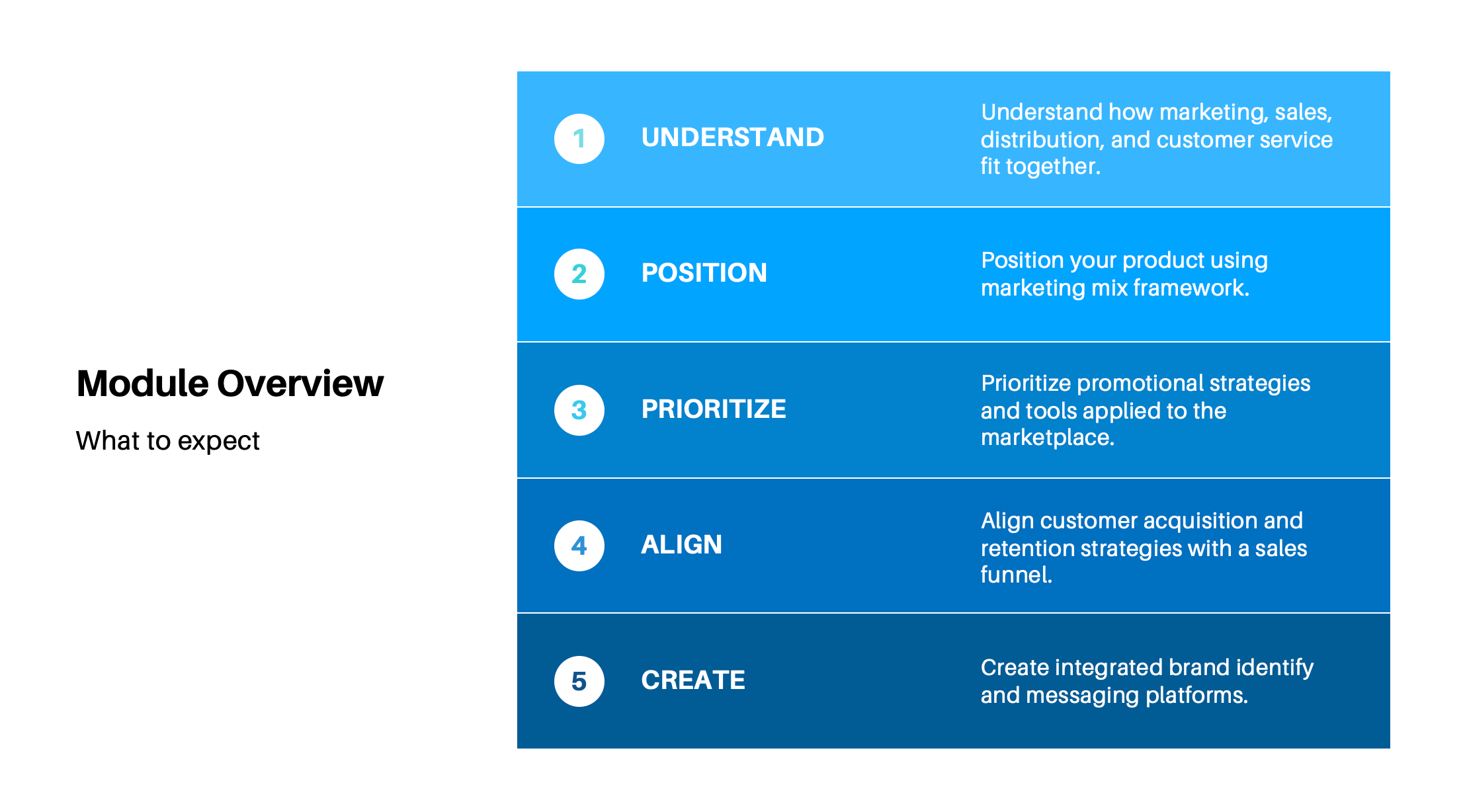
This chapter explores the essential elements of building a solid brand for your startup. We discuss positioning your product effectively in the market, determining customer acquisition costs, and creating a compelling brand identity. By focusing on these critical aspects, you can develop a powerful brand that resonates with your target audience and drives the growth of your venture.
Building a strong brand is not a one-time event but an ongoing process that requires continuous effort and refinement. Throughout this chapter, we provide the tools, frameworks, and strategies to create a brand that stands out in the market, connects with your customers emotionally, and supports your startup’s growth objectives. By implementing these concepts and regularly reviewing your brand’s performance, you can establish a lasting competitive advantage and build a loyal customer base.
Section 1. Positioning the Product
Introduction
Positioning your product is crucial in attracting and acquiring the right customers for your startup. In this section, we delve into the strategies and frameworks that help you define your unique value proposition, differentiate your product from competitors, and communicate your brand message effectively to your target market.
We examine the importance of understanding your target audience and identifying their pain points, needs, and preferences. From there, we guide you through crafting a compelling value proposition that showcases how your product solves your customers’ problems better than existing alternatives. We also discuss how to analyze your competitors, identify your key differentiators, and develop a positioning statement that communicates your brand’s unique value to your target market.
The Marketing Mix | The Four “Ps.”
In many ventures, these activities fall under marketing and brand management, a cohesive approach to attracting and retaining customers through integrated activities. A crucial strategic focus for new ventures is acquiring and retaining target customers. These activities must be well-coordinated and consistent with the desired brand image. Various documented approaches and tools are available to help design an optimal marketing mix for effective brand development. One widely-used tool is the “Four Ps” framework, comprising Product, Price, Promotion, and Place.
The “Four Ps” concept has seen several iterations, with some models adding elements like People and Processes. Working with the original four parts is a good starting point for startups. Still, it can be customized to suit specific needs as more information about customers and competitors is acquired.
As a founder, we recommend starting with your initial target customer and considering the customer interaction as a transaction composed of multiple elements that must work harmoniously. Once you establish a repeatable transaction process with a segment of customers, assess the feasibility of expanding into new customer segments. As you explore new segments, adapt your strategies to cater to different customer groups’ unique needs, contexts, and desired outcomes.
The Foundation | Product Positioning
The product is the cornerstone of the “Four Ps” and serves as the basis for all other elements. Your product is the solution you offer to address specific customer needs. Therefore, your first task is to articulate how your product addresses these critical needs and demonstrates a better solution than the current market offerings.
Remember that one customer segment’s value proposition may not resonate with another. It’s essential to create tailored value propositions for each customer segment, focusing on your initial target customer. Your value proposition should balance functional, emotional, and economic benefits provided to your customers. This balance can be a competitive advantage for your venture in attracting, retaining, and growing your customer base. Additionally, as you position your product in the customer’s mind, providing evidence that supports your claims is crucial. For startups, building credibility may take time.
Begin by defining and positioning your product and service. Focus on your solution and the unique attributes that differentiate your offering. You should revisit and update your product description in your business model canvas’s “value proposition” section. Since the inception of your business, you’ve worked on articulating your product offering and how it addresses the customer’s primary pain point. Now, it’s time to ensure that you have clear answers to questions such as:
What is our offer?
How does it create value for our customers?
What is our value proposition and product positioning?
What do we want our customers to experience?
What does our brand stand for?
Regarding brand development, you must convey key product messages highlighting attributes critical to solving the customer’s problem. These messages should draw on insights from your customer discovery process. Next, differentiate your product from existing solutions by communicating your unique selling proposition (USP). For investors, be transparent about your product’s development status, ranging from a minimal viable product to full-fledged product generations.
As part of this effort, consider crafting a product positioning statement that outlines the problem your product or service solves. It should clearly state the target customer, the addressable opportunity, and the value the customer should expect to receive.
Your product positioning statement should guide all company communications regarding your venture’s offering.
Here are some points to consider when creating your statement:
Communicate the problem or need your product/service addresses rather than leaving it up to customers to figure it out.
Ask yourself what your product/service provides or solves for your customers and convey that information directly.
Focus on the value your offering brings (functional, emotional, and economic benefits).
Provide clear messaging about the benefits and outcomes customers can expect.
Pricing Strategies | The Profit Maximizer
After articulating your product positioning, the next step is determining your pricing strategy. Your pricing strategy should align with the value your product or service provides to customers and the overall marketing message. Additionally, it should encompass methods used to drive revenue, such as special offers, discounts, payment schedules, credit terms, warranties, and more.
The critical question to answer is, what is the value of your product or service to the customer? While customers may be concerned about price, they usually weigh the cost against the importance of solving their problem. Are you effectively conveying the benefits of your offering about the price? I advise new venture creators to quantify customer problems and expected gains (value/benefits) during the discovery process. The more you can quantify your product’s benefits, the more precise the impact will be to customers. If customers perceive the value of your product correctly, they are more likely to accept your pricing.
As in the product section, it’s essential to differentiate your product from competitors and justify any price differences. Part of your messaging should emphasize the value gained compared to competing products. This information helps customers understand and accept price differences.
The other aspect of your pricing strategy involves specific elements such as special offers, discount practices, payment methods and schedules, warranties, etc. Innovative payment options or competitive warranties can support your pricing strategy and reinforce your overall marketing message.
Place | Channels & Engagement Touch Points
In the past, the “place” element of the marketing mix primarily referred to the physical point of sale. Today, it encompasses the broader concept of customer access throughout all stages of engagement, from initial awareness to post-sales service. As a starting point, identify all potential touchpoints with customers throughout the sales cycle and product lifecycle.
The sales cycle begins when customers become aware of your solution and continues through customer inquiries and other interactions with your company representatives until the final sale occurs. Identify the points of engagement that occur before the sale. Where do these pre-sale touchpoints occur? Are they online, in a physical location, or both?
After determining the pre-sale touchpoints, consider the frequency and nature of post-sale engagement. Will there be a formal follow-up to check on customer satisfaction? How do you plan to address customer questions or concerns about the product? What is the product’s expected lifespan before it requires replacement, upgrades, or other sales opportunities?
Mapping out these engagement points is crucial for determining your placement strategy. However, access involves not only timing but also the method.
Another vital aspect of your channel strategy is identifying the optimal “place” to engage customers throughout the sales and product life cycles. Today’s customers expect convenient access to products and services when and where they desire. This demand has led to multi-channel access, where physical and online channels converge at various customer lifecycle stages. One typical example of multi-channel access is ordering a product online and picking it up at a local store. In this scenario, the business engages the customer early in the process online and offers an option to visit the local store. For the customer, this provides quick access to the product. For the company, it creates another touchpoint with the customer, fostering awareness and opportunities for additional sales.
Prioritizing Promotional Activities
While many startups initially consider promotion as the core of their marketing strategy, it’s crucial to understand the other three Ps (Product, Price, Place) before deciding on your promotional approach. In the different areas, you have defined the problem your product solves, the value it creates for the customer, how much it values a practical solution, and identified potential touchpoints throughout the customer lifecycle. Now, focus on the best ways to educate and engage your target customers, moving them from initial awareness to purchase.
With this knowledge, you can prioritize your promotional activities based on anticipated traction and sales funnel rates, forming the basis of your go-to-market plan. Apply these core principles:
Understand how and where your customers consume information: Learn how they “hear, see, & buy.”
Discover “what has worked” in your market or industry and the key metrics.
Prioritize channels and programs.
Test channel and program performance.
Minimize expenses until a channel is proven.
Build your “Pro-forma” plan based on industry metrics, tests, and hypotheses.
Understand the implications of a multi-sided market.
Incorporate “get/keep/grow” into your program.
Begin by exploring all available promotional options. Categorize promotional tactics into digital or traditional. Digital options include search engine optimization, social media advertising & influencer strategies, content marketing, and email newsletters. Traditional approaches suitable for startups encompass speaking events, earned media & publicity, and brand ambassadors.
After reviewing available promotional tactics:
Plan to test the top two or three options to determine which effectively reaches your target customer.
Start with the tactic you believe will be most successful and run a short experiment.
Based on the results, phase the second option and assess its contribution to customer reach.
Set goals for these experiments, such as the number of customers reached, actions taken, and sales (conversions) generated.
Digital marketing techniques allow for testing various product or service aspects before fully committing to a specific path. Through digital advertising, you can try particular value proposition elements and customer attraction methods, evaluate pricing strategies and levels with landing pages, surveys, or A/B testing, and even determine product features using crowdsourced data.
Startups typically have limited marketing resources, so these phased-in experiments will help identify the most effective promotional tactics without exhausting your marketing budget.
Product positioning is a strategic process critical for startups to get right when bringing innovations to market. How a startup frames its offering can make or break customer adoption and ongoing loyalty. This article will provide founders with an overview of best practices in formulating an effective positioning strategy, from initial customer discovery through aligning with brand identity. Key steps covered include:
* Identifying target customer needs.
* Analyzing the competitive landscape.
* Testing positioning with early products.
* Leveraging behavioral science insights.
With a data-driven positioning strategy rooted in customer insights and aligned to brand essence, startups can craft compelling messaging that resonates with their audience and accelerates traction.
Understanding the Role of Positioning in the Marketing Mix
One of the significant decisions startups face is positioning their product offering for market entry. The final decision is challenging even when you conduct extensive customer discovery and competitive analysis and speak with fellow entrepreneurs and industry experts. In this post, I will talk about the pieces of information that you gather throughout the venture realization process and how to integrate this information into effective product positioning.
Before highlighting the steps toward optimal positioning, let’s define it. A traditional definition of product positioning is determining a new product’s position in consumers’ minds. This positioning process includes an in-depth understanding of the marketplace and differentiating how your product differs from existing customer options. This understanding is then applied to communicate your brand’s product image to customers.
As mentioned in an earlier post on marketing mix, your product’s position is the foundation for determining your pricing, promotional, and placement strategies. Positioning involves creating a specific image of your brand’s product in your target customer’s minds. This image must highlight the key benefits of your offering while demonstrating how it differs from competing solutions. The message must be compelling enough to move customers from interest to purchase to advocacy.
For positioning to be effective, founders must consider several critical issues. First, language and context matter. Founders must realize how they frame their product, dramatically impacting the customer’s mind. The words product innovators use and the context in which they place their products influence the lens customers use to compare and choose among all existing offerings.
Most startups think about their initial product in a restricted fashion, thus limiting their market potential. How you see the customer’s problem versus how they see it almost always differs in the early stages. The same condition applies to effective solutions as well. Customers see issues and associated solutions, which vary depending on the context in which they are experiencing their situation. You must understand their context and design and market your solution to match the customer’s mindset.
Articulating the Target Customer’s Needs and Context
The first step in this journey is to define the opportunity you believe exists in the marketplace. As a starting point, founders must ask an essential question: What is the customer trying to accomplish? At the highest level, you want to consider whether the customer is hoping to do one of the following:
Solve a problem
Fulfill a need or want
Accomplish a specific task, job, or goal
Once you have framed the opportunity in one of the above categories, you start considering the details. First, you try to articulate what the customer is trying to do and in what context. For example, where does the effort occur if the customer attempts to accomplish a specific task? At work, home, school, etc. Next, you want to identify any obstacles or challenges the customer experiences as they try to accomplish said task. Finally, in startup jargon, what are the customer pain points?
Opportunity Statement Template [In a box]
The opportunity involves helping [Target Customer] when in [Context] to [Solve Problem, Fulfill Need, Do the job, or Achieve goal]. In addition, the customer is looking to [Minimize or Eliminate Pain Points] for [Benefits or Outcomes] measured by these [Metrics].
Researching and Selecting Your Target Customer Segment
Early in the venture realization process, founders consider which customers they should target for early market entry. At this point, there are two criteria to ponder: First, customers are actively looking for a solution, and second, those meeting the first criteria are most dissatisfied with current options in the marketplace. Based on these conditions, the founders develop and execute customer discovery and market research strategies.
Customer discovery is a critical part of your positioning journey. In the early stages, you focus on the customer’s needs, pain points, and how they currently solve these challenges. During customer discovery, founders must focus on refining their understanding of what the customer truly values in a solution. As you work towards a future solution, you find that various segments view value differently. In other words, your value proposition will vary across customers. As you prepare for customer interviews and surveys, you should focus on the customer’s values in solutions they have experienced in the marketplace. Also, do they value something that is currently missing in current options?
To enhance their knowledge about what customers value, founders want to capture behavioral characteristics that align with how they perceive their expected value from an effective product solution. One of the best ways to develop this understanding is to listen to their experience with current products and brands, what they like and don’t like in each product, and whether there are “ must-have” attributes that other brands possess or lack.
From a positioning perspective, you want to understand how your customers compare existing solutions. Why did they choose specific competing products? How do they describe the value in terms of benefits and product attributes? What market category do they perceive the competitors to be operating in? The same or different? The responses to these questions will help you decide later what market category you should see yourself in and who your real direct and indirect competitors will be upon market entry.
Once you start early product testing, you can continue to refine your customer segment. It is essential to keep your customer base narrow initially, targeting those that best represent those who truly value the benefits and features of your product offering. At this juncture, you want to stay as narrow as possible but broad enough to meet early revenue goals. It is a challenging balance, but it is crucial to get it right.
Conducting In-Depth Competitor Research
While founders conduct early customer discovery, they can also dive deeply into the competitive landscape. In the early stages, before you have settled on a solution for design and testing, you can take what you are hearing from your customer and then conduct a deep dive into the competitive landscape. The information from early customer engagement guides your thinking about how customers see competition. Again, this may differ significantly from your initial thoughts on the competition. However, don’t give up on your initial assumptions about the competitive landscape. Research competitors from both perspectives. Customer input is precious, but you must become the domain expert on your competition.
You base your eventual decisions about positioning on what you consider your key differentiators. What does your product do best? Your competitive analysis aims to identify what aspects of your offer are different and better than existing marketplace options. As a starting point, founders should conduct deep research on the competing products in the market. Make sure to include both established and emerging opportunities. Next, list all the product attributes and features of these competitors. Next, compare the feature list to what your customers have identified as essential or missing. This comparison allows you to isolate the critical attributes that already exist and those that are missing. This analysis provides a clear picture of where you can be unique and better than existing options.
Later in your product design and testing stage, you can isolate these differentiating features and build them into your product. As you show your early product iterations to customers, you will solicit feedback on how they see your offer versus competing products to see the unique features shine through the noise. Listen carefully to how customers describe your product’s characteristics and how specific features enable the desired benefit. At this stage, you may be considering many potential product features. At this point, this makes sense. You will begin to prioritize critical features during the MVP phase.
While early research provides initial insights into competitors, founders should take a more structured approach as they conduct an in-depth competitive analysis. This structured approach involves:
Creating a database of direct competitors with similar offerings and indirect ones providing alternative solutions. Include critical details on product features, pricing, segments, marketing, etc.
Analyzing competitors’ business models across elements like value proposition, customer relationships, activities, resources, partnerships, costs, and revenue streams reveals their strengths, weaknesses, opportunities, and threats.
Identifying differentiation opportunities based on underserved needs, inferior features, lack of customization, etc., that competitors exhibit.
Continuous monitoring of competitor product developments, marketing initiatives, and partnerships post-launch. This intelligence activity enables rapid response to competitive threats.
While founders conduct early customer discovery, they can also dive deeply into the competitive landscape. In the early stages, before you have settled on a solution for design and testing, you can take what you are hearing from your customer and then conduct a deep dive into the competitive landscape. The information from early customer engagement guides your thinking about how customers see competition. Again, this may differ significantly from your initial thoughts on the competition. However, don’t give up on your initial assumptions about the competitive landscape. Research competitors from both perspectives. Customer input is precious, but you must become the domain expert on your competition.
One final consideration at this stage is to decide what industry and market will best communicate your value to the customer. This decision has become more challenging in today’s marketplace as industry verticals blend into new emerging spaces. I have lost count of the number of founders who started their idea as being in one market area only to decide on a different one later. These standard pivots are because your product and the markets evolve. When you are ready to enter the market, your earlier thoughts on the positioning may no longer be relevant. Framing your offering in the right market is vital to your positioning effort. When you establish your business in a particular market, you alert the customer to how they should think about your product and other options. You tell your customers which products to compare you with and your key benefits, features, and pricing. These comparisons help tell your customers what you are all about and why they should consider your offer over others.
As you establish your marketing strategies, you will want to decide how to frame your business in the best market. The choice may be straightforward. Your product aligns with most of your competitors within the same market. However, consider identifying with an adjacent market. While the boundaries between markets can blur, you should place your business in a growing adjoining market. For example, you develop a new note-taking app. You can position it against other note-taking apps (a competitive space). Or you could frame your product as part of the knowledge management system market. Your customers now view your product differently, which may broaden your opportunities, making it more appealing to specific business customers.
Leveraging Early Testing to Refine Positioning
A chicken and egg scenario. What comes first, product or positioning? They influence each other. Your understanding of your customer’s perceptions of competition, along with your research, shows where there are gaps in the market, benefits, and features that need to be added or improved in some manner. This information drives your design focus. On the other side, once you have designed early versions of your product, you can solicit direct feedback from customers about how they perceive your value and how they compare it with the competition (and who they compare it with is critical).
As you plan to design and test an early product version, this is the perfect opportunity to learn how your customers see your offering. Founders should always plan how to engage the customer during product testing. In many cases, before testing, you create questions that you want to ask during the testing period. To understand how customers perceive your product, you want to know what products they compare your offering. What alternative products do they have in mind? How do they see the differences? Responses to these questions help you to define what different and better means from your customer’s point of view.
Once several customers have had a chance to experience your product, you can determine the best way to position your offer’s unique attributes - features, and capabilities. With the information derived from your market research and direct customer experience with the product, you now know what product features and benefits to highlight.
Crafting a Positioning Statement to Guide Marketing
An important outcome of your MVP process is to work with your customers to develop proof that your product features drive the desired benefits in the customers’ eyes. How customers validate the feature and benefit relationship allows you to articulate your position for marketing and branding purposes.
Many founders need clarification on the difference between features, benefits, and value. You must clearly define each and map how specific features enable benefits that lead to the value your target customer desires. At this point, I have founders create a table that maps out the relationships between specific features and the benefits enabled by said attribute. Additionally, it would be best to consider how this feature-benefit relationship maps to the initial customer opportunity you selected early in the process. For example, does this product feature help the customer solve the problem or achieve the goal?
Once you have a clear picture of these relationships, you can consider how to communicate your position to your customers and the market at large. As founders consider their customer acquisition strategy, I suggest using a marketing mix framework, such as the Four Ps - Product - Price - Promotion - Placement. As discussed earlier, each of the four “Ps” is important and must work together. However, the first P, your product, is the foundational element. Formulating the product’s position in the market drives your decisions across all marketing mix elements. For example, your product positioning determines how your initial target customer views your offer regarding product attributes, benefits, and value. Additionally, you want to demonstrate how your product meets these needs better than current market solutions.
At this point in the process, I think it helps to draft a positioning statement to communicate to all stakeholders how your offer fits into the market. While there are potentially many applications of such a statement, I see it more as an internal document to support marketing and branding decisions. In addition, these statements ensure you are communicating your offer to the market effectively.
A positioning statement clarifies who the target customer is and why they care. The information must identify the market and product category that will be the primary competitive landscape during early product deployment. As part of this statement, you clarify how your product’s unique features enable benefits vital to your target customer. Finally, describing how your product differs from current market options would be best. Sometimes, founders integrate a specific core competency that supports the differentiating elements of the offer, thus telling the customer that this is the right enterprise to solve their problem.
Many positioning templates on the Internet help a founder get started. Below is one I use in my classes.
Sample Template
For (target customer) Who (statement of need or opportunity), (Product name) is a (product category) That (statement of key benefit). Unlike (competing alternative) (Product name)(statement of primary differentiation).
A positioning statement looks like this:
For (target customer or market)…
Who (have a compelling reason to buy)….
Our product is a (product’s placement within a new or existing category)….
That provides (a critical benefit that directly addresses the compelling reason to buy)
Unlike (primary alternative source [that is, competitor] of the same benefit)
Our product (key difference or point of differentiation to the specific target customer)
Aligning Positioning with Brand Identity
A startup’s product positioning strategy should tightly align with its core brand identity. Rooting your positioning in your authentic brand essence allows you to spark deeper connections with target customers.
Ensure your brand pillars, personality traits, and origin story inform how you frame your value proposition and differentiation points. Reflect your brand’s tone of voice, mission, and essence in your positioning language and messaging. For example, an eco-friendly brand should incorporate sustainability themes and focus on social impact into its statements. Choose words and phrases that tap into the emotions your brand aims to evoke based on its personality.
Strategically apply visual components of your brand identity, such as logo, color palette, typography, and other graphic assets to reinforce your desired positioning. Incorporate these visual identity elements prominently into campaigns and materials to cue critical aspects of how you wish to be perceived. For instance, a startup aiming to be seen as bold and innovative could strengthen this perception by using visuals in their aesthetics that convey modernity and forward-thinking design.
As you expand your target customer base over time, evolve the positioning accordingly while maintaining alignment with your core brand identity. Consistent expression of your origins and heritage strengthens messaging and avoids fragmentation even amidst growth into new segments. Periodically re-validate that your essence permeates all efforts to optimize the enduring resonance.
Tracking Market Response to Optimize Positioning
Effective product positioning requires ongoing refinement and optimization based on market response data. Rather than finalizing their positioning just once during initial development, startups should continually track performance metrics and test variations to keep messaging resonant as market dynamics shift.
During MVP creation and initial sales outreach, systematically test alternative positioning statements and value proposition framing with target customers. Surveys, interviews, and focus groups conducted throughout development provide quantitative and qualitative data to identify which messaging strongly resonates with each customer segment.
Once launched in the market, closely analyze key performance indicators tied to your positioning. Monitor conversion rates, sales cycle length, churn, and other metrics. If results are unsatisfactory, revisit your messaging and value communication. Use techniques like A/B testing to iterate positioning rapidly based on real-world responses.
Monitor competitors’ messaging updates, promotional strategies, and partnerships regularly. Additionally, watch for significant shifts in broader customer needs, industry forces, or market expectations. If substantial changes occur, rapidly adapt and re-align your positioning to stay connected and resonant with your audience.
Continuously refine marketing assets, including website content, ad creative, email campaigns, and more, using market response insights to better highlight your differentiated value. Your messaging should evolve as you optimize it across channels.
Positioning Through a Behavioral Science Lens
Leveraging behavioral science principles gives startups an edge in crafting product positioning that profoundly resonates with customer motivations. Techniques based on psychology and behavioral economics allow founders to create messaging tailored to emotional triggers and cognitive biases.
Customers feel drawn towards products that tap into fond memories or associations from their past. Positioning a new offering as recapturing positive nostalgic experiences can help drive adoption. For example, an app that digitizes family photos could position itself as enabling customers to reconnect with cherished childhood moments.
How a product is positioned using positive or negative framing influences customer perception. For example, a travel app may be framed as enabling seamless booking experiences rather than reducing booking headaches. Testing both variants during customer research provides data on which style of framing resonates strongly.
Positioning a product as scarce, exclusive, or limited-time incentivizes urgent customer action. Playing upon scarcity triggers fear of missing out, which can boost early conversions. A launch promotion offering 50% off to the first 100 customers creates excitement to capitalize on the value.
Monitoring customer sentiment and emotional associations evoked by different positioning languages provides insightful data. AI tools can analyze responses to identify subtle differences in emotional resonance across phrasing variations. Startups can iterate messaging to optimize for desired reactions.
Incorporating behavioral techniques allows startups to develop emotionally informed, psychology-driven product positioning. Frameworks based on robust behavioral research can be continually tested and refined to resonate strongly with the motivations of target customers.
Why Product Positioning Matters for Startups
Keeping positioning in mind throughout the new venture realization process has many benefits. As a starting point, it forces the team to stay focused on customers’ needs from the perspective of the customers themselves. Their needs, behaviors, and desired value should drive product design and deployment. Internally, a strong positioning statement provides a solid foundation for your marketing mix and branding strategies. It guides your promotional and brand messages throughout the sales process and should help shorten the time from initial awareness to purchase.
A strong positioning message makes it easier to explain your value to all stakeholders, starting with your customers. As you build a strong understanding of your product’s position in the customer’s mind, you will be able to attract the right customer to gain early traction in the market. Additionally, providing clear expectations of what value your customer will get should reduce churn and increase advocacy.
Finally, investors are interested in how you position yourself in the market. Knowing where your product fits in the marketplace helps founders stay ahead of trends and respond intelligently to market changes.
Section Conclusion
By carefully positioning your product, you lay the foundation for successful customer acquisition and long-term growth. Aligning your marketing, sales, channel strategies, and customer service creates a seamless experience that attracts, engages, and retains your ideal customers.
Continuously refine your positioning based on market insights and customer feedback to maintain a competitive edge. Regularly reassess your positioning as your startup grows and evolves to ensure it remains relevant and compelling to your target audience. By staying attuned to market trends and customer needs, you can adapt your positioning strategy to capitalize on new opportunities and stay ahead of the competition.
Section Two: Determining Acquisition Costs
Introduction
Determining customer acquisition costs is a critical aspect of building a sustainable startup. In this section, we explore how to map the customer journey, create targeted messaging for each stage of the sales cycle, and calculate key metrics such as customer acquisition costs, lifetime value, and churn rates. By understanding these factors, you can optimize your marketing efforts and make data-driven decisions to grow your customer base.
We begin by discussing the importance of creating a detailed customer journey map that outlines the various touchpoints and interactions a customer has with your brand, from initial awareness to post-purchase engagement. We then develop targeted messaging and content for each sales cycle stage to guide customers toward a purchase decision. Finally, we introduce essential metrics such as customer acquisition costs, lifetime value, and churn rates and explain how to calculate and interpret these metrics to gauge the effectiveness of your customer acquisition strategies.
Customer Segment Focus
As a starting point, most marketing decisions begin with a specific target customer segment in mind. As noted in previous posts, startups should select their early customers based on several criteria, including:
the importance & urgency of the customer’s needs,
the team’s access to the customer,
the customer’s ability to pay and
the degree to which they are dissatisfied with existing solutions in the marketplace.
Your early promotional strategies should be laser-focused on your selected target customer.
Once you have your target defined, consider what you want to communicate at each sales cycle stage. Your messaging comes directly from your product positioning work referenced in the marketing mix post. You must be clear about the offer and how it helps your customer. You should explain why your offer is the best choice for your customer compared to other options in the marketplace. Why is your product better, and why are you the best source to solve their problem? You want to demonstrate that you understand and fulfill their needs throughout your messaging.
Another essential element of your customer messaging is to clarify how they can learn more about your offer as needed and how to purchase when ready. You must provide clear calls to action points during the sales cycle. Depending on how much the customer needs to learn before making a purchase, you may need to create an intermediate call to action, such as providing ways to request additional information.
Customer Journey Maps
Once you have the message to convey to the customer, you should create a customer or buyer journey map. This map identifies all the points at which you believe the customer will engage with your venture, from initial awareness to post-purchase services. This mapping activity is a significant step toward deciding the most effective promotional and channel strategies.
Mapping the customer experience before being exposed to your solution facilitates your understanding of the customer’s problem, experience with current solutions, and what benefits they expect from a better solution. You visualize the steps and actions the customer takes to solve the problem in a specific context, their challenges, and their mindset throughout the process. Experience maps look at how customers are engaging with other brands to find a solution to their problems. This information is invaluable to understanding how the customer looks for answers, their decision process, and current marketplace options. The focus is on the customer’s experience with the problem, emphasizing all the challenges throughout the process. Your solution still needs to enter the picture.
If you applied this mapping activity earlier in your customer discovery phase, you would have a solid foundation to understand better the customer or buyer journey with your brand and solution. Customer (or buyer) journey maps focus on the customer’s engagement with your brand at each touchpoint, from initial awareness through purchase and post-purchase engagement. Therefore, consider starting with the earlier customer experience map or beginning fresh with the sales cycle phase as the focus.
Sales Cycle Stages
For a customer or buyer journey map, it is best to outline customer behaviors across a typical sales cycle or funnel framework. While there are many variations, let’s start with these four - Awareness, Consideration, Decision, and Post Purchase. You will want to provide compelling content that addresses the customer’s pain points, functional and emotional needs, and desired outcomes at each stage. The information at each stage becomes increasingly more detailed. You must provide clear guidance for the customer at each step so they can move through the process seamlessly, gaining confidence in your ability to solve their problem.
Awareness. When does your target customer become aware that you are offering a solution to their problem? Understanding this starting point can be challenging, and it is difficult to identify how this can happen. Are your customers actively searching for a solution? What precipitated the search? Where do they look for an answer? Who do they speak with to learn about possible solutions? You will want to consider possible answers to these questions to determine the best ways to get your offer in front of your customer at the right time. As I will discuss in a future post, your solution will need to be where and when the customer needs it (and you will need to make this happen with large numbers of potential customers).
At this early juncture of the sales process, a strong positioning statement drives your message to the customer. You need to concisely let the customer know that you understand their pain points, have an effective solution to their problem, and solve it better than others in the marketplace. The message must be compelling enough to motivate the customer to learn more about your offer. At this early juncture of the sales process, make sure that you provide a clear path to learn more about your products and brand.
Consideration. Once interested, your target customers will seek additional information to help them decide whether your solution is correct. At this sales cycle stage, you want to provide information demonstrating how your product will solve their problem. An in-depth understanding of the customer’s pain points is helpful. You want to show that you understand what they are going through and possess what they need to improve their situation.
During this phase, the customer seeks more details on how your product will solve their problem. It would be best to showcase how your solutions address each pain point while reinforcing that you have the capacity and expertise to deliver on your offer. The level of detail will depend on the overall complexity of the decision process. In general, customers will conduct more research on solutions that are both long-term and costly. Additionally, if the customer is already entrenched in using an alternative solution, motivating them to switch may take more effort. The proof that you can solve the problem better than existing solutions must be credible and compelling. There are many strategies to reinforce your expertise, including testimonials, case studies, educational content, and the like. Again, your understanding of your customers’ experience with the problem, where they look for information, and who they turn to for information can drive your content decisions.
Decision. Once your customer decides to purchase your product, you want to guide them through the process. Nothing is more frustrating to a customer than deciding to purchase something and finding it difficult. I can’t tell you how many times I have tried to buy something and found it challenging to complete the transaction.
As you guide your customer toward closing the sale, make sure that each step is straightforward and as seamless as you can make it. The more complex or costly the decision, the more you have the proper support to answer last-minute questions. Remember, the customer is still evaluating your capacity to solve their problem, and any cause of frustration can result in a lost sale.
Post Purchase. Early startups do not usually focus on selling to the customer and celebrating each successful conversion. However, I consider engaging the customer after the sale even more critical for continued growth and sustainability. Data shows that acquiring new customers is six times more costly than retaining them. So, there is a clear economic advantage. However, there is a more compelling reason for having a successful strategy to keep existing customers happy. You want your customers to become advocates for your brand, helping you spread the word about the benefits of your solutions.
Engaging existing customers with compelling content is essential to keep them posted on your venture, current activities, and new products. This outreach should be customer-centric in support of their needs and interests. Don’t just pitch new products and services. Please take the opportunity to make them a part of a community, people with like interests and needs.
Customer/Buyer Mapping
Applying the above sales cycle to map the customer journey provides a valuable framework for your marketing strategies. As noted earlier, you have a great start if you visualize your customer’s experience before developing your solution and then validate assumptions during customer discovery.
As mentioned in an earlier post on customer experience maps, start by thinking about your target customers’ experience with the problem. Next, review your assumptions about the specific issue, the context in which they occur, and what the customer wants as a successful outcome. Finally, with this information as a foundation, you outline critical actions, behaviors, and cognitive or emotional reactions throughout the experience. If you created an earlier version of the map before developing your solution, this is an excellent time to review your initial assumptions. Have your earlier assumptions been validated during customer interviews, surveys, and other market research?
Pain Points. Hopefully, your discovery efforts have produced a deep understanding of the customer pain points. You should have valid answers to questions like What challenges are they experiencing as they attempt to perform the task/job or solve the problem? And how important is it to the customer to solve these challenges? Demonstrating to your customer that you have a solid understanding of their challenges and solutions becomes an integral part of your promotional message. Your customer wants someone who understands their functional and emotional needs and can fulfill them in the desired manner.
Messaging/Content. Once you have the above information gathered, you can now address how you plan to convey the value of your solution to the customer. The best way to articulate the benefits of using your solution, expected outcomes, and the steps required to acquire your solution. Your messages to the customer change as they move from awareness to consideration to final decision and post-purchase services. Content should transition from benefit highlights to a deeper dive into how the solution works. This is when you begin to provide information about how your solutions have worked for other customers to show the efficacy of your offering. Post-purchase messaging can include additional information, including “how to use” videos and ways to stay connected to the brand and customer community.
Call to Action. An important message to the customer relates to what they must do at each sales cycle step. You are helping them to navigate each step with clear guidance on what they are supposed to do next. In the awareness stage, you should show them how to get additional information to support the consideration phase. In this latter stage, you will move them towards making a purchase decision with information about special offers, discounts, and other incentives to get them to the final step.
Most importantly, you should provide clear guidance on how customers can stay engaged with the brand after purchasing your product. Unfortunately, many startups do little to engage their customers after purchase. This lack of engagement is a critical mistake that is likely to lead to eventual venture stagnation.
Touchpoints. Now that you have formulated your content strategy across the sales cycle, it is time to determine which promotional channels will be optional for delivering your message to the customer. It would be best if you had a pretty good idea of where your customer solicits their information from your customer discovery efforts. Where are their go-to information sources? Who do they ask for advice? Learning how they solve the problem will provide a good starting point for determining where to promote your solution. As with the other promotional decisions, the channels you use to reach and connect with your customers will change as they move through the sales cycle. You may use more outbound strategies, such as social media or Google ads, during your awareness campaign. As you move into the later stages of the sales cycle, you can use a more inbound approach, such as emails and direct messaging.
Metrics of Success. The last element is what data you should collect and monitor to hit promotional goals. Many of these goals relate to the number of customers moving from one stage to another. For example, if you plan to reach customers using Google Ads, your budget and track how many customers visit your website and how many visitors purchase your product. From this information, you can determine your conversion rate for this particular promotional channel and the percentage of total visitors to your site that become paying customers.
Customer Acquisition Costs
The most appropriate for startups is measuring and monitoring the costs associated with new customer acquisition. Customer acquisition (CAC) cost is calculated as total marketing and sales expenses divided by the number of new customers. However, several factors founders should consider when calculating CAC. First, calculate marketing expenses with a bottom-up approach, where one considers the cost of each promotional channel separately and then aggregates it into a final cost total. Then, if you plan to reach and acquire new customers using specific promotional channels, you can estimate how many customers you will get and convert for a specified budget amount.
A standard method to support COCA estimates in calculating your “funnel math.” Basic process: Estimate revenue goals divided by product/service price. This calculation gives you the number of customers you need to purchase the product. Once you know the number of customers required to meet your revenue goals, you apply industry-standard conversion rates (this will take some research). The funnel labels depend on the industry, but opportunities, qualified leads, and prospects are standard labels.
For example, if you plan to reach customers using Google Ads, you set a budget and track how many customers visit your website and how many visitors purchase your product. From this information, you can determine your conversion rate for this particular promotional channel and the percentage of total visitors to your site that become paying customers. For example, if 10,000 people visit your site from a specific Google Ad campaign and 500 customers buy your product, the conversion rate is 5 percent. Once you know how much you want to spend on the customer acquisition campaign, you can estimate and monitor new customers per the funds expended. For example, if your ad campaign costs $23,200 to reach 10,000 potential customers ($2.32 per click) and you acquire 500 customers, your COCA is $46.40.
Estimating and monitoring COCA is one of the most critical metrics for most startups as it drives revenues and is most likely one of your highest costs. Therefore, it is a vital metric to track.
Customer Lifetime Value
Customer lifetime value (CLV) is critical for most business models. This metric and conversion and churn rates can tell much of the story behind your venture’s performance. CLV indicates the total revenue you expect customers to generate over their predicted lifespan. The more extended customers purchase goods and services from your venture, the greater their value.
To calculate CLV, you must make several underlying assumptions, especially early in your venture growth phase. The first variable to estimate is the average purchase value for your customers. Depending on the business type and product offerings, this can be as straightforward as dividing the total company’s revenues by the number of customer purchases over a specific period. From here, you estimate the average frequency rate, in other words, how many purchases are made over the same period divided by the number of unique customers who made purchases in the same period. Now, you can generate a baseline customer value for the period in question. You do this by dividing the average purchase value by the average purchase frequency rate.
Once you have the average customer value, it is time to estimate the length of time a customer continues to make purchases from your venture. The size of time varies depending on your business. It can span from a one-time transaction to purchases for several years. When you have historical data, you can quickly insert the actual average length of time a customer continues to purchase from your company. You must make some assumptions if you don’t have a history, as is most likely the case for an early venture. These assumptions can come from industry benchmarks or comparative data from similar products. The final step is calculating LTV by multiplying customer value by the average customer lifespan. These steps give you a reasonable estimate of how much revenue you can expect to form from your average customer throughout their relationship with you.
The above approach is the simplest form of LTV calculation. Depending on your business and the analysis’s goals, more complex customer methods exist. In any event, there are plenty of nuances to consider.
First, the general calculation above creates an inflated value for your customer. Looking at revenue without associated variable costs provides a current or short-term value statistic. A better method is to estimate CLV after accounting for customer acquisition costs (CAC). Next, you take the average revenue per customer -any variable costs associated with the sale. Depending on how you define your variable expenses, you are measuring the net contribution of each customer. Then, you take the average life span of the customer for a specific period of months. You should add your monthly churn (see below) to better estimate the average customer life span.
Using this more conservative approach, you determine your CLV by multiplying the customer contribution margin by the customer’s average lifespan. This approach can give you a better baseline for determining how much to spend on customer acquisition and the payback period.
As with most customer-associated metrics, your results will vary for customer segments. Founders should consider breaking down the customer “averages” by segment, thus calculating separate LTVs. This information helps to form your customer acquisition strategy by segment, facilitating an understanding of how much you want to spend for specific customer types. As mentioned, you should pay more for customer segments with historically higher purchase values.
Retention | Churn Rates
Under the customer metrics category, there are two other vital performance measures to monitor, primarily if your revenue model relies on repeat purchase rates or recurring payments, such as gym memberships or software subscriptions. In addition, if your business model relies on repeat customers, you will want to monitor customer retention rates or, the opposite, attrition rates (sometimes referred to as customer churn rates).
You calculate and monitor these metrics based on the most relevant period for your business model. For example, if customers pay monthly fees, you will want to watch the percentage of customers who continue to pay recurring fees. From the loss of customer perspective, you can calculate the monthly customer “churn” as follows: customers at the beginning of the month minus those remaining at the end of the month divided by the number of customers at the beginning. Example: 100 customers at the start minus 95 at the end/the 100 starting = 5 percent churn rates for that month. Other churn-related calculations include Annual Churn Rate, Revenue Churn rate (applicable if you have a different level of paying customers), and Net Revenue Churn (Churned Revenue minus New Revenue/Total Starting Revenue).
While churn rate is essential for businesses with recurring revenue models, it is critical to understand no matter what the industry. Customer churn manifests in several ways. In a recurring revenue model, churn occurs when a customer ends or opts out of a subscription. Customers discontinue service contacts or stop visiting your shop in non-recurring revenue business models like services or retail. Customers can stop purchasing your products. In any of these scenarios, monitoring your churn rates and evaluating whether they align with your industry and business model is vital. Founders should compare churn with industry benchmarks and any internal historical trends. Industry/product category benchmarks may be helpful, but be wary of different ways of calculating, categorizing, and other standards such as timing.
Additionally, it is wise to establish a protocol to conduct exit interviews with customers who no longer use your products. You can gain actionable data from talking to customers about their experience with your product and company. For example, you may find their dissatisfaction with some aspect of your product’s performance or a poor customer service experience. In addition, these interviews provide a direction to facilitate a reduction in churn rates. Several tools can help with this exit interview process, from customer relations management (CRM) software to customer journey analytics platforms to online surveys.
Conversely, you want to understand which customers are leaving and why. Assessing how much customers leave is worth to the company is essential. When you look at “churned” customers, evaluate how much they spend and what products they buy. Do you need more customers with high purchase repeat and frequency rates? Or are low-spenders the ones leaving? You don’t want to lose any customers, but understanding how much they are worth lets you determine how much to spend on retaining them. Once you know which customers are leaving and why, you can choose a cost-effective strategy to keep them.
Retention marketing must be part of a startup’s strategy (new customers cost 5 to 10 times more than retaining existing ones). By increasing customer retention, you will lower your customer acquisition costs. In general, if customer acquisition does not outpace churn, you are headed towards a slowdown in growth. If your acquisition rates don’t continue to increase and churn remains the same, growth starts to flatten out.
Section Conclusion
Tracking and analyzing customer acquisition costs, lifetime value, and churn rates provides valuable insights into the effectiveness of your marketing strategies. By continuously monitoring these metrics and making data-driven optimizations, you can improve the efficiency of your customer acquisition efforts, increase customer retention, and ultimately drive your startup’s growth.
Regular review and analysis of these metrics should be integral to your startup’s growth strategy. By setting clear benchmarks and targets, you can measure the impact of your marketing initiatives and make informed decisions about where to allocate resources for maximum return on investment. By identifying trends and patterns in customer behavior, you can proactively address issues that may lead to churn and develop targeted retention strategies to keep your customers engaged and loyal.
Section Three: Creating Brand Identify
Introduction
Creating a solid brand identity is essential for differentiating your startup in the market and building an emotional connection with your target audience. This section discusses crafting an authentic brand personality, translating it into a compelling visual identity, and ensuring consistency across all touchpoints. We also explore the role of founders in embodying the brand and measuring its impact.
We start by emphasizing the importance of developing a brand personality that aligns with your startup’s mission, values, and target audience. We then outline the process of translating this personality into a visual identity, including your logo, color palette, typography, and imagery. We discuss the importance of maintaining consistency across all customer touchpoints, from your website and social media profiles to your product packaging and customer service interactions. Finally, we highlight the crucial role that founders play in embodying the brand and setting the tone for company culture, as well as the need to regularly measure and assess the impact of your brand identity using a range of quantitative and qualitative metrics.
Know Your Audience to Craft an Authentic Brand
The starting point for creating value through innovation is profoundly understanding your target audience—resisting assumptions and uncovering their actual needs.
Leverage a mix of qualitative and quantitative research to gain multi-pronged insights into your audience. Conduct in-depth interviews to uncover needs and behaviors. Observe customers in their natural environment with ethnographic studies. Run focus groups for group insights and concept validation. Deploy surveys to gather data around preferences, habits, and demographics. Monitor social channels through social listening.
Analyze secondary sources to complement primary research. Industry reports provide market landscape data. Academic studies offer behavioral psychology insights. Macro trends data gives you a significant picture context.
Rather than seeking confirmation, let your research redirect early assumptions about the audience. List assumptions upfront, then systematically test for validation through research.
Compile learnings into customer personas and journey maps that capture the essence of key audience segments. Walk in their shoes until you empathize fully with their frustrations and motivations.
This intimate understanding of your audience builds empathy, allowing you to identify real problems to solve rather than create solutions in search of issues.
Crafting an Authentic Brand Personality
The starting point is intimately understanding your audience’s behaviors, motivations, and desired outcomes.
Compile learnings into customer personas, walking in their shoes until you empathize fully.
As founders, we intensely focus on helping customers achieve goals. This passion informs an authentic brand personality that resonates with them.
For example, the founders of a fitness startup that aims to empower customers on their health journey could craft a motivational yet understanding brand personality that acknowledges the challenges customers face while rallying their desire to succeed. This messaging would align the audience’s frustration with the startup’s purpose.
Your brand personality should stem from your mission to help customers. Identify human traits and values reflecting this purpose. Convey your point of view transparently through tone of voice, emotions, and messaging.
Evolve your brand personality based on customer feedback while staying true to your purpose. Build trust by expressing your mission in terms they appreciate.
An authentic brand personality fosters emotional connections, differentiates you from competitors, and turns customers into advocates. Know your audience inside out so your personality aligns with their aspirations.
With a deep understanding of their target audience, founders can craft an authentic brand personality that aligns with their startup’s mission, values, and vision. Founders must translate their intimate knowledge of customer needs, frustrations, and desired outcomes into brand personalities that reflect their purpose and passions for enabling customer success. To make this happen, startups must identify human personality traits, tone of voice, and values for the brand that resonate with the audience’s insights while staying true to the startup’s ethos. The brand personality should feel like an authentic manifestation of the founder’s vision and the audience’s aspirations.
Translating Brand Personality into Brand Identity
Once you’ve defined your authentic brand personality, the next step is methodically translating it into tangible brand identity elements that customers see and interact with. Your brand identity is the visual encapsulation of your personality.
Systematically transform your brand personality into the identifiers that differentiate you in the marketplace - your name, logo, visuals, color palette, fonts, and more. This process bridges the gap between your essence and outward expression.
Articulate your brand personality and pillars in a messaging guide. Outline your mission, voice, tone, values, and brand pillars.
Brainstorm potential names that reflect your personality traits and elicit your desired emotions. Shortlist options, check domains, and conduct market research to select your brand name.
Design a logo that visually encapsulates your brand. Start with symbolic representations of your pillars. Iterate on shapes, colors, and fonts that align with your personality.
Choose brand colors that reflect your tone and evoke the desired mood. Use a color psychology chart to match colors to emotions.
Select fonts that communicate your point of view. Experiment with font styles and personality associations.
Curate visual assets like photography and illustration that authentically reflect your audience’s world. Portray your customers and values.
Apply these identity elements across touchpoints like your website, packaging, ads, etc. Develop guidelines and assets for broader usage.
You achieve tight strategic alignment between your inner values and outer touch points by systematically translating your personality into a visual identity. This process forms the critical bridge between developing your brand essence and expressing it cohesively.
With a consistent brand identity shaped by your personality, you maintain strategic consistency as you scale into new markets and channels without brand dilution.
Assessing Your Brand Elements
Once you have developed your brand personality and identity, evaluate the elements against critical criteria before moving to activation. This assessment will ensure your brand identity aligns strategically with business goals and resonates powerfully with target audiences. It also identifies any gaps needing refinement.
Relevant – Ensure your brand personality authentically resonates with target audiences. Conduct qualitative research and surveys to validate that it “feels right” to customers. Assess whether it creates an emotional connection across segments. Refine personality if certain groups do not relate or find it inauthentic.
Credible —Build a personality backed by proof points that reinforce positioning. Ensure claims are believable and supported by evidence of value delivered. Do not overstate personality without providing substance. Continue validating as you scale to sustain credibility.
Differentiated – Deliver a unique personality that owns a specific emotional or functional space. Convey it in a brief, powerful tagline. Avoid replicable traits and generics competitors can claim. Assess the landscape routinely to maintain points of differentiation.
Sustainable —Craft a personality that remains relevant over time while evolving with the business. Ensure it aligns with future growth plans and long-term customer value. Periodically evaluate to keep the personality fresh yet consistent.
Extendable - Develop a flexible personality that maintains resonance across diverse touchpoints. Ensure it drives consistent innovation as you expand reach. Audit touchpoints routinely to prevent fragmented expressions from diluting the impact.
Evaluating brand elements against criteria provides vital strategic insights pre-launch. This objective assessment flags potential issues early for correction before allocating resources to activation. It also uncovers strengths to amplify and equips you with data to support executive buy-in. Rigorous evaluation ensures your brand identity drives maximum impact as you execute across touch points.
Aligning your identity across all touchpoints
Touchpoints refer to the channels and mediums through which customers interact with and experience your brand. Each touchpoint is an opportunity to express your brand identity. You must rigorously maintain brand consistency across customer touchpoints as you scale. Here are some examples:
Your website is a critical touchpoint and hub for your digital brand experience. Ensure your visual design, content style, tone of voice, and UX interactions align with your core brand personality. Website visuals, animations, photography, and illustrations should reflect your aesthetic. Content should educate and engage visitors in a way that resonates with your audience.
In your mobile app, combine your brand colors, fonts, icons, interface elements, and graphic styling to strengthen recognition and recall. Build continuity through UI/UX interactions that align with your voice and personality. Craft push notifications that reflect your brand’s mission and values.
Social media enables startups to engage audiences and build their brand identity directly. Maintain a consistent personality across platforms through your content strategy, visuals, and engagement style. Coordinate across channels to convey cohesive messaging. Leverage analytics to determine content that best resonates with your audience and reinforces your brand pillars.
In advertisements and campaigns across channels like search, display, social, and TV, strictly follow brand guidelines for visuals, colors, and messaging. Ensure consistency no matter the external placement. Work with creative teams to develop concepts aligned with your personality and audience segments. Reinforce your unique identity clearly across all campaigns.
With packaging, incorporate your brand’s signature colors, typography, and graphic cues like logos and icons to increase brand recognition and association. Through careful design considerations, distill your brand personality into the unboxing experience. Include subtle brand reminders and delightful moments that reflect your attention to detail.
At public events, conferences, and trade shows, have brand elements like signage, banners, presentation templates, and collateral that visibly consistently express your identity. Ensure that your brand ambassadors are equipped to convey your mission and values in their talking points and interpersonal interactions.
To help uphold consistency, develop a comprehensive brand guide that codifies all the usage guidelines for your visual identity, messaging, tone of voice, and more. This living document serves as the single source of truth for your brand identity across departments and external partners. The brand guide provides precise specifications for visuals, writing style, language, color codes, logo usage, and more. It ensures alignment at scale by equipping everyone involved in activating your brand with clear instructions. Review and update your guide as your brand evolves.
The brand guide provides a centralized way to preserve continuity as touch points expand into new contexts. It serves as your brand’s instruction manual.
Consistency across touchpoints is critical once you’ve defined your brand identity as emanating from your authentic brand personality. Maintaining identity alignment across touchpoints reinforces your unique brand personality in all interactions, strengthening recognition and trust in your brand.
Bringing Your Brand to Life as Founders
As founders, you are the foremost representatives of your brand. Your actions and leadership style set the cultural tone and model your values for the entire team. Practicing empathy, active listening, transparency, and celebrating wins reflects your brand commitment through daily behaviors. Employees look to your example of living the brand.
Leverage storytelling regularly to connect your team to the deeper motivations behind your brand. Share your personal origin story and journey to founding this company. Explain how past experiences shaped your mission and the importance of helping specific customers. Storytelling builds an emotional commitment as you convey your authentic passion and purpose.
During onboarding, tie each new team member’s role directly to tangible customer outcomes. Explain how their specific skills and contributions will empower real people and enable success stories. Share inspiring customer anecdotes that exemplify the impact they will help create. These actions drive greater engagement as employees see how their work contributes to meaningful change.
Demonstrate your brand values consistently through your daily leadership style and interactions. Listen attentively, seek diverse perspectives, provide developmental feedback, and celebrate wins and milestones. Make your culture tangible by modeling behaviors like collaboration and a growth mindset. Employees will emulate your example.
Promote ongoing alignment through initiatives that reinforce your brand. Spotlight achievements in standups, host culture-building activities, and showcase internal brand advocates. Tactics like peer recognition awards for demonstrating brand values help infuse your culture day-to-day.
Actively check your blind spots as founders through feedback. Lack of self-awareness or ego can sometimes override your intentions. Stay receptive by soliciting input and reflecting on how you authentically live your brand. Course correct as needed. Consistent alignment strengthens your credibility.
Measuring Your Brand Identity Impact
Measuring your brand identity’s performance is crucial to maximizing its strategic impact and aligning it with evolving customer needs. Approach measurement holistically using both quantitative data and qualitative insights. Establish metrics across dimensions like awareness, customer perceptions, funnel impact, engagement, and brand equity.
The Role of Data Analytics and AI
Leveraging data and analytics is critical for startups to make data-driven branding decisions. Use A/B testing to iterate visual identities and messaging. Conduct market research to quantify brand equity. Analyze performance to identify high-converting touchpoints. Implement dashboards to track awareness and sentiment. Develop frameworks to assess consistency.
Incorporating AI provides additional opportunities to derive strategic brand insights. AI can analyze vast customer data, including metrics, trends, and sentiment, to reveal patterns and correlations that inform brand identity and resonance. For example, natural language feedback processing identifies brand perceptions to refine messaging. Predictive analytics and generative AI enable modeling of potential brand identity impacts before launch. AI-driven insights help craft high-impact brand identities rooted in data.
Suggested Metrics and Approaches
The insights derived from analytics empower startups to measure branding effectiveness, guide strategy and optimization, and build an authentic brand rooted in audience needs. Here are a few suggestions for startups to consider:
Monitor brand awareness through surveys and tools measuring metrics like unaided and aided recall, branded search volume, and brand mentions across social media. Set specific goals around growing visibility and repeating key messages.
Analyze your sales funnel conversion rates by stage, channel, and campaigns. Assess performance from initial leads to final sales. Attempt to directly tie conversions to specific brand identity elements like messaging and campaign visuals.
Track customer retention and loyalty through metrics like repurchase rates, renewal or cancellation rates, average order value, referrals, and share of wallet. Strengthen brand identity elements that show a positive correlation with driving retention.
Conduct detailed customer sentiment analysis through text analysis of surveys, reviews, and social media conversations. Identify brand perceptions, emotional connections, and value associations. Uncover areas needing realignment.
Develop standardized scoring to assess employee engagement and embodiment of brand values regularly. Incorporate as a KPI into performance management to incentivize living the brand.
Research overall brand equity periodically through valuations, brand rankings, and market studies. Benchmark your brand image against competitors and previous periods to showcase growth.
Build real-time dashboards with metrics segmented by region, customer segment, and channels. Empower stakeholders to monitor key identity metrics for rapid insights and issue identification.
A/B tests brand identity elements like names, taglines, and design variations on touchpoints to make data-driven optimization decisions based on customer engagement.
Conduct rigorous brand guideline audit processes regularly to proactively evaluate consistency and adherence across touchpoints, campaigns, and materials.
Solicit qualitative feedback through customer advisory boards or focus groups. Gather insights on emotional connections your brand creates and areas for improvement.
Consistent multidimensional measurement of your brand identity provides actionable data for continuous optimization. It ensures your brand identity resonates with customers emotionally while achieving business impact. With a clear picture of your brand identity’s performance through metrics-driven tracking, you can strategically refine it to remain competitive. Ongoing alignment of identity with audience values is vital to startup success.
Aligning Brand Identity with Product Positioning
A startup’s brand identity should directly inform its product positioning strategy to create deeper resonance with target audiences. Rooting your positioning in your authentic brand essence is critical.
Your brand pillars, personality, and origin story should guide how you frame your value proposition and differentiation points. Ensure your positioning statement uses language that reflects your brand’s tone of voice, heartfelt mission, and human personality for emotional appeal.
Strategically apply visual identity components like colors, fonts, and logos to cue and reinforce aspects of your desired positioning. For example, a startup with an innovative ethos could incorporate bold, vibrant hues to underscore that sentiment.
As you expand your brand into new customer segments, evolve the positioning accordingly while maintaining alignment with your core identity for consistency. Your heritage and founding principles should permeate recent positioning efforts even as you adjust messaging for different audiences.
By comprehensively embedding your authentic brand DNA into product positioning, you spark deeper connections and build loyalty with target audiences. An identity rooted in your essence permeates effective positioning across markets.
The Strategic Value of Brand Identity
An authentic brand identity offers immense strategic value beyond marketing tactics - fueling organic growth by forging deep customer connections.
A compelling brand personality attracts those who share your values. Consistent expression across touchpoints cultivates recognition and trust. Loyal brand advocates drive growth through word-of-mouth and referrals.
A unique identity carved from audience insights sets you apart from competitors in saturated markets. Customers gravitate towards brands expressing human personality traits and values they relate to.
Strategic partnerships with aligned brands can further amplify your reach and recognition. Carefully evaluate collaborations to ensure alignment with your essence and avoid dilution. Compatible co-branding expands exposure through shared values. Strategic brand partnerships with complementary companies and influencers can help amplify your reach and recognition. Collaborate with brands that share your values and complement your strengths. Co-create content that provides value to your combined audience. Ensure the partnership authentically aligns with your identity. Carefully evaluate joint branding to avoid dilution. The right brand alliances expand your exposure while remaining true to your essence.
The brand is a crucial strategic asset for startups - generating affinity, establishing connections, and conveying vision. An authentic brand identity gives your company purpose and soul. Today’s audiences increasingly connect with brands with a genuine social purpose and commitment to sustainability. Make social impact a pillar of your brand identity. Communicate your values through brand messaging and initiatives. Weave in sustainability across touch points like product design and packaging. Report on your progress and programs for transparency. Alignment between your identity and positive impact drives deeper audience connections.
The brand is a crucial asset for startups that establishes connections, fuels growth, and conveys your strategic vision. An authentic identity generates affinity and gives your company purpose. A personalized brand is the soul of your startup.
Section Conclusion
A well-defined brand identity is a powerful asset for your startup. By authentically representing your mission, values, and personality, you can forge deep connections with your target audience, establish trust, and drive loyalty.
Continuously monitor and refine your brand identity based on market insights and customer feedback to maintain its relevance and impact as your startup grows. Regularly assess the consistency of your brand expression across all touchpoints and make adjustments as needed to ensure a cohesive and compelling brand experience for your customers. Investing in your brand identity’s ongoing development and management can build a strong foundation for your startup’s long-term success and growth.
Chapter Conclusion
Building a strong brand is critical to the success of your startup. By effectively positioning your product, determining customer acquisition costs, and creating a compelling brand identity, you can attract the right customers, differentiate yourself from competitors, and establish a loyal following.
Remember to continuously monitor, analyze, and refine your branding strategies based on data-driven insights to maintain a competitive edge and drive the long-term growth of your venture. Building a strong brand is an ongoing process that requires dedication, consistency, and a deep understanding of your target audience. By staying attuned to market trends, customer needs, and your startup’s mission and values, you can develop a brand that resonates with your customers and is a powerful driver of your startup’s success. Embrace the power of branding, and watch your startup thrive in the competitive marketplace.
Module 6 Posts
Positioning the Product
The Importance of Product Positioning for Startups
Startup Growth: How to Attract and Retain Customers Through Your Marketing Mix
Pricing Strategies for Startups
From Awareness to Advocacy: Unlocking Promotional Tactics Throughout the Sales Cycle
Minimum Viable New Market Entry (MVNME): A Step-by-Step Framework for Expanding Your Business
Determining Acquisition Costs
Optimizing Your Sales Funnel for Every Stage of the Customer Journey
Understanding Early Customer Metrics to Drive Startup Success
Creating Brand Identity
Building a Strategic Brand Identity for Startup Success
Behavioral Science Unlocked: Transform Your Startup's Marketing and Sales


