

M5 | Your Product
Module Five: Your Product
Chapter Introduction
Launching a new product is inherently risky. We often invest substantial time and resources into product development based on our best assumptions about what customers want and will pay for. However, the unfortunate reality is that most new products fail to gain sufficient traction in the market. The lean startup methodology aims to reduce this risk by testing core product and business model hypotheses with customers early in development. The minimum viable product (MVP) is a central tool in the lean startup toolbox. An MVP is a version of a new product that allows a team to collect the maximum amount of validated learning about customers with the least effort. By getting an early product version into customers’ hands, we can get honest feedback to inform product strategy and development priorities. This approach contrasts with traditional product development practices that expend considerable resources upfront to launch fully featured products based on untested assumptions.
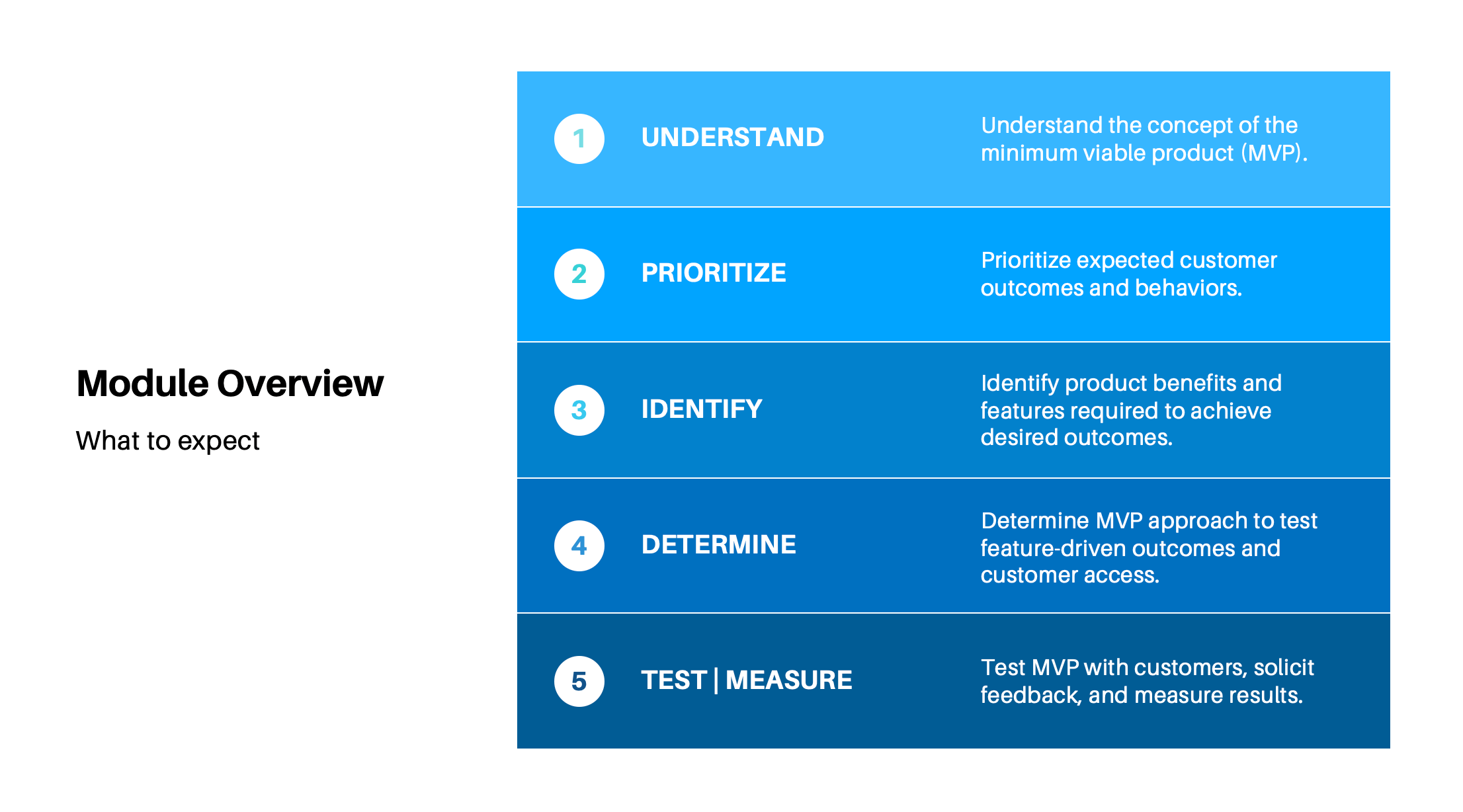
This chapter will explore using MVPs to support evidence-based product development effectively. We’ll start by discussing prioritizing assumptions to test and determine the proper feature set for an MVP. We’ll then cover critical considerations for MVP prototyping, gathering feedback, and managing the iterative development process. Finally, we’ll discuss how to analyze results and determine when you’ve achieved problem-solution fit and are ready to transition to scaling your product. Launching products is always a leap into the unknown to some degree. But by leveraging MVPs, we can make that leap with greater confidence that we’re building something customers genuinely want and need.
Section One: Prioritizing Expected Value
Section Introduction
Not all assumptions are created equal when it comes to developing new products. Some leaps of faith are more critical to the product’s viability than others. As product developers, we must focus our limited resources on testing the riskiest assumptions. Determining where to start with an MVP requires identifying and prioritizing the assumptions underlying the desirability and feasibility of the product vision.
This section will discuss frameworks for pinpointing and ranking key assumptions. We’ll cover how to define success criteria upfront so we know what we’re aiming to learn. We’ll also explore how to map assumptions to testable hypotheses and MVP feature sets. The goal is to zero in on the most miniature features that will allow us to collect relevant feedback on our most critical assumptions. Let’s dive in.
Customer Discovery: From Opportunity to Solution
Viewing product design and testing as an integral part of the customer discovery process is essential. By engaging with target customers early on, startups can validate assumptions about customer needs and establish a foundation for long-term relationships. Properly structured customer interviews allow for ongoing learning about the customers’ problems and potential solutions. As startups gain a deeper understanding of the customer experience and needs, they can seek feedback on solution concepts and early working versions, progressing from problem validation to solution testing. This two-phase customer discovery approach provides valuable data points on the customer journey. It allows startups to gain early traction by converting early contacts into paying customers and brand advocates. If you structure the process carefully and choose your first customer segments wisely, you can make many of these first contacts your first paying customers, leading to early traction.
Early Product Development & Testing
Early[DM1] solution development efforts provide vital opportunities to test the underlying assumptions of a startup’s business model. Through continuous refinement of the business model, which involves customer interviews, market research, and competitor analysis, startups can gather valuable insights. The primary goal of early solution design activities is to create tangible and measurable tests for the business model assumptions with customers. By involving customers in the design process, startups can co-create solutions that address customer problems and deliver value that the market truly values. This customer-centric approach aligns with the lean startup philosophy and helps transition early participants into paying customers and brand advocates.
Early product development efforts provide vital opportunities to test the underlying assumptions of your business model. As an entrepreneur, you continually refine your business model through customer interviews, market research, and discussions with competitors, suppliers, and distributors. You will have many customer and marketplace discussions as you craft your business model’s “first cut.” Once you have early validation that you have a solution to a customer problem of great value, you can think about the best way to design and build your product.
The main goal of early solution design activities is to provide a tangible and measurable way to test your business model assumptions with customers. This phase of customer engagement helps to clarify any misunderstandings you have about the problem, the desired solution, and what they are willing to pay for in a finished product. Engaging the customer early in the design process enables them to visualize and experience the value of your proposed solution. By engaging with early designs, the customer co-creates the solution. This early customer involvement ensures that you build a solution that truly addresses the problem in a way that the market values.
Involving the customer early in the design process is consistent with the current lean startup philosophy. Early solution iterations allow you to quickly test key business model assumptions about the customer problem, solution, and expected value. More importantly, it establishes an environment where the customer co-creates the solution, ensuring that the finished offering meets or exceeds marketplace expectations. This co-creation process has the added benefit of helping you transition early participants to paying customers and brand advocates.
Minimum Viable Product
Engaging customers early in the design process is a best practice for entrepreneurs and product teams, but it comes with challenges. Startups may need more technical expertise, domain knowledge, time pressures, and funding limitations. The concept of a Minimum Viable Product (MVP) has emerged in response to these challenges. The idea is to build a product version that focuses on a specific and limited part of the problem solution, allowing for validation with customers while conserving resources. The early versions of MVPs can be partially functional. Designs should facilitate customer feedback and provide real value. By following an iterative approach and continuously improving the MVP based on customer input, startups can navigate the early stages of product development more effectively.
The Minimum Viable Product (MVP) is an excellent approach to test your solution’s alignment with customer needs and expectations. The initial definition of this approach comes from Eric Reis, stating, “A Minimum Viable Product is that version of a new product which allows a team to collect the maximum amount of validated learning about customers with the least effort.”
The concept of a minimum viable product (MVP) emerged from the lean startup methodology proposed by Eric Ries in 2008. As startups operate in conditions of extreme uncertainty, Ries advocated for rapidly testing business model hypotheses with customers rather than investing months or years in product development upfront. In his 2011 book The Lean Startup, he popularized MVP to validate learning through market experiments.
One of the earliest precursors to the MVP concept goes back to the original Stage-Gate process developed by Robert G. Cooper in the 1980s. This process emphasized early customer involvement and rapid prototyping, critical elements of the MVP approach. The Stage-Gate process manages risks in new product development by dividing the process into stages separated by decision points or “ gates.” At each gate, the development team project reviews and decides whether to continue, redirect, or stop the project.
The Agile software development movement, which began in the 1990s, also incorporated similar concepts. Agile is a customer-centric, iterative approach to product development. It emphasizes collaboration, adaptability, and responsiveness to changing requirements throughout development. Agile breaks down the product development lifecycle into smaller, manageable increments called ‘’sprints’‘ or ‘’iterations’‘. Agile development strongly emphasizes involving customers or end-users in the development process. Regular feedback and customer engagement help ensure the product meets their needs and expectations. These attributes align with the MVP’s release of a primary product version to test assumptions.
2009 Cooper integrated lean methodologies into an updated Next Generation Stage-Gate process. His book Lean, Rapid, and Profitable New Product Development emphasized techniques like flexible stages and early, continuous customer engagement, which are vital components of the MVP approach.
The MVP approach places a more targeted emphasis on testing fundamental business model hypotheses with the minimum viable product. This focus on hypothesis testing tied to core assumptions is a distinguishing feature.
The understanding of MVPs has evolved. Initially, MVPs were seen as stripped-down product versions to validate demand. However, as Steve Blank and others pointed out, this risks alienating customers. Blank encourages startups to shift their mindset from building MVPs to testing MVPs by rigorously validating hypotheses while demonstrating genuine value. The MVP combines existing concepts like continual customer engagement with a targeted focus on hypothesis testing tied to core business model assumptions. This distinction has helped popularize MVPs as a strategic framework tailored to startups operating under uncertainty.
The MVP concept has evolved through practice. However, the significant tenets remain, especially the need to build a product version that focuses on a particular and limited part of a problem solution to validate the outcome with the customer. Early MVP versions can be partially functional, but one designs them to solicit customer feedback. Don’t strive for perfection, but ensure the product version is “good enough” to illustrate the core features required to solve the customer problem. I consider an essential criterion of an effective MVP to provide some value to the customer. The customer needs to experience some portion of the solution and how it will impact their lives.
MVPs vs. Prototypes
It’s essential to understand the difference between an MVP and a prototype. Prototypes demonstrate and test the functionality, look, and feel of a product idea. In contrast, MVPs test the underlying business hypotheses and assumptions about a product opportunity.
For example, a prototype for a new mobile app would aim to showcase the user interface, navigation, key features, and overall design to get feedback on the concept. Designers may ask users: Do you find this app easy to use? Is the layout intuitive? Does it have the right features?
An MVP for the same app may test just the sign-up process to validate whether the target users even want or see value in the core promise of the app. The MVP tests the riskiest assumptions before entirely building out the solution.
Prototypes tend to emphasize breadth - demonstrating multiple features to gauge interest. MVPs focus on depth - thoroughly testing one or two critical assumptions that impact product-market fit. Prototypes evaluate design elements, while MVPs validate business hypotheses. Both play essential roles in product development.
MVP Misconceptions
Some common misconceptions about MVPs are essential to debunk:
MVPs are only one of the quickest ways to build a product. The goal of an MVP is not to shortcut product development but to rigorously test hypotheses using the minimum effort required. Rushing an incomplete product to market without validating key assumptions risks wasting resources.
MVPs are not about cutting corners or compromising on quality. While MVPs focus on critical assumptions, they should demonstrate enough value to gain honest customer feedback. A low-quality MVP needs to reflect better on the business.
MVPs do not focus solely on the product. Testing business model assumptions related to the customer segment, channels, revenue streams, etc., are also crucial. An MVP should test the entire business model, not just product features.
MVPs are not one-time market experiments. They are part of an ongoing process of hypothesis testing and learning. Insights gained shape future MVP iterations.
MVPs are not just about the first product release. The principles of validated learning apply throughout the product development lifecycle, not just at the start.
MVPs are not prototypes. In comparison, prototypes demonstrate features, and MVPs test assumptions. MVPs can utilize prototypes but with different intents.
MVPs are no shortcuts to getting to market faster. Time pressures can tempt teams to rush MVPs, risking building something customers do not want.
In summary, MVPs are about rigorously testing assumptions to gain validated learning, not accelerating product launches. This practice helps to save resources on building products that customers do not find valuable. MVPs require discipline to focus on the critical hypotheses that matter most to the business model.
The MVP Approach
Early solution design follows the same experimental testing approach applied to validate all aspects of your business model. You start with assumptions on how the product solves the customer’s problem and creates value. Then, you test these assumptions through customer engagement, make adjustments, and repeat the process. As part of the testing process, you should generate outcome measures or metrics that support business model validation. Validating metrics include post-use surveys, web statistics, or specific criteria associated with problem solutions, sometimes called quantifying customer value. Measuring customer value may include how product use has created cost savings, time efficiencies, performance enhancements, or error reductions.
In preparation for planning your MVP testing, it is the perfect time to leverage the knowledge gained from customer discovery and market research to refine your product development strategy, prioritize customer needs effectively, and create a focused and valuable MVP.
Review Customer Discovery and Market Research: Take a comprehensive look at the insights gained from your customer discovery process and market research. Please look at all the data and feedback collected, including pain points, desires, and preferences your target customers express.
Prioritize Customer Needs: Analyze the information gathered and prioritize the most critical customer needs. This step involves understanding your target audience’s most pressing pain points or requirements. By prioritizing customer needs, you can ensure that your development efforts focus on delivering value where it matters most.
Determine Testing Priorities: Once you have identified the most critical customer needs, decide which aspects of your product or service you should test first. This consideration involves specific features, functionalities, or improvements that address the prioritized needs. Testing these elements early on allows you to gather valuable feedback and validate assumptions, enabling you to make informed decisions in the future.
Update Journey Map: Take this opportunity to revisit and refine your customer journey map. A customer journey map illustrates the various touchpoints and experiences your customers encounter when interacting with your product or service. Updating the journey map allows you to identify specific stages or interactions that align with the prioritized customer needs. This update will help guide your focus during the early stages of MVP development.
MVP Development: With the updated journey map and testing priorities in mind, concentrate on developing the Minimum Viable Product. The MVP should include the key features and functionalities that address the most critical customer needs. By aligning the MVP development with the customer’s journey and testing priorities, you can iterate quickly, gather feedback, and make necessary adjustments to enhance the product’s value.
The Process
As a starting point, you should define the essential customer experience your product needs to create to assess if the offering solves the problem in the way the customer values it. From initial customer engagement, you should have a shared understanding of the problem, current solutions tested, and expected outcomes. Then, armed with this shared understanding, you need to identify the minimum product features required to provide the customer with the desired results and benefits.
During this process, you can review your current assumptions about what outcomes the customer expects or desires from an effective solution. Articulate customer outcomes clearly and quantify them whenever possible. Along with the outcome review, you should articulate any specific product benefits associated with the customer’s needs. Customer outcomes and product benefits are closely associated; your assessment should reflect this relationship.
With customer outcomes and associated product benefits defined, you can prioritize them according to their needs. From your customer discovery activities and research on current market offerings, you will understand how the customer values specific outcomes. Additionally, you should identify existing solutions and where there are potential gaps in the marketplace. One approach to help with this prioritization is the importance satisfaction matrix. Here, you rank the importance of the outcome and the level of satisfaction that the customer has with current, existing solutions. If the result for the customer is significant and the level of satisfaction with existing products is relatively low, you should look to prioritize this need area.
Once you have prioritized the customer outcomes and associated product benefits, you can identify what product features need to be designed and tested. At this point, you determine what your new product has to do functionally to produce a specific outcome and benefit. With a minimum viable products or solutions (MVP/MVS) approach, you can identify the minor features required to demonstrate value to the customer. For the entrepreneur, this can be pretty challenging. It takes quite a bit of self-discipline to limit the early testable features. Typically, founders are motivated to get a product out into the marketplace by now, so it is easy to expand the offering, sometimes called feature creep.
The next step is to decide on the best approach to illustrating your product’s ability to solve the customer’s problem. Early MVP versions can take many forms, such as sketches, graphic depictions, or diagrams for physical products, web launch pages, screen mockups, and click-through samples for digital or software solutions. Later MVP iterations take more functional forms, such as scaled models, hand-made or 3D-printed constructions, or working prototypes.
One of the primary purposes of your MVP is to validate whether you are providing the customer with an effective solution to their problem. In other words, it is crucial to demonstrate to the customer what value your solution can offer them. As always, emphasize to founders that they should always provide value to the customer in every interaction. Offering value demonstrates how the customer will benefit from your solution.
Considering how to provide value at this stage, the “fidelity” of your MVP/MVS is critical. In this context, the fidelity of your MVP refers to the degree to which the customer can experience the real solution. To what degree does the test product solve some of the customer’s problems? Do they experience real value, even to a small degree? A low-fidelity MVP/MVS provides a glimpse into the venture concept, the look without the feel. A critical missing element is an interaction with the product and some meaningful, minimal outcome.
Finally, you determine what measurements or metrics you will use to validate the learning in these early MVP/MVS iterations. Again, asking customers to complete a short survey after reviewing and using the MVP is an excellent start.
MVP Types: Low to High Fidelity
The fidelity of an MVP refers to how closely it resembles and functions like the final product envisioned. Fidelity includes both visual resemblance and interactive capability. Low-fidelity MVPs have limited visual representation and interactivity and focus on testing hypotheses. High-fidelity MVPs offer more visual realism and robust functionality for hands-on testing and enable deeper evaluation of the product experience.
Here are several MVP approaches that range from low to high-fidelity methods:
Landing Pages: Simple web pages with brief explanatory text and email sign-up forms used to gauge customer interest before having a functional product. Example: An electric scooter startup creates a landing page to collect customer emails before launch.
Sketches/Diagrams: Rough hand-drawn or digital sketches and diagrams convey a product’s core concept and user flow during the early ideation stages. An example is a single hand-drawn wireframe representing a proposed wedding planning app.
Wireframes/Mockups: More polished digital visual guides demonstrating page layouts, user interface elements, and journey map of a product. Example: Designers show how an e-commerce might work using detailed clickable mockups,
Paper Prototypes: Hand-sketched or printed models used to gather user feedback on proposed features and designs for physical or digital products. Example: A smartwatch startup uses paper prototypes to illustrate possible watch face designs.
Explainer Videos: Short animated videos digitally illustrating a product’s benefits and functionality before being built. Example: A narrated explainer video demonstrates how an Internet of Things product will create a seamless workflow.
Pre-Order Pages: Web pages allow prospective customers to reserve or pre-order a product to assess demand before it is ready for delivery. For example, a pre-order page promotes a new action camera before manufacturing.
3D Models: Digital 3D renderings or physical scale models showcase a new product’s form, function, and feel. An example is visualizing a consumer drone through detailed 3D-printed models.
Digital Prototypes: Interactive digital representations of a product’s user interface and features for hands-on user testing and feedback. Example: Test A travel app via a clickable prototype simulating its UI and booking flow.
Piecemeal/Manual: Leveraging existing tools and manual processes to deliver a product experience before building a solution. For example, a tutor manually creates lesson plans while testing the market for their online platform.
Physical Constructions: Handmade or machined high-fidelity models of a physical product made with final materials to test functionality. Example: An electric bicycle startup machines an early model to test its motor and frame design.
Wizard of Oz: Manually mimicking a product’s functionality behind the scenes to make it appear fully operational. For example, a team books travel for users manually while pretending its travel website works via AI.
Concierge: Delivering a service manually to assess interest, gain insights, and gather feedback from early customers. Example: A house cleaning startup founder performs services themselves for initial customers.
Single Feature: A product with only its core functionality, limiting complexity during early testing. For example, a note-taking app launches with a text editing feature and no formatting options.
The Steps
One of the challenges in designing your minimal viable product or solution is to decide which product features to focus on in early iterations. Here are suggested steps to hone in on the best MVP approaches for your early product testing.
Step 1. Review/Refine Target Customer Assumptions: In this step, you should review the information gathered from your early customer discovery interviews and analyze the results. It would be best to evaluate whether changes or refinements in your understanding of the target customer’s jobs, tasks, pain points, and desired outcomes are necessary. Ensure you can test key customer behaviors required to enable specific customer goals. Evaluate which assumptions about the customer are still valid and which may require adjustments or pivots based on the feedback received.
Step 2. Evaluate and Prioritize Product Benefits: Using importance and satisfaction scales, assess the needs of your target customers. Identify areas where their needs are unmet or unfulfilled (high importance/low satisfaction). List your product’s benefits based on customer interviews and specific desired gains. Rate each benefit in terms of importance and the current level of satisfaction provided by existing solutions in the market. For MVP testing, you want to focus on a priority customer need area and identify what your product has to do functionally to facilitate support of specific customer goals (see Step 4.)
Step 3. Compare Your Product to Competitor Offerings: Using the importance and satisfaction ratings obtained in Step 2, prioritize the benefits that fall into the high importance, low satisfaction zone. Then, compare your competitors’ offerings for each prioritized benefit area. The goal is to identify areas where your product can provide unique customer benefits than competitor products. This analysis helps you differentiate your product and understand its competitive advantages.
Step 4. Identify Essential Product Features: After the previous steps, you will clearly understand which benefits are critical for your target customers and how your product compares to competitors. Now, it’s time to identify the essential features that will create value for your customers. For each prioritized benefit, determine the top product features that align with providing the desired benefit. Evaluate the importance of each product feature in delivering the desired benefit to the customer. Additionally, estimate the development time and costs associated with implementing each feature. The goal is to identify features that offer significant customer value while requiring minimal development effort and resources.
Step 5. Select MVP Approach for Early Tests: In this final step, you select the high-value/low-development features identified in the previous step for possible testing with customers. Next, consider the various MVP approaches available (as shown in the MVP Approaches figure). Choose the approach that allows you to demonstrate the look and feel of your solution to the customer with the highest possible fidelity. It should be a prototype or demonstration that showcases the value of your solution effectively while being developed quickly and cost-effectively.
By following these steps, you can focus on the most critical features and benefits, differentiate your product from competitors, and build an MVP that effectively addresses the needs of your target customers for early testing and validation.
Section Conclusion
Prioritizing where to focus an MVP is both a strategic and hypothesis-driven process. We can streamline MVP development by mapping out our riskiest assumptions and determining the minor functionality needed to test them. The frameworks and techniques provided a logical approach to deciding what to build first. They push us to resist the temptation to overbuild upfront or succumb to confirmation bias about our initial ideas.
With our critical assumptions clarified and an initial MVP plan defined, we’re ready to build our prototype. In the next section, we’ll explore the iterative process of developing an MVP, translating our strategic priorities into tangible product increments.
Section Two: Iterating Minimum Viable Products
Section Introduction
With target assumptions defined, it’s time to get tangible. The process of MVP development is highly iterative and incremental. Rather than getting bogged down upfront with a long list of features for a distant release, we focus on rapidly building a core set of functionalities to put in front of customers. Based on the feedback, we enhance the MVP with a successive series of short development cycles. The goal is to quickly create something we can take to market to test while preserving the flexibility to adjust based on feedback.
In this section, we’ll explore critical techniques for iterative MVP development. We’ll discuss how to define a backlog of features and slice it into small increments. We’ll cover how to structure agile implementation cycles to enable rapid prototyping. We’ll also highlight common pitfalls to avoid, like premature scaling or losing sight of the big picture. The aim is to progressively design and develop MVPs in a way that maximizes the speed of learning.
Running Small Pilot Tests with Select Customers
Before full launch, running small-scale controlled pilots with targeted user segments enables startups to gather extensive feedback for refinements in a lower-risk setting.
Approaches to Effective Startup Pilot Testing
Early testing reduces market risks for startups by validating and allowing assumptions before making heavy investments in development and launch. Running pilots with a smaller set of prospects willing to try the MVP and provide input can accelerate insights.
Ideal pilot testers possess domain expertise, a willingness to engage deeply, an ability to evaluate workflows extensively, and alignment with target customer profiles. A sample size between 10 and 20 enables gathering broad qualitative feedback on multiple facets, such as usability, value perceptions, error scenarios, etc., through techniques like interviews and usability testing.
The feedback then shapes everything from branding approaches to feature priorities for the next set of iterations before the market debut. Startups gain diverse but focused inputs to build products that resonate with user needs.
The quality and relevance of insights unlocked via controlled small-group testing enable startups to de-risk product development before scaling up across broader target markets.
Gathering Feedback through Surveys, Interviews, etc.
Soliciting qualitative user perspectives frequently using inclusive engagement modes shapes startup product evolution to align with emerging needs.
Approaches for Gathering Insightful User Feedback
Ongoing customer consultation, beyond quantitative analytics, provides the voice of the user required to transform MVPs into desirable products that match expectations.
Surveys offer scalable pulse checks to gauge satisfaction, challenges, and feature requests on a mass scale. Interviews and focus group discussions uncover more profound insights that questionnaires may miss. Usability test observations, support tickets, and community forums capture pain points.
Analyzing collective feedback to cluster users into segments, map journeys to pinpoint friction, and determine priorities provides actionable focus areas for development backlogs. The mode, frequency, and sample size for engaging users offer trade-offs between depth and scale of insights. Omnichannel outbound and inbound techniques provide richness.
Combining participatory feedback channels provides well-rounded inputs for startups to sustain alignment with target user needs as products and markets evolve.
Incorporating Insights into Product Improvements
Rapidly translating user feedback into prioritized roadmap enhancements enables startups to refine MVPs through data-driven iterations that establish fit.
Approaches for Aligning Development to User Insights
Qualitative and quantitative learnings uncovered from surveys, analytics, interviews, etc., provide the fuel for validating product direction through evidence-based enhancements. Grouping user inputs to reveal priority theme channel efforts.
Engineering capacity constrains the feature scope feasible per iteration. So, startups must consider severity, costs, and dependencies when sequencing roadmap items based on customer inputs.
Maintenance fixes address stability, while minor suggestions go into the backlog for potential later incorporation. New user stories are carved out for upcoming sprints in major desired areas. Committing to shared feature proposal transparency keeps users engaged through build-measure-learn cycles.
Continuously analyzing and incorporating a mix of feedback into development sprints enables startups to systematically enhance their MVPs while aligning tightly to emergent user needs.
Managing the MVP Process
Carefully managing the MVP development and testing process is essential for startups to maintain focus, speed, and alignment with customer needs. This process involves critical product management disciplines like creating a prioritized feature backlog, adopting agile tracking methods, budgeting for rapid iterations, and remaining flexible to user feedback. By taking a structured approach to managing MVP iterations, startups can enhance their productivity, optimize limited resources, and accelerate validated learning. The goal is to evolve the MVP into a viable product matching market expectations as quickly and cost-effectively as possible.
Creating a Prioritized Product Backlog
Ruthlessly prioritizing feature scope for each sprint based on customer value optimization allocates constrained startup resources to the highest impact opportunities.
Approaches to Defining MVP Roadmaps
Given limited funding and tight development bandwidth, early-stage startups must strategically scope roadmaps to focus on testing assumptions vital to product-market fit. Capabilities get prioritized based on criteria like dependency, cost, feasibility, and customer-validated urgency.
Analyzing qualitative feedback and usage metrics helps classify feature requests into must-have versus nice-to-have categories. Avoiding scope creep by saying no to items unlikely to make the top 20% in results enables startups to channel resources toward moving the needle for users.
Publicly sharing roadmap visibility manages external stakeholder expectations around launch timelines and implementation commitments while retaining the flexibility to adapt based on learnings. Deliberate scoping trade-offs are crucial for startups to ensure optimal allocation of constrained capabilities to features that directly enhance user traction.
Tracking Progress through Sprints/Iterations
Utilizing agile strategies sustains disciplined progress cadences for startups to ship continuous customer value through rapid build-measure-learn cycles.
Keeping Track of Progress
Startups should work in short, focused development cycles lasting 1-2 weeks. Each process should have assigned team members, goals for what success looks like, and an end deadline. This approach creates accountability and urgency compared to vague long-term plans.
Use techniques like tickets, progress charts, daily team syncs, reviews, and automated testing to monitor forward movement within each cycle. Focus on steadily improving velocity by accomplishing defined development increments predictably within these agile sprints.
Celebrate small wins when possible while navigating more significant challenges through transparency. Maintaining reasonable processes balanced with flexibility allows startups to incorporate user feedback fluidly.
Being Flexible and Responsive to Changes Based on Feedback
Rapidly adapting products and plans based on user insights rather than rigidly sticking to assumptions allows startups to stay in alignment with evolving needs.
Remaining Nimble to Changing Needs
Testing startup assumptions is unpredictable since customer reactions frequently differ from initial expectations. Startups can adapt swiftly by implementing reasonable processes for transparency while retaining flexibility.
Empower product teams to respond rapidly to negative feedback by providing adaptable staffing models and quick prototype approval. Interpret setbacks as valuable learnings rather than failures. Continuously re-evaluate roadmaps as new customer inputs emerge.
Take a modular design approach, creating Lego-like components that can be extended and reconfigured instead of rebuilt from scratch. This approach allows startups to meet evolving needs primarily through configuration changes rather than overhauls.
Budgeting Resources and Managing Costs
Given funding constraints, startups must creatively resource MVP development. Leverage extended team networks to find affordable freelance talent. Seek barter arrangements to gain technical skills in return for equity. Explore no-code tools and lean operations rather than large dev teams. Analyze hosting and infrastructure options, balancing capabilities, control, and costs. For example, serverless MVPs on cloud platforms can offer savings over managing their infrastructure. Think frugally and maintain flexibility to pivot based on learnings.
Budget Categories to Consider
Here are some budget categories to consider when building a budget for the first iteration of a fully functioning product.
Design - UX, UI, branding needs
Development - Coding costs and resources
Testing - User research incentives and tools
Iterations - Enhancements post-feedback
Infrastructure - Hosting, hardware requirements
Marketing - Initial user acquisition costs
Carefully evaluating alternatives allows startups to acquire essential capabilities that match iterative testing and product development creative needs within tight budget constraints during the MVP stage before seeking more significant investments.
Section Conclusion
Developing an MVP is not a linear process. It requires comfort with iteration and learning as you go. We maintain flexibility by taking an incremental approach and organizing development work into short cycles. The key is striking the right balance between rapidly developing core functionality and building with quality. It can be tempting to cut corners to get features out the door. But buggy, unreliable MVPs undermine trust with early customers.
As we build and enhance MVPs, the role of customer feedback is paramount. We’re not just building to our specifications but engaging in a collaborative external validation process. The following section will dive deeper into best practices for gathering customer input throughout the MVP journey.
Section Three: Validating with Customers
Section Introduction
MVPs are ultimately judged by the real-world feedback they enable us to gather. Collaborating with customers throughout the development process is essential for market validation. By treating MVPs as vehicles for hypothesis testing, we can evaluate everything from feature desirability to interface usability to pricing sensitivity. This evaluation requires a systematic approach to defining target metrics, determining feedback methods, and analyzing results.
In this section, we’ll explore strategies for structuring customer feedback loops, discuss how to facilitate co-creation at different stages of MVP development and cover critical metrics to track and assess technical feasibility, customer engagement, and business viability. The insights gathered help inform the iterative evolution of the MVP. When done well, ongoing customer validation helps build confidence that we’re moving in the right direction.
Integrating Behavioral Feedback Loops
Designing a behavioral feedback loop within the MVP process is paramount as it enables businesses to create a dynamic and iterative product that drives user engagement and behavior change. The MVP can effectively guide users toward desired actions and results by incorporating mechanisms that provide customers with immediate feedback on critical behaviors and outcomes.
Immediate feedback serves as a powerful reinforcement tool. By demonstrating the connection between specific behaviors and their corresponding outcomes, users can better understand the value and impact of their actions. This feedback loop reinforces behavior change by highlighting the direct relationship between user behavior and the desired outcome. When users can see the cause-and-effect relationship, it becomes easier for them to make informed decisions and adjust their behavior accordingly.
Moreover, a well-designed feedback loop triggers reflection among users. It encourages them to assess their behavior with the desired outcomes and identify areas for improvement. This reflective process allows users to self-assess and make necessary adjustments, leading to more efficient and effective use of the MVP. An effective behavioral feedback loop facilitates behavior assessment and increases motivation and engagement with the product. When users receive timely feedback and witness the positive outcomes of their actions, it creates a sense of accomplishment and satisfaction. This positive reinforcement fosters motivation, encouraging users to remain engaged with the product and continue exhibiting the desired behaviors.
By incorporating a well-designed behavioral feedback loop, the MVP process becomes a collaborative journey between the user and the product. It empowers users to shape their experience and achieve desired outcomes actively. Additionally, this feedback loop allows businesses to gather valuable data on user behavior and preferences, which can inform future iterations and improvements to the MVP.
In conclusion, a thoughtfully designed behavioral feedback loop within the MVP process has a profound impact. It provides immediate feedback on critical behaviors and outcomes, reinforces behavior change, triggers reflection for self-assessment, and increases motivation and engagement. By integrating this feedback loop, businesses can create a user-centric MVP that drives meaningful engagement and delivers value to both the users and the company.
Co-Creating the MVP with Customers
Customer co-creation is a collaborative process of engaging target customers to shape the design and development of an MVP. Rather than building an MVP in isolation, startups can involve customers early to ensure the product resonates with user needs.
The co-creation process typically begins by clearly describing the problem the startup aims to solve based on insights gathered from customer discovery interviews. Customers share their experiences with the problem and provide recommendations on potential solutions.
Next, the startup shares early MVP prototypes or demonstrations. Customers give feedback on proposed features and functionality. The goal is to gain insights into how customers would solve the problem themselves and what they find most valuable.
Co-creation enables startups to incorporate customer considerations into the MVP from the outset. Customers feel invested in solutions they help shape, and their input guides startups to build features that closely align with customer needs and desires.
Effective co-creation provides customers with visual stimulus and opportunities for hands-on engagement with early MVP versions. This arrangement creates a collaborative product development journey rather than simply presenting finished ideas.
Gathering Actionable MVP Feedback
The approach to gathering feedback may differ depending on the MVP’s fidelity level. Low-fidelity experiments may rely more on qualitative feedback, while high-fidelity MVPs enable quantitative data gathering.
For low-fidelity MVPs, focus on gathering qualitative feedback through customer interviews, surveys, and user observations. Quantitative data like usage analytics, conversion rates, and other metrics should also be incorporated for high-fidelity MVPs to complement user insights.
The type of feedback collected can vary based on MVP fidelity. Low-fidelity experiments lend themselves to exploratory qualitative insights like interviews and surveys to understand user perceptions. High-fidelity MVPs allow more quantitative data through metrics like conversion rates, retention, and usage analytics to understand behavior.
Generally, the feedback gathered from MVP testing should be qualitative and quantitative. Qualitative feedback from open-ended interviews and surveys provides insights into how customers respond to different product attributes and where they experience friction.
Quantitative data on conversion rates, usage metrics, sales, and other metrics shed light on the market viability of different business model assumptions.
Connecting insights directly to the hypotheses and assumptions framed before testing is essential to making the feedback actionable. The feedback validates whether to persevere or pivot regarding specific assumptions.
It is crucial to facilitate this connection throughout the MVP development and testing process. Business model canvases and other frameworks can help link feedback to original hypotheses. Ongoing documentation of insights gained, decisions prompted, and results achieved is invaluable.
MVP Metrics
When evaluating an early Minimum Viable Product (MVP), shifting the focus from customer acquisition to customer engagement is essential. While acquiring users is crucial, understanding their enthusiasm and satisfaction with the product’s outcomes during the testing phase provides valuable insights. Several metrics are available to measure customer engagement effectively.
One significant metric is how quickly customers perceive value in the MVP. Can users recognize the benefits and advantages the product offers shortly after interacting with it? By assessing the speed at which users grasp the value proposition, it becomes possible to gauge the effectiveness of the MVP in addressing customer needs.
Another important metric is the number of active users engaging with the MVP. This metric indicates the level of interest and adoption among the target audience. Monitoring user activity and tracking the growth in active users makes it apparent whether the product resonates with customers and captures their attention. Additionally, measuring the rate at which the MVP reaches new customers is crucial. This metric provides insights into the product’s reach and ability to attract a broader audience. Analyzing how quickly new customers are onboarded and assessing their level of engagement allows for a better understanding of the MVP’s scalability and market potential.
Observing customer feedback and recommendations can provide valuable insights into the MVP’s success. Are early customers actively recommending the product to others? Positive word-of-mouth and customer advocacy indicate that the MVP resonates with its target audience and delivers value. Monitoring customer sentiment and gathering feedback makes it possible to identify aspects of the MVP working well and areas that may require further improvement.
By focusing on these customer engagement metrics, such as the speed of perceiving value, active user count, customer reach, and recommendations, businesses can gain valuable insights into the success and potential of their early MVP. These measurements go beyond acquisition numbers and provide a holistic understanding of customer satisfaction and enthusiasm during product testing.
Section Conclusion
Staying closely connected to customers as we build and refine MVPs is paramount. By treating our customers as co-creators rather than end users, we develop the evidence to persevere or pivot. Taking a process-oriented and data-driven approach to gathering input and measuring results allows us to maintain objectivity. It’s easy to fall in love with our solution as we translate an initial vision into a tangible product. But continuous market validation keeps us honest.
With each round of feedback, we gain more excellent resolutions on problem-solving fit. We move from testing basic assumptions to optimizing the product experience. Over time, key indicators like engagement, retention, and willingness to pay signal when an MVP is gaining market traction. We can shift our focus from achieving initial fit to preparing for scale at that point.
Chapter Summary
The MVP process is ultimately about maximizing validated learning while minimizing wasted resources. We can more efficiently achieve product-market fit by ruthlessly prioritizing the riskiest assumptions, incrementally building and refining prototypes, and continuously gathering customer feedback. The frameworks and best practices covered provide a roadmap for evidence-based product development.
While MVPs are often associated with scrappy startups, the core principles are relevant for organizations of all sizes. The imperative to test ideas before investing significant time and money is universal. In a world of escalating consumer expectations and competition, we can only afford to base product decisions on something other than intuition and historical practices. Embracing an experimental mindset and collaborating closely with customers is increasingly essential.
As you look to launch new offerings, challenge yourself to articulate and test your key assumptions upfront. Follow an iterative approach and engage your customers early and often. When you do, you’ll find yourself launching products with greater confidence and a higher likelihood of market success. Real learning is the outcome of an effective MVP process.
Module 5 Posts
Prioritizing Expected Value
Articulating Customer Outcomes and Key Behaviors: A Pre-Product Roadmap
Cognitive-Behavioral Design Strategies: Unraveling Customer Psychology to Foster Meaningful Change
Leveraging Behavioral Science to Drive Early Product Design
Iterating Minimum Viable Products
Design Thinking: From Empathy to Insight
From MVP to Scalable Product: A Tactical Guide for Development, Validation, and Growth
Validating with Customers
Why Your MVP is Lying to You: The Hidden Difference Between Interest, Intent, and Action
Leveraging Behavioral Science to Optimize Product Engagement Metrics
Driving Startup Growth: Harnessing Early Product Design and Testing


