

M4 | Your Market
Module Four: Your Market
Chapter Introduction
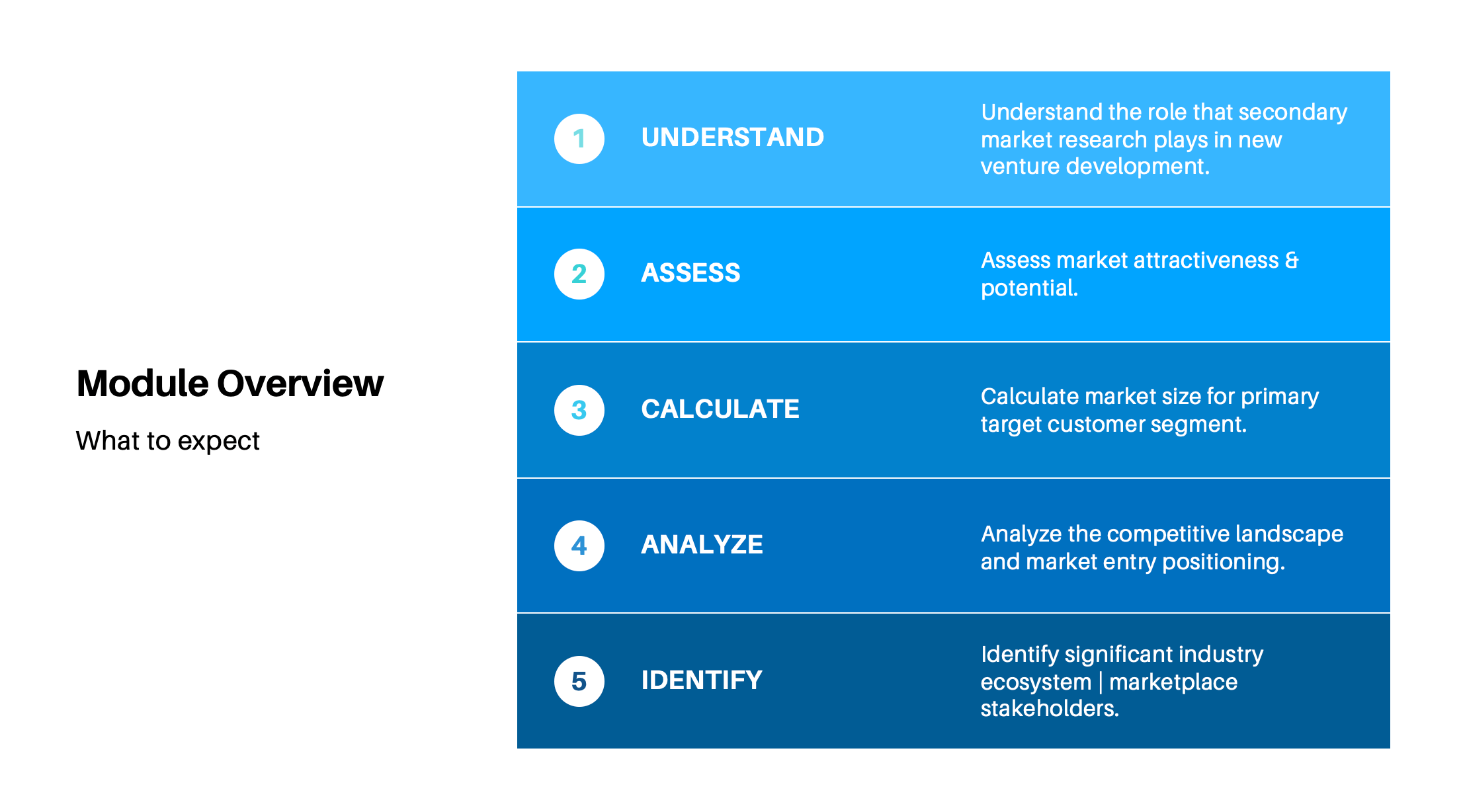
In this chapter, we explore the critical steps entrepreneurs must take to fully understand their target customers and evaluate the potential of the market opportunity. Gaining clarity into your ideal customer profile and accurately sizing the addressable market builds the foundation for developing sound marketing strategies and financial projections.
The chapter is organized into three main sections:
1. Evaluating Market Potential: We discuss best practices for conducting rigorous top-down and bottom-up market analysis to quantify the total addressable market (TAM) and serviceable available market (SAM). This approach provides data to assess market viability and scalability.
2. Analyzing Competitive Landscape: We explore frameworks for identifying direct and indirect competitors, studying their business models, and conducting SWOT analysis to inform market entry strategies based on strengths, weaknesses, opportunities, and threats.
3. Mapping the Industry Ecosystem: We examine tools like industry analysis and startup ecosystem evaluation to understand the broader landscape surrounding a venture, including support networks, partners, regulations, and infrastructure. This knowledge aids in strategic planning.
Together, these three sections provide methodologies for entrepreneurs to thoroughly research and evaluate target customers, market opportunities, competitive forces, and industry dynamics during the early stages of developing a new venture. The qualitative and quantitative insights derived from customer discovery and market analysis form the foundation for strategy decisions further down the road. With realistic perspectives grounded in data, founders can set their ventures up for sustainable growth and impact.
Section 1: Evaluating Market Potential
Determining the attractiveness and viability of a new venture opportunity requires founders to understand the target market’s size and segmentation comprehensively. While developing a new venture, entrepreneurs will encounter multiple opportunities to assess the potential number of customers within their beachhead market segment. By continuously refining their understanding of target customers and estimating how many they can realistically reach, founders can gain valuable insights into the scalability and profitability of their business idea.
This post emphasizes the importance for entrepreneurs of clearly defining their ideal customer profile upfront and dividing the overall market into priority segments based on detailed demographic, behavioral, and need-based criteria. Furthermore, it explores methodologies founders can leverage to generate a rigorous top-down and bottom-up market sizing analysis. Conducting this level of due diligence across the pre-screen, segmentation, and go-to-market strategy phases enables founders to accurately quantify the revenue potential of their venture’s beachhead market.
The ability to accurately size and segment the target market provides the foundation for founders to develop sound marketing strategies and financial projections. By investing significant effort into market sizing and segmentation, entrepreneurs equip themselves to make well-informed strategic and operational decisions as they work to prove and scale their venture over time.
The Pre-Screen Phase
Very early on in the process, as part of your pre-screening efforts, it is worth conducting what is sometimes called a top-down assessment of your market. This assessment derives from accessible secondary research into current customer behavior patterns related to the problem area you hope to solve with your venture. Staying focused on the market as directly associated with the customer’s needs is essential. Think of your market as customers (consumers or organizations) who require solutions (products or services) to solve problems and satisfy needs. Keeping your focus on customer needs is critical to the future success of your venture. Start early and get into the habit of doing this.
During the pre-screening phase, keep your market definition open and flexible. If you focus too early on a market definition related to a specific product (solution), you limit your view of the market potential. We see this occurring time and time again. Founders view the market through their specific product idea instead of the customer’s need. When this happens, you narrowly view the opportunity, limiting who you see as domain experts, influencers, competitors, and other market-industry stakeholders.
At this stage, you want to understand the market’s overall size at the highest level. The current market size and associated trends will give you a 30-thousand-foot view of your potential market in the future. However, entrepreneurs should not see this as their future sales opportunity. You are just viewing current customer activity associated with the problem and any observable trends in the market direction.
There are a few additional questions to answer in this pre-screening effort beyond the question of size:
1. With a focus on customer needs, can you readily identify your market? This identification is not as easy as it sounds. Founders typically have many assumptions about customers. However, the beliefs are rarely detailed or actionable.
2. Is the market growing? How fast? It is time to understand where the market and associated products are regarding the life cycle. Are the solutions relatively new? Early-late growth phase? Or declining? For startups, there are always opportunities to enter a market. But most would agree that entering a fast-growing market is optimal.
3. Is the market segmenting? Associated with growth is the understanding of whether different customer behaviors or demographics segment the market. As will become apparent, understanding which segments already exist may open up opportunities for new market niches.
To conduct this high-level market analysis, founders can leverage secondary sources such as:
Government data on population demographics and industry trends
Market research reports from firms like Gartner, Forrester, IDC
Industry associations and non-profit foundations
Academic journals and conferences
News articles and press releases related to the market
Your early estimates of your market’s size will focus on the total number of potential customers needing a solution for the problem you hope to solve. The main reason to spend time on this estimate is to give you a sense of whether the opportunity is sufficient for your efforts and resources. This decision can be very personal for a founder, dependent on your passion for the problem and longer-term venture goals. However, if you plan to seek outside funding at some point, then you need to consider what the investors will see as an attractive size. Investor criteria depend on several factors and are beyond the scope of this post. In general, venture capitalists are looking for a minimum of 10X return on their investment, so potential markets valued at $500MM to $1Billion would be attractive. Smaller investors, such as angels, might see smaller markets as attractive depending on the percentage of the venture they think they would own after future funding rounds and associated dilutions. In this scenario, angels may be willing to invest in ventures that capture a good percentage of a $100MM to $500MM market.
So, where should you look for market size data at this pre-screen stage? For the most part, secondary sources should provide enough information to support a decision to continue to work on the venture or change directions. Founders rarely find a “report” that provides the exact market data required. And if such a report exists, it is rarely affordable. Start by focusing on available data in the public domain and some well-conceived assumptions to provide what you need at this point. From my experience, some of the most fruitful market data sources come from government publications and data sites, industry trade journals, press releases associated with the problem to be solved, and analyses of current solution providers—most likely your competitors.
This secondary research information will not go to waste as it will become an essential foundation as you analyze your market in more detail during the segmentation phase.
The Segmentation Phase
As you move deeper into the venture realization process, you will spend a lot of time defining your customer profile and thinking about how customer behaviors and demographics might segment the overall market. Understanding each customer segment’s size is essential for selecting your first market to enter and future follow-on market segments.
The Customer Demographics Profile
Many of your early assumptions focus on identifiable characteristics of your potential target customers. List these first. Do you suspect that your early customers will be predominantly of a specific gender and age range? Education and income level? Do they have a particular lifestyle or manifest specific behaviors? With these characteristics, you are making assumptions about the demographics of your target customers. As with all assumptions, you will test these during early customer discovery. You will be looking to speak to customers with the specified demographics to learn about their experience with the problem and current solutions. You will begin to validate whether your assumptions about your target customer’s demographics are correct from these interviews.
There are many ways to segment your customer base or market. Possible market segment methods include Geographic, Demographic, Lifestyle, Behavioral, Special Characteristics, and Reason for Solution or Purchase. These segments work well for Business-to-Customer (B2C) profiles. For Business-to-Business (B2B) profiles, segmentation focuses on business entities, the purchasing decision-maker, and the end user where applicable.
For example, a company selling gym equipment may segment its market demographically into age groups like 20-30-year-olds, 30-40-year-olds, etc. Or behaviorally into frequent gym-goers, at-home fitness enthusiasts, physical therapy patients, etc.
Prioritizing Segments
Once you have identified potential segments, the next step is to prioritize which ones to target first. Criteria to consider when prioritizing segments include:
· Growth potential - Focus on segments that are growing quickly
· Competition - Target segments with lower competition
· Accessibility - Prioritize segments you can reach through your distribution channels
· The value proposition - Align with segments where you offer maximum value
· Strategic fit - Select segments that leverage your core competencies
By allocating resources to high-potential segments first, you can maximize the return on your customer acquisition investments.
Applying Customer Segmentation to Market Size Analysis
A common approach provides entrepreneurs with a cascading model where you start at the broadest definition of the market and then peel back the layers. You hone in on your market picture until you have identified the customer base you will most likely reach in your venture’s early period. This model typically includes multiple layers and applies the following four: Total Potential Market (TPM), Total Addressable Market (TAM), Served Addressable Market (SAM), and Share of Market (SOM). If you google this approach, you will find many definitions, so you should define each level. Here is how I tend to determine each market level.
Total Potential Market (TPM)
The total Potential Market (TPM) is the number of customers looking to solve the problem. How many customers would that total if they all (100%) purchased your solution? I think of this estimate as including customers across all segments. You should calculate this number after defining all the customer segments and completing the rest of the market size analysis. You start by defining all potential customer segments. Then prioritize the top 5-6 segments. These prioritized segments will meet the criteria mentioned above in the beachhead section. However, I think the keyword here is addressable, meaning a clear path exists to access and acquire the customers within each segment. There will be segments within the total potential market that you will not seek in the early stages.
To understand “your” full market potential, determine the Total Addressable Market (TAM) for each segment you consider for early market entry. Like the TPM, the TAM represents how many customers you would acquire if you had a 100% market share in a specific segment. You will notice that I focus on the number of customers and not revenues. Many articles on market size discuss TAM in terms of expected market share in revenues. I tend to have founders focus on customer numbers, sometimes referred to as market volume, early on and revenue later. You can extrapolate some potential market revenue estimates through secondary research. For example, you should find any data about how much customers spend on products and solutions already in the market. You won’t determine your potential revenues until you have decided on your revenue and pricing strategies.
Total Addressable Market (TAM)
To determine the TAM for a specific segment, you will apply a combination of top-down analysis through secondary research resources and a bottom-up analysis from select primary resources. You should conduct a deeper analysis of the potential number of customers in the segment in question, starting with details from your customer profiles, including demographics, behaviors, and reasons for purchasing. This step begins with demographic data for each customer segment bounded by the identified geographic area. Then search for market data that provides a portion (percentages) of the population that manifests your target customer’s lifestyle or behavior. This analysis will result in the Total Addressable Market for the segment in question.
Once you thoroughly analyze your TAM for each segment, you add all segments together to have a reasonable estimate of your total potential market. This analysis will be a much better estimate than the one you started with during your pre-screening efforts.
Served Available Market (SAM)
The next level of market size analysis looks at customer purchasing behavior with a specific eye on the number of customers actively looking to solve the problem at stake. These customers are using current solutions to solve the problem, demonstrating how important it is for them to find a solution. Served Addressable Market (SAM) refers to the number of customers actively looking to solve the specific problem your solution addresses. You identify this market group by customers buying optional product solutions from your competitors or associated products typically purchased by those with a genuine interest in the product category. You accomplish this analysis by integrating market data on similar products’ purchasing behavior or optional solutions, including competitors’ market share data. Then, extrapolate segment size by combining demographic and geographic data with percentages of the population that manifest appropriate behavior and purchasing patterns.
The analysis you conduct to determine the TAM and SAM for a segment will give you a reasonable estimate of how many customers will be interested in your solution. You will focus on them during future marketing efforts.
Share of Market (SOM)
The final market size analysis for a specific segment is your Share of the Market (SOM). SOM refers to how many actual customer sales you can achieve over a specified period. Once you understand customer acquisition strategies, costs, and other financial and operational considerations, you calculate SOM later in the venture realization process as you make strategic go-to-market decisions. Let’s take a look at what I call the marketing strategy phase.
Marketing Strategy Phase
Up to this point, you have focused on quantifying the number of potential customers across segments in your total potential market. As you determine your go-to-market strategy, your understanding of market size becomes all the more critical. A significant part of your marketing strategy concerns how you plan to acquire new customers and the promotional channels you will apply in customer acquisition.
Understanding your priority customer segment size becomes an important determinant of your marketing efforts and dollars. To estimate how many customers will purchase your solution over a specific time, you need to consider how many customers within the segment can gain access to and convert to an actual sale. The market size work conducted up to this point should give you an upper limit on how many customers are addressable within your target segment. This upper limit lets you decide on the most effective promotional channels. In turn, you have a more robust basis for estimating how many customers you can acquire and the expected revenues. So you can see why such due diligence on market size supports your decisions regarding marketing efforts and subsequent revenue projections.
By this point in the venture realization process, you can better predict your potential SOM, the number of customers, and the revenues you can realistically achieve once you enter the market. This estimate is typically for a time frame of 1-3 years. After your venture has been in operation for a while, you can refine your estimates of future market share.
Market Sizing Data Collection Methods
Founders can use several primary research approaches to gather the data needed for rigorous top-down and bottom-up market sizing analysis. Each method has strengths and weaknesses, so market experts recommend blending multiple data sources to validate estimates. Leveraging existing market research provides top-down benchmarks, while building models from the ground up gives bottom-up forecasts. Analyzing competitors reveals the current served market size. Primary research through surveys and interviews offers direct customer feedback. And compiling industry data furnishes a broader market context. Using a mix of these data collection methods allows founders to overcome the limitations of any single technique. The time invested pays dividends by equipping founders with realistic TAM and SAM projections to inform strategy.
Top-down analysis: This leverages existing market research reports from firms like Gartner, IDC, and Forrester to benchmark the total global market size for the product category. Founders can then segment this overall market estimate based on geographic regions, customer demographics, use cases, and other relevant factors to derive the target addressable market (TAM). Valid for established product categories.
Bottom-up modeling: This builds TAM estimates from the ground up, starting with the target customer population size based on census and industry data. Surveys and interviews can help determine the percentage likely to adopt the product. Multiplying the addressable population by the adoption percentage and estimated average revenue per customer leads to the TAM projection. Helpful when products are highly innovative without precedents.
Competitor analysis: Researching pricing models, customer segments, market shares, and revenues of current competitor solutions help reveal the existing served available market (SAM). A good comparison for analogous products. Public financial disclosures and third-party market research reports provide data.
Primary research: Surveys, interviews, focus groups, and beta testing with target customers and industry experts can provide insights into demand levels, feature needs, willingness to pay, purchase criteria, and reactions to the product concept. Invaluable for estimating serviceable obtainable market (SOM) potential.
Industry data aggregation: Compiling data points from government statistics, industry analyst projections, academic studies, and news articles can reveal trends in customer demographics, historic market growth, seasonal fluctuations, global vs. regional demand, and other functional patterns. Helps triangulate estimates.
Blending these approaches allows founders to cross-validate sizing estimates and minimize reliance on any single source. Robust market analysis requires synthesizing data from different vantage points to develop an accurate perspective.
Market Sizing Challenges and Common Mistakes
Obtaining reliable total addressable market (TAM) and serviceable available market (SAM) estimates is crucial, yet it can be challenging for founders. Without a realistic perspective on market size, founders risk building ventures on shifting sands. However, accurately quantifying the opportunity for an innovative new offering requires navigating complex analysis with limited data. It is easy to make missteps that severely skew projections. Being aware of potential pitfalls can help founders avoid them.
One major obstacle is the lack of robust data sources. Founders rarely have access to comprehensive third-party market research reports or extensive internal sales data to leverage like large corporates. This scarcity forces founders to make broad assumptions when extrapolating TAM and SAM. They may rely on snippets of secondary research, limited survey samples, and best guesses. Conducting extensive primary research through large-scale surveys, interviews, and focus groups requires significant time and financial resources - a luxury cash-strapped founders lack. These data limitations make it extremely difficult to corroborate estimates through triangulation.
Another critical challenge is the difficulty delineating the target market, especially for novel products. Without comparable offerings in the market, founders struggle to identify direct competitors and adjacent offerings to benchmark against. They also grapple with determining which customer segments, use cases, and niches to include when modeling the total addressable market. Founders tend to underestimate the intricacy of analyzing entirely new markets.
Additionally, first-time founders without experienced mentors often make flawed assumptions that skew TAM calculations. For example, they may double-count multiple segments or incorrectly estimate addressable customer populations and revenue per user. These faulty assumptions during bottom-up modeling lead to grossly exaggerated TAM projections. The optimism bias creeps in without oversight.
These challenges lead founders to common market sizing mistakes:
Basing SAM on an inflated TAM figure without segmentation
Overestimating TAM by assuming all possible customers purchase
Using unreliable, outdated, or biased secondary sources
Disregarding SAM and SOM, focusing solely on massive TAM estimates
Misunderstanding TAM as customers versus total revenue opportunity
Careful market analysis requires synthesizing data from multiple approaches to pressure test assumptions. Experienced mentors provide invaluable devil’s advocate perspectives. With eyes wide open to potential pitfalls, founders can mitigate risks and develop reasonably accurate projections.
Sidebar: Cognitive Traps to Avoid in Market Analysis
Estimating a new business’s market size requires careful consideration, especially considering the numerous heuristics that can lead to distorted or incomplete assessments. For example, entrepreneurs must be cautious of the availability heuristic, where one relies heavily on information that is immediately available or based on personal experiences. This condition can easily result in biased estimates. It’s essential to counteract this bias by conducting comprehensive research and collecting diverse data to provide a more balanced market view. This approach will enable more accurate and reliable market size estimations.
Another common trap is the representativeness heuristic, which involves concluding by comparing a new business or market to existing, successful ones. Founders might assume that their venture will also succeed because a similar business or industry is thriving. However, this can lead to either overestimating or underestimating the market size. To prevent this, entrepreneurs should thoroughly analyze their target market to ensure it genuinely represents the opportunity they are pursuing. Making evidence-based comparisons rather than relying on superficial similarities is crucial for accurate market sizing.
The anchoring and adjustment heuristic presents another challenge, as it involves basing estimations on a specific number or reference point, which can then influence subsequent adjustments. Entrepreneurs might inadvertently anchor their market size estimates to initial numbers, limiting their ability to adjust based on new information. To minimize this bias, entrepreneurs should critically evaluate their assumptions and use multiple data points to make more informed adjustments. Continuously revising estimates in light of new information is crucial for accurate market sizing.
Confirmation bias, the tendency to selectively acquire or interpret information that supports preexisting beliefs, can also distort market size estimations. Entrepreneurs might unconsciously seek data confirming their initial assumptions and ignore evidence that challenges them. It’s essential to seek diverse perspectives and challenge one’s assumptions actively. Entrepreneurs should consider alternative viewpoints and data sources that provide a more comprehensive market understanding.
Finally, overconfidence bias, which involves overestimating one’s abilities or the accuracy of judgments, can lead to inflated market size estimations. Entrepreneurs might be overly optimistic about their business idea and potential, which can result in unrealistic expectations.
It’s essential to approach market sizing with a realistic and critical mindset, carefully considering the potential risks and challenges. This mindset helps entrepreneurs make more balanced and evidence-based estimations.
By recognizing and actively managing these heuristics and biases, entrepreneurs can adopt a more objective approach to market size estimation. Gathering comprehensive data, critically evaluating assumptions, seeking diverse perspectives, and revising estimates based on a thorough analysis of market dynamics are all essential steps in achieving accurate market sizing. With a clear understanding of the market, entrepreneurs can make informed decisions and position their businesses for success.
Making Realistic Market Sizing Estimates
Developing reliable total addressable market (TAM) and serviceable available market (SAM) projections is critical for founders yet fraught with potential pitfalls. Without realistic market sizing, all subsequent startup strategy risks may rely on faulty assumptions. However, obtaining accurate estimates requires navigating complex analysis with limited data. Diligence and an unbiased perspective are indispensable.
The first essential step is sourcing high-quality data. Founders should gather market information from reputable providers like government agencies, academic institutions, market research firms, and industry associations. Relying on accurate, unbiased, and current data ensures estimates are grounded in market realities.
Next, founders must employ top-down and bottom-up modeling approaches and compare the outputs. The top-down analysis leverages existing market research benchmarks, while bottom-up projections build estimates from granular customer and revenue modeling. Using both allows mutual validation.
Founders must also carefully define the geographic, demographic, behavioral, and need-based target market segments of the TAM. Scoping the boundaries avoids inflating estimates by overextending into peripheral segments unlikely to purchase.
Additionally, factoring in market dynamics like competitive forces, industry lifecycles, technological shifts, regulations, and customer preference trends is crucial. Incorporating these expected changes over the projection period results in estimates reflecting real-world conditions.
Connecting with experienced mentors and advisors also provides an invaluable outside perspective. They can scrutinize assumptions, call out cognitive biases, and surface potential flaws obscured by founders’ narrow vantage points.
Finally, founders need to stress test their key assumptions through sensitivity analysis. Varying assumptions around conversion percentages, revenue per customer, and market growth reveal how projections shift. This method filters out unrealistic estimates derived from flawed assumptions.
With eyes open to potential pitfalls, founders can develop pragmatic market sizing to inform strategy. Though imperfect, realistic TAM and SAM models provide an indispensable compass for new venture direction.
Maximizing Venture Success with the Power Duo
There are a few actions to follow throughout the venture development process to effectively leverage the power duo of customer segmentation and market sizing. These activities include a continuous review of segments and market dynamics. These actions lead to potential refinements to your customer segmentation efforts and associated sizing calculations.
Prioritize Segments
Allocate resources based on the potential value of each customer segment, focusing on segments with higher growth potential or untapped opportunities. Not all customer segments are equal regarding revenue potential or long-term growth prospects. Businesses should prioritize segments that align with their core competencies and offer the most significant growth opportunities. This prioritization ensures the proper allocation of resources such as time, budget, and personnel where they can have the most significant impact. By focusing efforts on segments with higher potential, businesses can optimize resource allocation and maximize returns on investment.
Monitor Market Dynamics
Stay updated on market trends, customer behaviors, and changes in customer segmentation to adapt strategies and seize emerging opportunities. Markets and customer preferences are dynamic and continually evolving. Businesses must stay attuned to market trends, shifts in customer behaviors, and emerging opportunities. Companies can continuously monitor market dynamics to identify new segments, emerging needs, or changing customer preferences. This proactive monitoring allows them to adapt their strategies proactively and stay ahead of the competition. Regular market research, customer surveys, and competitor analysis can provide valuable insights for ongoing investigation and adaptation.
Refine Segmentation Efforts
Continuously review and refine customer segments based on market feedback and evolving customer needs, ensuring the segmentation remains accurate and relevant. Customer segmentation is not a one-time exercise. As markets evolve, customer needs change, and new data becomes available, businesses must refine their segmentation efforts. This process involves reviewing and updating customer profiles, reassessing segment characteristics, and incorporating new insights into segmentation strategies. By maintaining accurate and relevant customer segments, businesses can tailor their offerings, improve customer targeting, and adapt their marketing efforts to meet evolving customer need
Section Conclusion
In the early stages of evaluating a new venture opportunity, thorough market sizing and customer segmentation analysis provide the indispensable analytical foundation. By continuously refining their understanding of the total addressable market, priority segments, and realistic market share, founders gain valuable insights into their business idea’s scalability and profitability potential.
While market analysis involves complexity, synthesizing data from multiple approaches allows founders to develop reasonably accurate projections, despite limitations. Combining top-down and bottom-up modeling, primary research, competitor analysis, and expert guidance minimizes the risk of biased or skewed estimates.
Diligently following key steps to size the market and profile target segments equips founders with a compass to guide strategy. Their market projections and customer insights directly inform positioning, messaging, sales modeling, fundraising targets, and operations planning. With a realistic perspective on TAM, SAM, and SOM, founders can make well-informed decisions aligned with market forces and customer needs.
Though imperfect, pragmatic market sizing and customer segmentation provide the foundation for founders to develop sound business strategies and financial projections. The time invested upfront generates clarity for direction and decision-making as founders progress on their venture realization journey.
Section 2: Analyzing Competitive Landscape
Studying your competition is an ongoing pursuit in the entrepreneurial context. It is not something you do sporadically. You identify and monitor all significant and emerging competitors throughout the venture realization process. You determine their strengths and weaknesses and consider how they will react to every one of your strategic moves. What some call competitive intelligence will be an ongoing process for you as an entrepreneur and business owner.
These “competitive intelligence” activities have always been important, but keeping up with your competitors is ever more critical in today’s business environment. There are many reasons for this, including more “educated” customers and competitors with greater access to product performance information. Intuitively, you already know this. You take advantage of the extensive and inexpensive product information as an integral part of your purchasing behavior.
There are several points within the venture realization process where you can learn about the competitive landscape. I will describe a systematic approach to investigating your competition. The approach changes as your venture develops, expanding in both breadth and depth of investigation and monitoring activities. I break competitive analysis activities into three stages: Pre-Screening, Deep Dive, and Post Launch. Within each step, the competitor analysis level expands, and the amount of effort you will need to expand on these activities. This article focuses on the pre-screening efforts.
Pre-Screening Stage
Let’s begin with the early pre-screen activity as you weigh whether your venture idea is the right opportunity for you. During the pre-screening stage, you incorporate high-level investigation into firms providing your target customer with solutions to their problems. As you list all your assumptions about your customer and their experience with a particular problem and its solution, you should assume that there are solutions in the market.
The first step is to discover the solutions serving your target customer through research on the Internet and early discussions with your network. As you begin your customer discovery interviews, you want to be armed with this list, listening to which competing solutions are recognized, used, and purchased by your target customer. There are several reasons for learning about your customer’s solution options in the marketplace.
This early investigative effort may serve as a “reality check” for some founders. Quite frequently, founders start to assume that their proposed product solves a significant problem and does so differently than any other offering in the marketplace. Both these assumptions are enormous leaps of faith, but the second one is rarely valid. As you conduct more market research, you quickly learn that there are always optional ways of solving a problem, which you want to learn more about by interviewing customers. Learning about current competitors early on also prevents what sometimes can be a very unpleasant surprise. I have watched many founders discover a competitor in the market offering the solution they are developing. I have seen occurrences where the competitor’s venture name is precisely the same. The later in the venture realization process that this happens, the more discouraging it may be for the founding team.
Another important outcome of the pre-screening process is identifying all solutions your target customer may apply to solve the problem early. These optional solutions are either direct or indirect. For now, think of direct competitive solutions as solving the problem exactly or similarly to what you propose. An indirect solution solves the problem with a different approach than your conceived product. As you dive deeper into market research and customer discovery, you will see how satisfied the customer is with various solutions and the advantage they may have in the market.
Understanding the relationship between the customer’s importance in solving the problem and their satisfaction with current solutions will help you identify market gaps to exploit.
Pre-Screening Research
There are several research strategies that you can use to find your direct and indirect competitors. As a starting point, this is an excellent time to identify the industry or industries your venture and competitors best fit. Sometimes this is not as easy as it seems. Start by looking at the North American Industry Classification System - NAICS. The comprehensive database provides classification and data by business establishments and economic activity. While the search can be overwhelming at first, stick with it. It will reward you with a better understanding of the competitive landscape and businesses that provide direct and indirect offerings.
Let’s examine some sample startup ideas - a new Brazilian Nut Milk product and a commuter e-bike venture. There are several categories associated with the manufacturing of dairy and non-dairy products. A quick review provides several keywords that facilitate your search for solutions. Would you have looked up fluid milk substitutes before checking this database? The milk substitute market will grow to $27 Billion by 2023. With this keyword, you will understand the significance and emerging competitors in non-dairy beverages and alternatives made from nuts, grains, and legumes. The NAICS site gives you a start by providing top businesses’ profiles by annual sales for a specific code.
The last NAICS update was in 2022, so e-bikes or equivalents may not be represented. But straightforward bicycle and motorized vehicle classifications will give you plenty to consider. For example, Trek, a major e-bike retailer, is classified under ‘Sporting Goods Stores”. You can then look up Trek on any financial information sites, such as Dun & Bradstreet, and find their significant competitors. These classifications also give you a head start on understanding how supply chain companies such as bicycle manufacturing and parts are defined and how to explore the current market ecosystem.
A second strategy that can support your search for competitors is to apply keywords that describe your venture and see which competitors emerge from the search. This keyword search is a valuable activity in its own right as you can begin to learn what keywords your competitors are using to describe themselves, giving you insight into their marketing strategies. We use Google Ad Keyword Finder as a good starting point. You can quickly see what keywords are related and famous, leading to competitors’ exact keywords. For example, I used Keyword Finder to search for associated keywords to our earlier NAICS term, fluid milk substitutes. One of the most popular keywords was non-dairy milk substitutes. A quick Google search of non-dairy milk substitutes led to a list of the top 20-selling brands of milk substitutes, sorted by revenue. When I searched for e-bikes, several competitors, including Trek, Rad, and even Harley Davidson ( a recent entrant to the e-bike market), popped up as high monthly searches.
Another quick research method to help search for competitors at this early stage is to take one of your known competitors on Linkedin. Go to the company page and then scroll down to similar pages. Most likely, you will find a substantial list to review. Check out Oatly and Trek and see what you discover.
Preliminary Research on Existing Solutions
During this early pre-screening competitor analysis, you can look for competitors from a product category perspective. This analysis broadens the lens to include potential solutions your target market may consider optional. What should this early competitor research look like at this pre-screen stage? I find it helpful to start with product or service-level research. Begin with the most specific product offering and see what competitors offer within the same customer segment, essentially the product you are considering. So if you are considering building a business that provides an organic milk beverage made from Brazil nuts, are there any firms offering Brazil nut milk? Want to create the latest e-bike for urban commuters? Then, start by looking for all e-bikes currently provided as solutions to people who cycle to work.
Once you review similar product offerings, expand the search for optional solutions that may also fit the customer’s needs. If you are creating this new Brazilian nut milk product, you may want to look at rivals offering nut-based milk products in general. For example, this list includes companies that provide almond or cashew milk. From here, you can look for competitive milk products that serve your target customers’ needs with similar attributes and features. If you determine that your target customer is looking for ways to add protein and calcium, you may broaden your search to include other milk products, such as yogurt or kefir drinks. For commuting e-bikes, you can expand your search to include non-e-bike alternatives, such as road, hybrid, or gravel bikes.
The above analysis focuses on direct solutions, solving customer problems with similar functionality and attributes. By broadening the lens further, you can move to products that solve the customer’s problems with a different approach to functionality. Direct competitors solve the customer’s needs with another product or service other than what you plan to offer. If the customer is trying to add protein and calcium to their diet in our milk example, they could select from other products with similar outcomes, such as calcium-fortified drinks. For commuters, maybe they can look beyond the bicycle category and explore mopeds and scooters.
At this stage, we suggest you list all the competitors offering products from the above three categories, the same product as your venture, within your product category, or offering products that fill customers’ needs more generically. List each competitor’s product name and a brief description, including features, attributes, and pricing information. Keep their website and other social media information available for future research and monitoring. Consider categorizing each competitor as either an established firm or a new entrant. This designation will help you predict competitors’ actions once you enter the marketplace.
Deep Dive into Your Competitors
Now let’s review the tools you can use to examine your competition. It takes several steps to understand your competition better and how they position themselves in the marketplace. The first step is to identify your direct and indirect competitors. The following step is to conduct an in-depth review of each competitor’s business model. Once you have a comprehensive view of each competitor’s business models, then you can conduct what is sometimes called a reverse or non-traditional SWOT analysis. With an understanding of the competitors’ strengths and weaknesses, you can identify your opportunities and threats. This information helps to make decisions about marketplace positioning and competitive advantage strategies.
Create a Comprehensive Database
To comprehensively analyze your competitors, you should list direct and indirect competitors, hopefully, identified during your early screening work. Direct competitors are those organizations that offer a comparative product to the one you plan on developing with your venture. In order words, the customer sees your venture’s offering as a similar product and an acceptable alternative to existing products. Think Nissan versus Volvo. Both sell cars and compete in specific markets, especially in technology-enabled vehicles. Direct competitors can further split into organizations that already exist and compete in the market, and those that currently don’t offer competitive products are possible new entrants. Think of Google’s early research into smart cars as the movement of a potential future entrant into the car industry.
While direct competitors offer similar products, indirect competitors are those organizations that provide optional solutions to the customer’s problem but are considered different products. They are considered different than what you plan to offer, but the customer may see them as an acceptable alternative solution to their problem. So, in this case, you might think about various transportation offerings that a customer can use to commute to work. They can buy or lease a car from Nissan. They could also consider public transportation or a car-sharing service as an optional way to get to work.
You will have identified many possible solutions available to your customers during an early screening. Solutions can function the same as you consider with your new product or optionally solve the customer’s problem. As you approach a deeper analysis, review your list. By this point in the venture realization process, you will have already engaged early customers through the discovery process. As you interview and survey target customers, one of the critical areas of exploration is learning how they currently solve the problem in question. Be sure to update your competitor database with what you learn from the customer discovery efforts.
Once you have a comprehensive list of competitors, we recommend starting with your direct competitors, especially those operating within your target customer segments. Are they reaching customers in your geographic area? Are they targeting similar customer segments? List these direct competitors and begin to research all the elements of their business models.
Explore Competitors’ Business Models
The following recommended step is to identify and evaluate each of your competitor’s business models in detail. Many founders focus most of the competitive analysis on the product benefits and features. Of course, this research element is critical, and I will spend some time on it. Many strategies exist to gain a competitive advantage when entering a new market. Entrepreneurs must evaluate all the ways that they can build a sustainable advantage. Successful market entry and penetration go beyond unique product offerings. You can be unique across any business model element, from different customer segments to innovative delivery systems to compelling pricing strategies.
For this reason, we advocate that you comprehensively study each competitor’s business model and all its elements. Note: At Columbia Business School, we teach Business Model Canvas with its nine elements created by Alexander Osterwalder. Many articles are written on this and beyond the scope of this post. However, I will review how to analyze competitors applying each of the nine business model canvas elements.
Value Proposition. Review your competitors’ product offerings and associated value propositions as a starting point. Learn as much as possible about their products, including the features and benefits they highlight in their marketing materials. During the pre-screening phase of your competitor analysis, you identified the companies offering products similar to your venture’s concept. Now it’s time to complete a more in-depth analysis of the competitors’ products - benefits, functionalities, and features. One approach is to list all the companies on a spreadsheet to conduct product analysis. Then, reviewing each competitor’s website and associated marketing materials, list any benefits and features each competitor provides. Once you complete your review, you will understand which benefits and features are standard across competitors. You will also identify if competitors have something unique compared to others. At this point, you should add information about your venture’s current product design concept. How does your product compare?
While, as you will see, each business model element will provide competitive insights, you cannot spend enough time learning about product offerings already in the market. A deep understanding will drive your strategy to best position your product for market entry. This comparative analysis helps to learn product design specifics, especially overall functionality, feature sets, and benefits. From a competitive strategy perspective, you want to know how many competitors offer your products the same benefits and features. The rare the occurrence, the better your chance of gaining some advantage.
Deep product analysis helps you understand where you may provide unique value to your customer, what your competitors are doing right, and where they fall short. Importantly, how are your competitors differentiating themselves in the marketplace?
Customer Segments. Your next step is to investigate what customer segments your competitors are targeting. The essential information is next to the analysis of your competitor’s product offerings and who they are selling to. You gain insight into how they view the customer problem and desired outcomes. Additionally, you can learn how they segment their customers and who the ideal customer is from the competitor’s perspective. Finally, by investigating what their customers say in reviews, you can determine where they meet their needs and what openings are for your venture in the marketplace.
You can ascertain information about your competitors’ customers in several ways. I suggest that you start by reviewing their website and social media presence. How are customers portrayed in these outlets? What demographics are represented by the images? Look at their marketing and promotional activities to see who they target as customers and how they segment them. If we take the e-bike companies as an example, look at the cyclists (demographics) and where they are riding (context) in the commercials. Commuters? Family vacations? Mountain bikers? You will begin to identify which segment(s) are the focus of their efforts.
Customer Engagement. Your competitors’ Customer Relationships and Channels are the following two BMC elements to investigate to learn more about the competitive landscape. These two elements describe how you and your competitors engage the customer.
Customer Relationships describe how enterprises interact and engage their customers throughout the product lifecycle, from initial awareness through post-purchase service. Focusing on how your competitors acquire new customers is an essential first step. As a startup, you will focus on customer acquisition, so learning competitor strategies and activities will facilitate your understanding of your best approach. What is their plan for creating awareness and educating the customer on the benefits of their solution? How are they engaging customers and moving them through the sales funnel from awareness to research to purchase? What promotional activities are they deploying? Social Media Activity? Free Webinars? Podcasts? FAQs? How involved are competitor employees or brand ambassadors in the sales process? To what degree does automation versus human contact answer customer questions?
Can you learn a lot by analyzing the competitors’ customer engagement with social media? How much are customers engaging with the company’s content? Is the tone positive or negative? Content analysis will validate whether the customer is happy with the current solutions or room to motivate them to consider options.
An essential part of customer engagement is the Customer Channels your competitors use to access the market and deliver solutions. Channels refer to how the enterprise delivers its products and communicates with your customer throughout the product lifecycle. These touchpoints may range from the point of purchase customer support provision, and customer feedback collection. Review all the touchpoints that your competitors are engaging the customer. What channels are they using to communicate throughout the sales funnel, from initial awareness to post-purchase interactions? In today’s business environment, competitors engage customers through several channels, sometimes referred to as the omnichannel approach.
Key Activities, Resources, & Partnerships. Three elements of the Business Model Canvas address the enterprise’s internal operational requirements. What Key Activities, Key Resources, and Key Partnerships are required to deliver value to the customer? I think of this as the infrastructure your competitors need to provide value to their customers. I investigate the competitor’s critical activities, focusing on their core competencies.
An organization’s core competencies are associated with the fundamental requirements for offering the value proposition to the target customer. The associated activities must operate at a very high level of quality and performance for your business model to be repeatable and scalable. Organizations typically view their core competencies as skills, domain knowledge, and experience that differentiates them in the marketplace and thus provides a competitive advantage. Core competencies can be associated with various operational activities, including research development, manufacturing, supply chain management, and industrial design. As part of this analysis, it is vital to ascertain your competitor’s core competencies. What specialized knowledge and skills does a competitor possess to offer customers innovative solutions consistently? Can these competency areas be readily replicated by you, and what actions must you take to develop them? Are there unique competencies you possess that will help position you competitively in the marketplace?
The Key Resources are the assets needed to deliver the solution to the customers. Assets can be physical, financial, intellectual, or human. If you are competing in a technology-focused product category, competitors’ critical assets may include human resources with specific technical skills, such as a recognized scientist or engineering expert. Intellectual property in patents or trademarks may give your competitors distinct advantages. Physical locations such as regional distribution centers may place competitors uniquely positioned to scale globally. Many of my students use
https://builtwith.com/
to learn what technologies competitors use to support their business model strategies.
Another business model element concerns what strategic relationships your competitors have cultivated to support their ability to provide value to the customer. These Key Partnerships help a competitor’s capacity to lower operational costs, expand distribution channels, or enhance brand recognition. As you research your competitors, look for key relationships with manufacturers, suppliers, distributors, trade associations, regulatory agencies, competitors, and technology providers.
Revenue Streams & Cost Structure. The last two business model elements to consider in your competitive analysis might be their profit model. The due diligence work here focuses on how they generate revenues and how much executing their business costs.
Your competitors’ Revenue Streams include how their various product and service offerings generate income. While it is often difficult (but not impossible) to determine specific revenue details by product, you can usually extrapolate from various sources some information about how much each product contributes to their overall revenues. You can ascertain how much customers pay for their products and payment schedules from marketing materials. Is a customer purchase a one-time event or ongoing, such as a monthly subscription payment? What options do they have regarding credit or payment schedules and the like? You can also look for any evidence that points to the length of the sales cycle, the time it takes the customer to complete the purchase, and the initial point in time that they know the product is available. By studying the competitor’s sales process, you can estimate how long it takes to convert an interested party to a paying customer.
While many factors influence how to price your product, one major piece of information is how much your competitors charge for similar solutions. At this analysis stage, you should prioritize efforts to determine competitors’ pricing strategies. Are competitors low or high-cost providers? Are there pricing strategies for online and physical delivery? How do they use discounting to move customers along the sales funnel? Do they offer free perks such as the first month, referral discounts, or free shipping?
Finally, you should see what you can learn about your competitors’ Cost Structure. At this point, you hope to identify any high percentage costs, those related to their key activities and resource requirements. You want to specifically focus on anything associated with the prices of goods sold or other variable costs that impact product profit contributions. In some cases, you can extrapolate this information from public records. But most likely, you will learn more by speaking to the supply chain and other industrial players in the market. For example, to estimate how much it costs to produce a specific product, you can call manufacturers to determine component costs. Usually, it takes some mental re-engineering to consider all the product components and then track down expenses. But it is pretty feasible.
Once the business model analysis is complete, there are several approaches you can take to develop a market entry strategy. I will review three practices: a non-traditional SWOT, competitive positioning, and market entry impact analysis. I am indebted to my good colleague, Craig Gosselin, who shared these approaches with many former students as guest lecturer.
Non-traditional SWOT Analysis
The first analysis recommended variation on the traditional Strengths, Weaknesses, Opportunities, and Threats (SWOT) analysis model. In this variation, you start by listing the strengths and weaknesses of each of your competitors. What aspects of their business model are considered strengths by the customer, the marketplace, and their industry? What weaknesses does the media identify? Customer forums and blogs? Industry reports? Once you have identified each competitor’s strengths and weaknesses, you can define the opportunities their weaknesses create for you and what threats may occur due to their strengths. By conducting this type of SWOT analysis for each business model element, you can identify several ways to position your venture for market entry.
During the business model analysis, you explore each competitor’s product offering and value proposition to the customer. How do customers perceive the strengths of their product offerings? Are they satisfied or dissatisfied? In your earlier analysis, you will have listed the benefits your competitors’ product offers the customer and what features are instrumental in creating said value. Typically, you conduct this analysis with your customer discovery research. You should have a pretty good sense of what product benefits and features are essential to your target customer and to what degree they are satisfied or dissatisfied. You can start by listing all the benefits and associated features and checking the status of each competitor. What benefits do they offer, and which features do they highlight in their marketing content? Here you are looking to see what aspects of the product customers are most satisfied with strengths versus those that customers consider less than satisfactory or weak. You can list all critical benefits and features and check with a plus (+) or minus (-) to indicate each competitor’s product offering status.
You can follow a similar approach for the remaining business model elements. For customer segmentation, please list all the customer types that require a solution and then review each competitor’s marketing materials to assess what segments they currently engage. Determining how focused the competitor is in their segmentation practices is essential. Are they focused on a particular segment or a limited customer profile? Or are they offering their products to a broader population with minimal targeting? Whether you should consider any of these conditions as strengths or weaknesses will depend on the industry and the overall maturing of the product category. However, by understanding the segmentation practices of your competitors, you will readily see opportunities or threats for your venture. Are there segments being underserved (an opportunity)? Is the market covered by your competitors (a threat)?
In your business model analysis, you review your competitors’ marketing strategies to determine the quality of their customer engagement strategies. One approach to assess their strengths and weaknesses is to look at how well your competitors engage customers throughout the sales funnel. You can break this down into initial awareness, customer acquisition, post-purchase retention, and service. Are they strong in customer acquisition but less successful in retention? Are customers expressing satisfaction or dissatisfaction with customer service? You can begin to give plus and minus scores for each of these areas, giving you a good sense of where you can create stronger relationships with the market.
On the operational side, you can identify the core competencies of your competitors. Do they have unique skills or experience that support their capacity to provide value to their customers? If so, can you develop or acquire a similar ability? Similarly, you can look at any essential resources that add or detract from their competitive strengths and potential advantage. Here you are looking for any assets that may be challenging to replicate, such as intellectual property or physical locations. You should also look at competitors’ key partnerships. You especially want to look for sales channel relationships that provide vital access to the market. Or strategic alliances with well-recognized entities that provide your competition instant credibility and brand recognition. These partnerships can serve as barriers to your successful market entry and, therefore, threats you will need to diminish.
Finally, your competitors’ profit models can be a source of either opportunity or threat. Pricing is a common challenge for a startup. Rarely can new ventures compete on price. How competitors price their products is an important area to address. By understanding the current pricing strategies, you can devise a plan to enter the market in a unique position by offering a solution with more value, thus worth a higher price. Or counter the pricing threat by offering unique payment schedules or special discounts for early customers.
Competitive Positioning
After completing the above competitor SWOT analysis and learning from engaging your target customers, you should plan how to position your product offering for market entry. The starting point for this kind of analysis starts by identifying and selecting two priority benefits that your target customers want in an effective solution. In other words, what are your customer’s two top priorities when deciding to purchase and use the offered solution? Selecting these two benefit areas for this analysis is always challenging.
There are many ways to define the benefits of your solution to the market. I usually start by looking across five benefit categories: product performance, pricing, access, service, and experience. There is a good chance that your customer views some aspect of one or more of these categories as essential to their purchase decisions. For example, your customer may find product performance benefits derived from specific product features critical to their purchase decision and a price commensurate with the value offered. Thus, they will look at all the products in the market that possess this feature and are reasonably priced.
Understanding your customer’s needs is the starting point for this competitive positioning analysis. You start by taking these two benefit areas, “feature X” and price, defining their extreme ranges, then create a typical X-Y axis chart with four quadrants. As part of setting up this analysis, make sure that you explain each benefit area clearly. It works well to quantify the ranges as part of their definition.
For example, let’s say you are developing a new bike for urban commuters. From your customer discovery and market research, you realize that the bike’s weight is vital to this customer. As it turns out, many urban bike commuters must carry their vehicles inside when not in use. So the lighter, the better. In this case, weight is quantifiable so that you can clarify the difference between heavy and lightweight.
Additionally, this is a competitive market, and many customers will be price sensitive. So you can define your second benefit area as pricing ranging from more to less expensive. Again, consider adding relevant dollar amounts to describe the range of pricing.
The final step is to place competitors who offer bikes to urban commuters in the quadrant that best describes their position. Some competitors will have lightweight bikes but at premium prices. Other companies may provide heavier bikes at lower prices. If this is the case, you will want to develop an e-bike that is light and comparatively inexpensive (most likely not an easy design to accomplish). If you can design such a product, you will be well-positioned to compete with the urban commuter bike buyer.
As a final note, don’t be hesitant to create more than one positioning map. For example, looking at different benefit areas for various customer segments may be necessary. In our bike example, some customers might be more interested in safety, comfort, or multi-terrain capabilities.
Market Entry Scenario Analysis
The final analysis you can conduct is what our colleague, Craig Gosselin, calls competitive chess. As in chess, you are more successful if you can anticipate the moves of your competitors in reaction to your entry into the marketplace. So as part of your overall analysis of the competition, you can determine what actions or changes the competitors might make to their product offerings or business model to compete with your business. The bottom line is that once you enter the market with your venture, your competitors will not remain stagnant.
We suggest you look at various scenarios within five categories: product offerings, pricing, customer experience, marketing & sales, and resource allocations. As you enter the market, you start projecting what your key competitors might change within each category. You are planning to enter the market with a product with some unique features. Can competitors quickly add these features to their existing products? Increase marketing to your beachhead customer segments and selected channels. Offer special discounts or promotional programs? Don’t hesitate to project multiple scenarios and timeframes (short-medium-long term actions) in each category. As market dynamics play out, this activity helps you determine potential changes to your strategy and business model.
Competitor Research Sources
As you interview and survey customers during the discovery phase, you learn how your customers view current product offerings. Your customer’s perspective tells you which products they see as viable means of achieving their goals. Whether they are satisfied with the results, you will learn how they may compare your products in the current marketplace.
You can learn much about your competitors’ business models through secondary sources. Everything from industry reports, public financials, marketing materials, and social media can provide much information. Be creative and open to new sources, and you will be surprised by what you find.
Here are some ideas:
Industry Reports: Industry reports are comprehensive documents that provide valuable insights into specific sectors or markets. These reports are typically compiled by research firms or industry associations and offer an in-depth analysis of market size, trends, growth drivers, and competitive landscape. They often include data and statistics on market share, key players, customer preferences, and emerging technologies. Industry reports are invaluable sources of competitive information as they provide a holistic view of the industry, enabling businesses to assess their position, identify opportunities, and make informed strategic decisions.
Market Research: Market research involves collecting and analyzing specific market or target audience data. This research includes surveys, interviews, focus groups, and data analysis. Market research provides insights into customer behavior, preferences, and needs, as well as competitor analysis. It helps businesses understand their target market, identify potential gaps, and uncover competitive advantages. By studying market research findings, companies can gain a deeper understanding of their customer’s needs and wants, allowing them to tailor their products or services to meet those demands and stay ahead of the competition.
Competitor Websites: Examining competitor websites is valuable for gathering competitive information. By thoroughly exploring competitors’ websites, businesses can gain insights into their product offerings, pricing strategies, promotional activities, and overall online presence. Analyzing their website design, user experience, and customer engagement can also provide clues about their marketing strategies and brand positioning. Additionally, competitor websites often feature press releases, case studies, and customer testimonials, which can shed light on their latest achievements, partnerships, and customer satisfaction. By studying competitor websites, businesses can uncover valuable information that helps them benchmark their offerings and make informed decisions to stay competitive.
Social Media Monitoring: Social media has become a powerful tool for gathering competitive intelligence. Monitoring competitors’ social media channels allow businesses to track their activities, such as product launches, promotions, customer interactions, and engagement levels. Businesses can gain insights into their content strategy, target audience, and brand messaging by analyzing competitors’ social media posts. Social media monitoring also helps identify customer sentiments and feedback, allowing companies to understand how customers perceive their competitors in the market. By staying updated with competitors’ social media presence, businesses can adapt their social media strategies and improve their competitive positioning.
Trade Shows and Conferences: Trade shows and conferences provide opportunities for businesses to gather competitive information in a face-to-face setting. These events often bring together industry experts, thought leaders, and key players, offering a platform to showcase products, technologies, and industry trends. Businesses can observe their competitors’ offerings by attending trade shows and conferences, interacting with their representatives, and gathering information on new product launches, partnerships, and business strategies. Networking with industry professionals and engaging in discussions can provide valuable insights into market trends and emerging opportunities. Trade shows and conferences are valuable sources of competitive information, allowing businesses to stay updated on the latest industry developments and gain a competitive edge.
Online Reviews and Customer Feedback: Online reviews and customer feedback platforms are rich sources of competitive information. Monitoring and analyzing customer reviews of competitors’ products or services can reveal valuable insights into their strengths and weaknesses. By understanding customer preferences and pain points, businesses can identify areas where they can differentiate themselves and improve their offerings. Additionally, online feedback platforms provide a space for customers to voice their opinions and experiences, enabling businesses better to understand customer satisfaction levels and areas for improvement. By leveraging online reviews and customer feedback, businesses can enhance their competitive strategies and refine their products or services to meet customer needs better.
Google Alerts: One of the most productive things you can do to enhance your research on the competitors is to create a Google Alert for each competitor. Then you will get email alerts right to your inbox on any associated news or social media comments. It will help you stay on top of each competitor.
These sources can provide businesses with a wealth of competitive information when utilized effectively. Companies can gain valuable insights into their industry, competitors, and target market by analyzing industry reports, conducting market research, examining competitor websites, monitoring social media, attending trade shows and conferences, and leveraging online reviews and customer feedback. With this knowledge, businesses can make informed decisions, develop effective strategies, and stay ahead of the competition in a rapidly evolving business landscape.
Post-Launch Competitor Monitoring
Monitoring the competitive landscape is crucial for startups even after they have launched their products or services. First and foremost, keeping an eye on the competition lets startups stay informed about market trends and emerging technologies. By monitoring their competitors, startups can identify new features, functionalities, or business strategies that may gain traction. This knowledge enables startups to adapt and innovate their offerings, ensuring they remain competitive and relevant in an ever-evolving market.
Secondly, monitoring the competitive landscape helps startups identify potential threats and opportunities. Competitors may introduce new products, enter new markets, or adopt disruptive business models that can significantly impact a startup’s position. By closely monitoring these developments, startups can proactively respond to threats and capitalize on opportunities. This awareness empowers startups to make informed decisions, whether adjusting pricing strategies, enhancing product features, or exploring new partnerships, ultimately improving their chances of long-term success.
Lastly, monitoring the competitive landscape enables startups to differentiate themselves. By analyzing their competitors’ strengths and weaknesses, startups can identify gaps in the market and tailor their products or services to meet specific customer needs. Startups achieve their differentiation through superior customer service, unique value propositions, or innovative marketing campaigns. By staying vigilant and adaptable, startups can position themselves as leaders in their industry, attract and retain customers, and build a strong brand reputation.
Section Conclusion
Studying your competition is crucial for entrepreneurs to refine their value proposition, differentiate in the market, and address challenges. Preliminary research helps understand direct competitors and explore alternatives, aiding in identifying gaps and differentiation opportunities. Utilizing industry classification systems, keyword searches, and LinkedIn can facilitate effective competitor discovery. A step-by-step approach involves identifying competitors and analyzing their business models. Ongoing post-launch monitoring is essential to stay informed, identify trends, and adapt strategies. By monitoring the competition, startups can differentiate, tailor offerings, and establish industry leadership.
Section 3: Mapping the Industry Ecosystem
Section Introduction
Market research and analysis are indispensable for startup success and growth. This article explores two robust frameworks entrepreneurs can leverage to gain strategic insights into their target market’s dynamics and ecosystem: industry analysis and startup ecosystem analysis. We will examine key elements of conducting industry analysis, including identifying your industry classification, researching historical trends and growth patterns, monitoring technological changes, analyzing the competitive landscape, and identifying influencers. We will also look at components of assessing your surrounding startup ecosystem, such as advisor and mentor networks, funding sources, infrastructure support, and talent pools. With insights from both frameworks, founders can make informed decisions and craft data-driven strategies tailored to capitalize on high-potential opportunities in their marketplace. The knowledge gained will equip entrepreneurs to navigate uncertainties on their journey adeptly.
Industry Analysis: It is crucial to stay informed about industry trends, competitive solutions, and key players in the marketplace to build a successful new venture. Analyze the industry landscape, including market size, growth potential, and emerging trends. Identify your direct and indirect competitors and evaluate their strengths, weaknesses, and market positioning. By understanding the competitive landscape, you can differentiate your offering and identify unique value propositions for your customers.
Startup Ecosystem Analysis: This area focuses on the supporting regional infrastructure that can aid in realizing your venture. Explore the startup ecosystem within your target market, including access to funding, mentorship programs, networking opportunities, and regulatory environment. Assess the availability of resources and support systems that can contribute to the success of your venture. Understanding the startup ecosystem will help you leverage available opportunities and navigate potential challenges more effectively.
You should conduct these analyses throughout your venture’s development and post-launch stages. In the early stages, perform a preliminary review of these areas as part of your pre-screening activities to assess the suitability of the venture idea for the founding team. Then, during the customer discovery and market research phases, conduct a more comprehensive analysis by combining primary customer discovery, such as interviews and surveys, with secondary market research. This approach will provide a holistic understanding of the relationship between customer needs and satisfaction with existing options, enabling you to effectively align your product innovation and venture strategy.
Industry Analysis
Conducting a robust industry analysis provides startups with invaluable insights into their target market’s competitive forces, trends, disruptions, and opportunities. Critical analysis of your industry includes identifying where your venture fits within standard industry classification systems, researching historical performance and growth patterns, monitoring technological changes and innovations, evaluating the competitive landscape, and discovering influential experts and domain leaders. By thoroughly investigating these areas, startups can realistically assess their positioning, differentiate their offerings, recognize unmet customer needs, and make strategic decisions aligned with marketplace realities. An informed perspective of the industrial landscape equips entrepreneurs to carve out their niche while adapting their strategies as the industry evolves.
Step 1. Classifying Your Industry
Understanding how to classify your startup across various elements effectively has always been a crucial aspect of business planning. One of the fundamental principles of strategic planning is comprehending your internal capabilities and the external environment in which your business operates. The distinction lies in the matter of control, as the external environment is beyond an entrepreneur’s influence. In a traditional SWOT analysis, you examine the opportunities and threats arising from the external environment. Internally, entrepreneurs need to evaluate the resources they bring to the venture.
This belief remains true today, but classifying startups, determining their industrial position, and defining their new venture status have become more complex in recent years, making it challenging to pinpoint where a particular venture fits. Consequently, multiple industrial classification systems, various sector and sub-sector categories, diverse business model types, and general startup classifications have emerged. Furthermore, experts disagree on which classification systems are still relevant in today’s dynamic business environment. Some argue that many enterprises span multiple industries, and a single industrial classification cannot accurately define these complex sectors.
Nevertheless, I contend that conducting a thorough analysis of the external environment in which you plan to launch and compete remains relevant. However, it is essential to streamline the investigative process. Therefore, as a starting point, let us examine the crucial industry-specific information to capture during the venture realization process.
We encourage founders to identify the industry classification and sector where they plan to operate and compete. Founders should consider one of two classification systems: the North American Industry Classification System (NAICS) or the preceding Standard Industrial Classification (SIC) code system. By researching your classification within these systems, you can begin with a primary type that aligns with your venture.
Traditional Industry Classifications
The first step to better understand your industry is determining how to best classify your venture in “industry” terms. As mentioned earlier, this is not always as easy as it seems. Specific classification systems will afford you different types of information and data. So to an extent, you should plan to apply strategies that provide the best information for your needs.
For industry analysis, I have founders look at two classification systems, the North America Industrial Classification System (NAICS) and The Global Industry Classification Standard (GICS). The NAICS has been the standard since 1997. It is updated frequently with the current data updated in 2017. The NAICS replaced the SIC codes, the earlier business classification. That said, many research databases still use this system. So it is worth looking up both and using readily available conversion tools to take one of the codes and translate it to the other system. The GICS, developed around 1998, is designed to support the global business community. This classification system and the similar Industry Classification Benchmark (ICB) provide research data on public companies categorized into sub-sectors. There are minimal differences in how these sub-sectors are defined and categorized.
With some practice and patience, these data systems help founders identify the venture’s industry, significant trends, and specific activity within the targeted geographic area, identify and evaluate competitors, and estimate market sales potential.
Industry Vertical Classifications
A second approach to industry classification focuses on startups that cut across multiple industries. Sometimes referred to as industry or market verticals, these categories reflect companies concentrating on a specialized market niche spanning numerous industries. For example, a startup labeled a fintech company provides technology solutions to facilitate financial services to various industries. There are a large and growing number of these industry vertical categories. For example, Pitchbook lists over 100 vertical classifications, including “emerging spaces” that embrace growing areas that may eventually become well-recognized verticals. Examples of these emerging verticals range from autonomous delivery to sleep tech.
We encourage founders to consider where they best fit into these vertical industries. Positioning your offerings and markets helps structure your market research and communicate your value proposition to customers, partners, and investors. Here is a list of startup sectors I have founders start with to consider where to position themselves for further analyses best. They can also go to the Pitchbook list or the categories used by the Startup Genome for other options that they feel are a better fit. Finally, I have them review this list with the more traditional classification approaches to optimize their industry research efforts. Founders typically find these categories easier to apply to help kickstart their research efforts. Additionally, these labels are standard in media and financial reporting, thus making it easier to communicate your focus to a broader audience.
E-Bike example
For example, consider that you want to start a venture to offer repair services to e-bike owners. You recently purchased one and started using it to commute to work in NYC. While you know how regular bikes operate and how to maintain them, you quickly realize that e-bikes have different maintenance and repair requirements. You start looking for a local repair shop specializing in e-bikes to no avail. Finally, you hypothesize that there is a gap in the market and that a new opportunity has presented itself.
A preliminary industry analysis will help you understand the e-bike market’s current state and associated repair services. Caveat. This sample analysis is abbreviated to show you special issues to address in your research. You must build on these steps to understand the marketplace robustly.
Bicycle Retail & Service Sector Classification
Start with the NAICS industrial category system as a foundation. You quickly realize that this specific service area may cut across a few industrial classifications. Using a Google search for the code for e-bike repair and service brings you to the category: Retail Trade (45) sector, sporting goods, hobby, & musical instrument stores (45111), and finally, Sporting Goods Stores (451110). Quite frankly, not that helpful yet. But if you continue to drill down and cross-check with the SIC code system, the preceding national code system, you will narrow down to Sporting Goods and Bicycle Shops (SIC 594100). You know that approximately 12K U.S. businesses are in this classification. If you narrow it down to Bicycle and bicycle parts (59419902), you have narrowed down the potential U.S. establishments to 7.4K. Now, you can estimate the number of U.S. businesses selling bicycles and components. However, you don’t know how many of these 7.4K also do repairs (and you have no idea if they repair e-bikes).
You may feel like you are making limited progress, but there is another path to explore. Establishments primarily repairing bicycles are in the Services, Industry SIC 7699 classification. Here you drill down to bicycle repair shops (7699090). There is 340 business in the U.S. classified in this category. You must remember that companies self-type, so one assumption is that many of the 7.4K retail bicycle shops offer some service. So you can be sure that more than 340 enterprises provide bike repair services. The data becomes less reliable as you move down the sub-code categories. The fact that businesses self-identify the classification leads to these data inconsistencies. The NAICS analysis gives you some top-down numbers, but you must be careful how you interpret the data.
If you search bicycle repair shops in New Jersey using a basic Google search, you find 116 such establishments. Many of these 116 repair shops include many sporting goods stores, so it is difficult to determine how many offer essential repair services. However, if you run a specific search for e-bike repair and maintenance using Google Search and cross-reference with Yelp, you will find a list of around 40 e-bike repair businesses in N.J. Now you have a starting database for discovery research and competitive analysis. At this point, I would create a database of these 40 e-bike repair locations and investigate their services in detail.
Step 2. Researching Historical Growth Trends
One of the first things you want to understand is the current business, including any essential historical data, recent patterns, and information that helps gauge the industry’s future outlook. In our example, you certainly want to validate that the retail e-bike trade is growing instead of declining. For instance 2017, 263K e-bikes were sold in North America. According to a Deloitte report, E-bikes sales continued to rise in 2018, with over 400K sold. In addition, the NPD Group reported U.S. e-bike sales in 2018 were up 79% from 2017, estimating a $143 million market. According to Mordor Intelligence, the North American market might grow at a CAGR of 12.51% over the next five years. You also see impressive growth globally. The global e-bike market was valued at USD 23.89 billion in 2020 and is expected to reach USD 47.68 billion by 2026.
As part of this analysis, you will also want to compare the e-bike growth trends with the bicycle industry. This additional information is highly relevant since customers purchasing and enjoying traditional cycling may be prime candidates for e-bikes and associated services. Consumer behavior regarding traditional bicycles (and relatively possibly stationary exercise bikes) will strongly indicate your available market. In recent comparisons, the latest figures (NPD) show a growth rate for electric bicycles of 240% in the 12 months leading up to July 2021, with non-electric bicycles growing by 15%. Before that, sales of e-bikes grew 145 percent in 2020 compared to 2019, outpacing sales of all bikes, which were up 65 percent. E-bikes are one of the significant growth trends in cycling.
While your competitive analysis will focus on repair services, you must follow and understand what is happening across the manufacturing and retail landscape. You will want to follow the most popular brands and emerging e-bike manufacturers that may sell or distribute in your region.
As part of growth trend analysis, you want to look for secondary patterns that might influence industry performance. One specific pattern in the bicycle industry is the growth of the direct-to-consumer business, moving bike sales outside of the traditional local bike shop. In general, there is a growing emphasis on direct-to-consumer brands. Bicycles and e-bike D2C brands are following this growth trend. One of the significant trends in this market is the growth of direct-to-consumer brands, most notably Rad Power Bikes and Aventon. These D2C brands are popular and show strong growth in the U.S. market. Developing this segment is essential for an entrepreneur looking to build an e-bike service business. Most of these companies ship e-bikes that are partially assembled and, even post assembly, need a thorough inspection before road-ready. While the companies claim they are almost ready to go “out of the box,” so far, that seems valid. One of the main reasons people avoid purchasing e-bikes is the concern about the assembly and the inability to do the repairs themselves.
This historical analysis is an integral part of your overall analysis. However, it would be best to be careful, as there is conflicting information. For example, you can not accurately assess the time evaluated, the applicable geographic regions, differences in data collection methods, etc. So I advise you to discover a few credible sources and compare the results to ensure you build good facts to support planning decisions.
Step 3. Monitoring Technology Advances
Anything you should know about e-bike technologies, anything that might impact the repair business? As a product category, e-bikes are a hotbed of innovation. As a result, many technical enhancements are driving e-bike sales and usage. Here is a couple to consider in your analysis.
One of the core areas of innovation is recent advancements in lithium-ion battery technology. The batteries are becoming more powerful while shrinking in overall size and weight. These battery advancements will allow cyclists to go longer distances on a charge and make the bikes themselves lighter - both vital product attributes. Some experts predict that e-bikes featuring lithium-ion batteries will account for about 60% of all e-bikes sold in 2023. While these advancements will continue to drive sales, e-bike service businesses will need to deal with the recycling of these larger batteries. Recycling these E.V. batteries can be seen as an additional business opportunity. Companies are already working to create a “closed-loop” supply chain for E.V. battery materials. In other words, collect the old battery and recover a substantial percentage of the waste materials.
Anyone who has ever studied the history of bicycles will recognize a familiar pattern where innovation tends to advance in design. The first bicycles were designed based on known transportation modes. The first bicycles were perceived as an extension of walking, and you never had two feet off the ground. E-bikes are still mostly modified bicycles, and current designs must catch up with many technological advances. As this evolution continues, the extra power and speed will take a toll on e-bike components, thus increasing the need for parts replacement and service.
Generally, I suggest that founders look at current patent activity using the USPTO or Google Patents search engines. For example, a quick search on electric bicycles yielded over 80K patents filed in 2021. Patents ranged from new child seats to public charging stations. Suppose you fine-tune the search for electric bicycle repair. In that case, you have 4.5K patent filings, with many directed toward battery innovations, more robust and lighter frames, and motor hub covers designed for easy maintenance.
Founders can learn a great deal by reviewing patent activity. Besides knowing what new technological advances may be on the horizon, you see who drives the industry’s innovations. There can be plenty of surprises with these filings as companies not recognized for the product in question are filing several patents in the area, signaling some strategic interest. For example, Yamaha, better known for its motorcycles, led many e-bike leaders, filing 15 patents in 2020. One patent shows their interest in new bike frame configurations that optimize battery placement on the bike for both aesthetics and battery maintenance.
Step 4. Identifying Supply Chain Issues
As with many industries, we have become aware of how fragile our global supply chains have evolved, exacerbated during the pandemic. The increase in e-bike interest has exploded during the pandemic, even with problems with lithium batteries and other component shortages. Additionally, most bicycle components come from outside the U.S., thus causing further supply shortages and increased shipping costs. As a retailer or service provider, there will be a need to monitor supplier shutdowns, containers in jammed ports, semiconductor shortages, and skyrocketing shipping expenses. You must carefully plan and manage parts inventory as a repair service business.
Step 5. Conducting PESTLE and Secondary Trend Analyses
Launching a startup in today’s dynamic business landscape requires diligent market research to identify opportunities, anticipate challenges, and make informed decisions. Entrepreneurs often use strategic tools like PESTLE analysis to understand the external factors influencing a startup’s success. This analytical framework allows startups to evaluate the political, economic, social, technological, legal, and environmental factors shaping their target markets.
Utilizing a PESTLE analysis as part of startup market research provides entrepreneurs with a comprehensive view of the external factors that can impact their business. This analytical framework helps identify opportunities, anticipate challenges, and make informed decisions based on the political, economic, social, technological, legal, and environmental landscape. By leveraging PESTLE analysis, startups can develop tailored strategies that align with market dynamics, ensuring long-term success and sustainability in a competitive business environment.
Political Factors
Political factors encompass the influence of government policies, regulations, and stability on a startup’s operations. By analyzing political trends, startups can identify potential risks, such as changes in tax laws, industry regulations, or government incentives. Understanding political factors allows entrepreneurs to adapt their strategies and mitigate potential challenges while leveraging opportunities emerging from political developments.
Economic Factors
Economic factors include economic growth, inflation, interest rates, and consumer purchasing power. Startups must evaluate these factors to determine the financial viability of their business model, pricing strategies, and target market. An in-depth analysis of economic trends can provide valuable insights into market demand, consumer behavior, and the overall economic climate, allowing startups to tailor their offerings and strategies accordingly.
Social Factors
Social factors are cultural, demographic, and societal aspects that impact consumer behavior and preferences. Startups must understand the social trends, lifestyle choices, and attitudes of their target market to position their products or services effectively. By examining social factors, entrepreneurs can gain insights into changing consumer needs, emerging trends, and cultural shifts, enabling them to develop more relevant and appealing offerings.
Technological Factors
Technology is pivotal in shaping markets and industries in today’s digital age. Startups must assess technological advancements, innovation, and disruptive trends within their industry. Understanding technical factors helps entrepreneurs identify opportunities for leveraging technology to create competitive advantages or anticipate threats posed by emerging technologies. This analysis enables startups to align their business models with technological developments and harness them to drive growth.
Legal Factors
Legal factors encompass laws, regulations, and compliance requirements that govern business operations. Startups must know industry-specific regulations, intellectual property rights, data protection laws, and other legal considerations. Conducting a PESTLE analysis helps entrepreneurs identify any legal barriers or potential risks associated with their business activities, ensuring compliance and avoiding legal issues in the long run.
Environmental Factors
Environmental factors focus on sustainability, climate change, and ecological impacts. Startups need to incorporate environmentally friendly practices into their operations. By evaluating environmental factors, entrepreneurs can identify opportunities for eco-friendly innovation and assess the potential impact of environmental regulations on their business. Understanding these factors enables startups to develop strategies that align with sustainable practices, attract environmentally conscious consumers, and reduce their ecological footprint.
In general, a couple of trends impact the continued growth of e-bikes. First, there is a growing trend where consumers and businesses alike want to use their cars less to support the environment. For consumers, e-bikes have become an option to replace driving in specific cases, like short shopping trips and commuting. The main reason for this is that e-bikes have much fewer carbon emissions associated with their manufacturing process than much larger electric vehicles. Additionally, the economic costs of maintaining an e-bike are less than electric automobiles.
This focus on sustainability goes beyond consumer use as companies looking to go green are exploring ways to transport goods and people in more sustainable practices. For example, urban delivery and courier services use e-bikes at an increasing rate. In addition, as commercial usage grows, demand for more repair and maintenance services will increase.
On the political front and also driven by environmental concerns is the creation of the bill introduced in the House of Representatives to provide refundable tax credits for 30% of the cost of qualified e-bikes. However, the tax credit is limited to $1,500 per taxpayer, less all credits allowed for the two preceding taxable years. A suitable electric bicycle is a two-wheeled vehicle that is, among other things, equipped with an electric motor of fewer than 750 watts that is capable of propelling such a vehicle. This Electric Bicycle Incentive Kickstart for the Environment Act, or the E-BIKE Act, is an example of how political actions can impact one’s industry, in this case, positively.
Additionally, like New York, many states are looking at new regulation strategies to support e-bikes by consumers and businesses. For example, New York has recently legalized e-bikes heavily used by food and other delivery services. If you are in the retail or service e-bike business, you must monitor the outcomes of these regulations. A positive scheme will increase e-bike sales for delivery workers, urban commuters, and e-bike ride-sharing companies.
Step 6. Identifying Recognized Domain Experts | Influencers
As you continue to research, you will repeatedly find specific sources quoted by other sources. Frequency citations should provide some evidence of credible information. For example, several well-established media outlets provide cited data from NPD. In addition, Dirk Sorenson is a well-respected industry analyst in The NPD Group’s Sports practice, covering the bicycle, outdoor, and team sports equipment categories.
Many well-known bloggers, youtube stars, and journalists focused on this industry. Finding a list of top influencers and blog sites was easy as I looked. You need a strategy for what you want from a specific influencer, ranging from knowledge to advocacy. I suggest having particular goals for why you may want to follow and engage specific individuals.
When following essential events, experts, and influencers in any industry, I would be remiss if I did not mention “Google Alerts .” This Google free service lets you create email notifications of specific topics using associated keywords. I am always surprised when I ask students who use it to discover that most have not heard of it. Alerts is a handy research tool that lets you stay on top of current events through web and social media articles. For our e-bike example, I suggest creating alerts for “e-bike,” selecting major e-bike manufacturers, and prioritizing industrial analysis and influencers. Additionally, for e-bike repair, you can add competitors you identify as essential to watch.
Step 7. Updating Your Understanding of Competitive Landscape
Understanding the competitive landscape is a critical element of any industrial analysis. In earlier posts, I addressed the steps to conduct robust research on individual direct and indirect competitors. First, you will want to create a database of all significant direct and indirect competitors. This initial listing will be the foundation for subsequent competitive analysis. In our example, direct competitors will certainly include bicycles and e-bike retailers with direct repair services on-premise and mobile bike repair enterprises. In addition, the indirect competition has “Do It Yourself” resources such as youtube channels dedicated to e-bike repair.
We know from our earlier industrial classification work that approximately 116 potential bicycle retailers provide repair services in New Jersey, 40 of which have customer reviews specifically about repair work. So as a starting point, you will want to create a table that outlines the salient business model elements for each of the 40 service businesses initially identified. In this analysis, as I have suggested before, you are not just focusing on the specific product offerings, in this case, repair services, but all aspects of their business model. For example, where do the repairs take place? There are several options to explore, especially with e-bikes heavier than most traditional bicycles. Does the competitor do all the repairs at their location? Do they offer e-bike pick-up? Do they have mobile repair services where they come to the customer’s location? The detailed analysis of competitors’ business models will help identify potential gaps in the marketplace for you to exploit in new innovative ways.
Startup Ecosystem Analysis
In addition to understanding their target industry, it is equally crucial for startups to thoroughly evaluate the surrounding entrepreneurial ecosystem, which can profoundly impact their success. This ecosystem comprises diverse components, including accessible advisors, robust support networks, educational programs, research capabilities, funding sources, professional service providers, human capital, quality infrastructure, and influential founders and ventures.
Assessing the local ecosystem landscape provides invaluable visibility into the external resources, partnerships, talent pools, community, and potential challenges that founders may leverage or overcome. Entrepreneurs gain strategic insight by analyzing areas such as the strength of advisor and mentor networks, education and research institutions, coworking spaces, accelerator programs, active investors, startup talent dynamics, legal and accounting services, broadband connectivity, and successful startup role models. They can pinpoint strengths to capitalize on, such as abundant funding and collaboration opportunities and gaps that may need to be proactively addressed by stakeholders.
Developing a detailed understanding of the surrounding startup ecosystem enables entrepreneurs to make informed strategic decisions about leveraging regional resources, forge meaningful partnerships, attract talent, and overcome potential hurdles to startup success. It also illuminates where the broader community could benefit from more robust support and infrastructure to unlock the fullest potential of local startups.
Advisors
Advisors play an invaluable role in the startup ecosystem by contributing their expertise, experience, and guidance to founders and early-stage ventures. These individuals possess highly relevant industry-specific knowledge, business operations experience, financial acumen, marketing skills, and other competencies that aspiring entrepreneurs can tap into. Advisors assist with critical activities like developing business models, creating strategic plans, making meaningful connections, and navigating partnerships. Startups must align with advisors who deeply understand their market landscape and needs. An advisor with decades of experience in a particular industry can provide tailored insights on market trends, customer segments, competitive dynamics, and capital-raising strategies. They can also introduce critical players across the startup’s target industry.
By leveraging the know-how of trusted advisors, founders can avoid common pitfalls and accelerate progress. Advisors mentor entrepreneurs through significant milestones like ideation, product development, fundraising campaigns, and company growth. Quality advisors actively ask thoughtful questions, review plans, and have regular check-ins to keep founders accountable. They draw from their networks, connections, and past experiences to open doors and uncover opportunities. The most effective advisor relationships are grounded in transparency around expectations, alignment on vision and values, and a commitment to the startup’s long-term success.
Support Networks
Access to robust support networks is vital for founders and startups across all stages of growth. These networks include like-minded entrepreneurs, industry professionals, program managers, and ecosystem builders who connect, collaborate, and celebrate startup innovation. Support networks include local meetup groups, university entrepreneurship centers, startup incubators and accelerators, industry conferences, and digital communities. Each provides unique value to founders and ventures. For example, by attending startup-focused meetup events, entrepreneurs can expand their network, meet potential co-founders, identify business partners, and build an early customer base. Startup accelerators and incubators like Y Combinator enable founders to work alongside peers to rapidly develop and iterate on their businesses through structured programming over months. Unlocking the opportunities within these supportive communities can profoundly enrich and strengthen any entrepreneurial journey.
Support networks offer more than just connections to people. They also provide access to physical spaces, events, capital, and programming tailored to the needs of new ventures. Hackathons unite developers to collaborate intensively on building new products over days or weekends. University entrepreneurship centers run pitch competitions and workshops to cultivate skills. Coworking spaces offer affordable office infrastructure where founders can work shoulder-to-shoulder and derive inspiration from other entrepreneurs. Quality support networks create communities and experiences where startups can genuinely thrive if they actively engage.
Education & Research
Robust entrepreneurial education opportunities and market research capabilities are invaluable assets within a startup ecosystem. Higher education institutions play a lead role through degree programs, courses, and workshops focused on new venture creation and management. For example, taking university classes in entrepreneurship exposes students to core concepts around opportunity recognition, business model development, fundraising, marketing, and leadership. These courses often incorporate practical elements like ideation exercises and business plan creation. Those looking to immerse themselves further can participate in degree programs like an MBA in Entrepreneurship to gain advanced training. Outside of traditional universities, emerging models like startup boot camps offer intensive short courses. These programs provide immersive training on launching new tech ventures.
Beyond formal instruction, research capabilities help strengthen the ecosystem. Market research firms and university centers focused on producing industry reports and data uncover valuable insights on market trends, opportunities, customer segments, and competitive benchmarking. By tapping into quality research resources, founders can make strategic decisions backed by data-driven market insights. For example, understanding historic venture capital investment patterns across different startup verticals can inform how a founder approaches fundraising. Having a pulse on emerging technologies, shifting consumer attitudes, and regulatory changes ensures startups remain aligned to capitalize on what’s next. Robust education and research capabilities empower founders with the knowledge and insights to build differentiated, high-growth new ventures.
Funders
Securing startup funding is foundational, and a strong presence of diverse funding sources provides the capital entrepreneurs need to transform ideas into reality. Ecosystem funding players include angel investors, venture capital firms, equity crowdfunding platforms, and government grants. Each type of funding source has unique expectations, funding stages, due diligence processes, and benefits. Angels invest their wealth, often provide hands-on mentoring, and take an early stake in promising ventures. Prominent angel groups can have extensive networks to leverage. Venture capitalists manage pooled funds from institutions or wealthy individuals to invest in scaling startups, usually in return for equity and board influence. V.C. firms also actively support portfolio companies through guidance and connections. Equity crowdfunding opens up startup investing to the public, enabling founders to raise smaller chunks of capital from many backers. Government agencies offer non-dilutive grant funding targeted for goals like economic development or cleantech innovation.
When assessing the funding environment, founders should understand the types of startups funders specialize in, typical check sizes, equity levels taken, and involvement expected following investment. For example, while accelerators may offer small seed rounds to very early-stage companies, prominent V.C. firms likely seek more mature startups with proven traction. The presence of active angels, early-stage V.C.s, and seed funds ensures entrepreneurs have capital access at all stages of maturing their ventures. Beyond providing necessary capital, experienced investors can accelerate startup success through their networks and sage advice. A robust funding landscape allows founders to choose the best partners aligned with their startup’s maturity and sector.
Professional Services
Access to reliable, professional services is critical to a thriving startup ecosystem. In the early stages of business formation, founders must navigate complex legal processes and regulatory frameworks covering incorporation, intellectual property protection, and employment policies. Working with business-savvy legal counsel helps entrepreneurs make sound decisions establishing the legal foundations of their ventures based on factors like equity splits, investor rights, and compliance obligations. On the financial side, accounting firms help structure bookkeeping, payroll, taxes, and reporting to meet legal and investor expectations. For technology startups, capable patent lawyers can assist with I.P. filings to protect inventions. Down the line, H.R. consultants assist rapidly scaling startups to refine their organizational structures, hiring practices, and employee policies as the team expands.
Beyond essential services like legal and accounting, other specialists provide vital strategic and operational support. Marketing consultants lend expertise in identifying target customers, craft positioning and messaging, and go-to-market. User experience designers optimize digital interfaces to drive user adoption and retention. Operations consultants assess processes and supply chains to maximize efficiency as startups scale. The availability of seasoned experts for hire in these critical areas allows founders to focus intensely on the core business while leveraging specialized skills and experience to execute excellently. Given the broad spectrum of complex needs facing startups, access to high-caliber professional services streamlines success.
Human Resources
A talented and motivated workforce powers startups, so a thriving entrepreneurial ecosystem cultivates and retains skilled human capital. Many startups emerge from university communities that represent dense talent pools. Ecosystems benefit from campus events connecting students to startup jobs and internship opportunities for smooth access to graduates. Founders may recruit more experienced professionals locally or attract them to relocate through professional networks and startup scene visibility. Industry conferences held in startup hubs also enable recruiting.
Government policies and programs play a role in talent development and retention. Friendly immigration laws allow founders to recruit globally. Initiatives like the Startup Visa program expedite visas for foreign founders building U.S. startups. Shared workspaces help retain talent by fostering community. Robust STEM education and training programs generate skilled technical workers. Internship initiatives create startup exposure for students. Stock option pools incentivize teams to forgo stability for startup equity upside. By collectively fostering a vibrant culture of innovation, ecosystems cultivate passionate talent inspired to join cutting-edge startups.
The smooth human capital circulation between startups, corporations, and investors represents a dynamic ecosystem. A dense landscape of startups creates abundant openings for those with startup experience to hop between emerging ventures. Large tech employers spawn experienced alumni into the startup ecosystem. Investors and advisors move talent across their portfolios. Shared events and networks enable this circulation. A depth of cloud, A.I., and other technical talent spurs startups in aligning industries.startup-aligned skill development positions ecosystems for ongoing human capital availability. With deliberate nurturing by stakeholders, ecosystems become magnets for exceptional talent to create and grow future-shaping companies.
Business Infrastructure
Quality business infrastructure fundamentally empowers startups to focus on customers and growth. Coworking spaces offer affordable, flexible office environments that foster founder collaboration and inspiration. Campus incubators provide subsidized workspaces paired with programming and mentorship. Hackerspaces give developers 24/7 access to high-end equipment like 3D printers to innovate. Shared machine shops offer startup-friendly equipment rentals. Events venues enable easy meetup organizing. Universities supply libraries, labs, and data centers critical for research and innovation.
Reliable high-speed internet, cloud platforms, business productivity software, and cybersecurity represent essential digital infrastructure. Dynamic websites and workflow management tools allow scrappy teams to project professionalism when interfacing with partners and customers. Robust broadband connectivity prevents delays in accessing cloud services and transmitting time-sensitive data. Cybersecurity solutions help mitigate vulnerabilities arising from thin early-stage resources. State and local governments can encourage growth by streamlining business licensing, providing tax incentives, and funding infrastructure upgrades to attract startups.
The well-designed physical and digital infrastructure allows startups to punch above their weight in building innovative products, serving customers, and competing for talent. Simple operational efficiencies like paperwork automation and fast internet relieve countless headaches. Access to cutting-edge labs and equipment unlocks complex technical innovation. Thoughtfully nurturing supportive infrastructure across the ecosystem reduces founder hurdles at all stages of the startup lifecycle.
Influential Founders & Startups
The presence of standout founders and high-growth startups within an ecosystem catalyzes further development through inspiration and accumulated know-how. As shining examples of what is possible in the region, influential founders and rocket-ship startups generate excitement that rallies and attracts other entrepreneurs. Their journeys demonstrate how to translate raw innovation into exponential business success and value creation. Up-and-coming founders study their playbooks to compress their learning curves.
These standout founders and startups attract greater interest from investors, technical and business talent, corporate partners, and industrial players. This condition strengthens density and linkages across the ecosystem. Investors eagerly seek to back founders with proven startup success and leverage their expertise across portfolios. Talented resources work alongside respected founders and cutting-edge startups advancing innovation. Corporations pursue partnerships with rising startups disrupting convention. The positive momentum these standout founders and startups create enables the entire ecosystem to elevate.
The business insights, personal networks, and reputational capital amassed by successful founders accumulate exponentially. A founder who previously built a unicorn startup has invaluable credibility and connections to pay forward across their next ambitious venture. Serial entrepreneurs continually channel lessons learned into ever-rising ventures. Their journeys trace an escalating flight path for the broader startup ecosystem. Even beyond directly supporting emerging founders, standout founders are luminous inspirations in unlocking the next phase of an ecosystem’s potential.
By thoroughly examining the diverse components that enable entrepreneurship within a region, founders gain an intimate understanding of the broader environment surrounding their startup. From accessible expertise to critical infrastructure, each element of the ecosystem impacts new venture success. Conducting in-depth assessments of advisor networks, support systems, research capabilities, funding sources, services, human capital dynamics, infrastructure quality, and role model startups illuminates avenues to leverage strengths and shore up weaknesses. Armed with insights into resources to activate and gaps to fill, entrepreneurs can make strategic decisions to maximize their startup’s odds by aligning with the realities and possibilities of their surrounding ecosystem. While broader conditions impact outcomes, true entrepreneurial success also requires actively engaging the ecosystem rather than passively coexisting within it. With informed strategic adaption, hunger for opportunity, and relentless drive, founders can still build stellar companies even within imperfect ecosystems.
Section Conclusion
By diligently leveraging frameworks like industry analysis and startup ecosystem evaluation, founders gain strategic insights into the market landscape and support structures surrounding their ventures. Developing a comprehensive understanding through robust research provides a critical context for identifying high-potential opportunities, recognizing risks requiring mitigation, and making well-informed decisions.
However, the analysis represents only one aspect of creating startup success. Entrepreneurs must complement research-backed planning with agile execution, continuously engaging customers, responding to market shifts, and refining strategies based on real-world feedback. Room must also be left for experimentation, iteration, and innovative thinking to disrupt the status quo.
Building a thriving, sustainable startup requires a balanced blend of practical, data-driven planning and adaptive creativity. By tempering analytical diligence with visionary risk-taking, founders can respond decisively when the moment suits a breakthrough. With focus, perseverance, and passion, innovators can transform any idea from concept to reality and scale into an impactful enterprise.
Though the entrepreneurial journey is filled with twists, turns, and uncertainty, arming yourself with deep knowledge of your industry ecosystem provides a strategic compass to navigate whatever lies ahead. By making choices informed by research yet guided by instinct, resourcefully leveraging regional strengths while addressing gaps, and executing with excellence, founders can build ventures that deliver value and stand the test of time.
Chapter Summary
In Chapter 5, we explored critical frameworks and methodologies enabling entrepreneurs to discover and analyze target customers, evaluate market opportunities, understand competitive landscapes, and map industry ecosystems.
Key lessons include:
Defining your ideal customer profile through demographic, behavioral, and need-based segmentation is essential for calculating addressable market size and developing marketing strategies.
Conducting rigorous top-down and bottom-up analysis using primary and secondary research provides data to quantify the total addressable market (TAM) and serviceable obtainable market (SOM). Realistic projections inform business planning.
Identifying and studying direct and indirect competitors using business model analysis reveals market gaps, SWOT intelligence, and insights to differentiate value propositions for competitive positioning.
Industry analysis through classification systems, growth evaluation, technology tracking, supply chain analysis, and PESTLE methods equips entrepreneurs with market landscape knowledge to capitalize on opportunities.
Assessing surrounding startup ecosystems in areas like advisors, networks, infrastructure, funding sources, and talent availability allows founders to leverage regional support structures fully.
By discovering target customers, sizing addressable markets, analyzing competition, and thoroughly understanding broader ecosystem dynamics, entrepreneurs gain invaluable perspectives to recognize high-potential opportunities and make smart strategic decisions grounded in real-world data.
Module 4 Posts
Evaluating Market Potential
The Power Duo: The Relationship Between Customer Segmentation and Market Sizing
Analyzing Competitive Landscape
Mastering Competitive Analysis: A Step-by-Step Approach for Entrepreneurs & Innovators
Beyond Competition: A Purpose-Driven Approach to Market Analysis
Mapping the Industry Ecosystem
Market Analysis for Startups: A Founder's Guide to Industry and Ecosystem Evaluation
Innovation at the Intersection: Corporate-Startup Partnerships


