



Almost every founder begins with an idea. The ones who build something that lasts learn to set it aside long enough to see the customer clearly.
Most founders arrive with the answer already in hand. A product they want to build, a service they are sure the market needs, a technology they believe will matter. The idea feels like the starting point, so the work begins there: describe the product, find the people who might want it, build the case.
That sequence is one of the most common and costly mistakes in early-stage venture work. It produces a customer defined around a solution, evidence gathered to confirm a decision already made, and a business model built on the founder’s own frustrations. The idea arrives first because ideas are exciting. The customer arrives second, already shaped to fit.
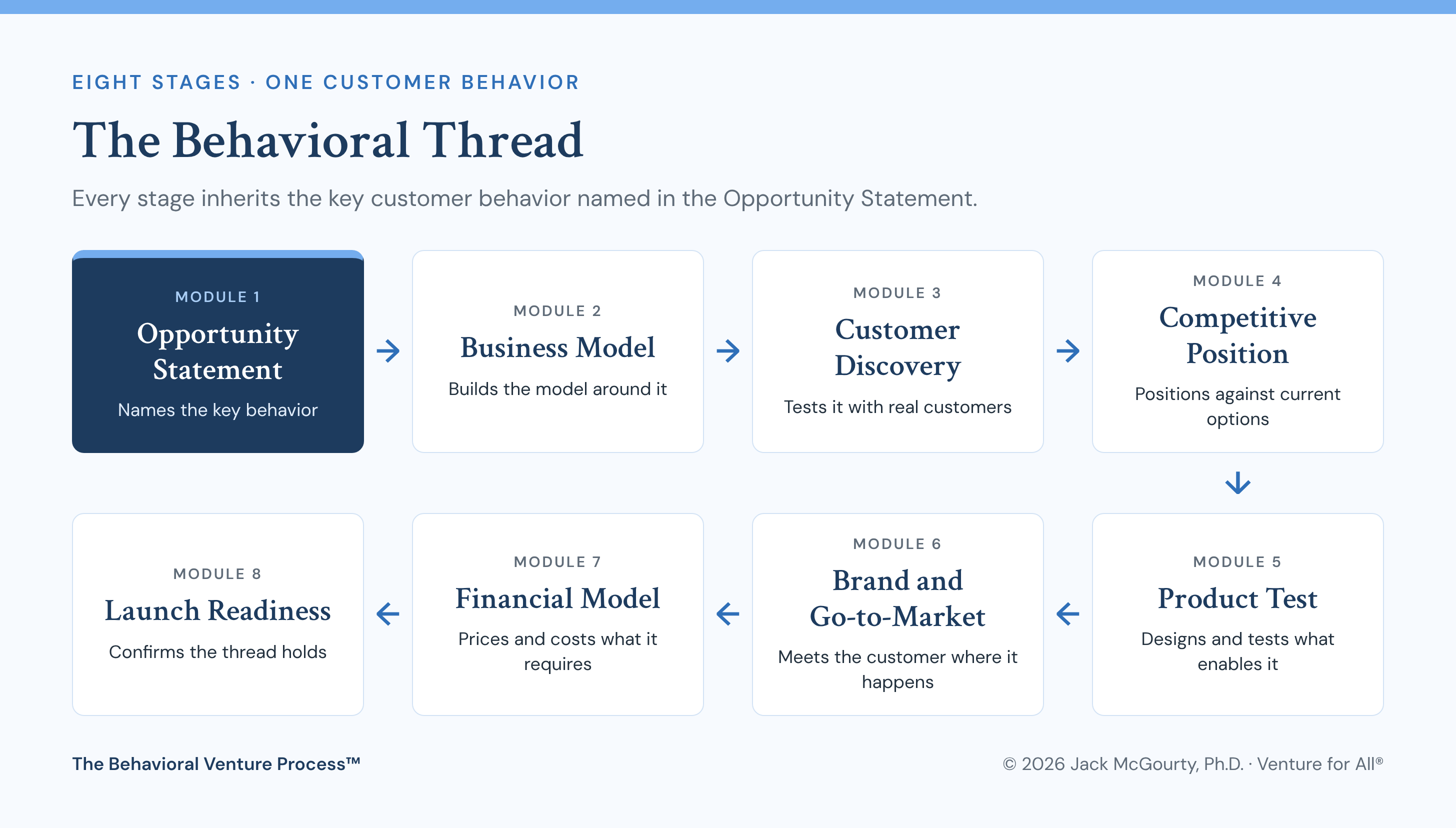
This article opens a series that follows the Behavioral Venture Process™, an eight-stage sequence that takes a venture from first idea to launch, one article per stage. Each article is a compact version of a chapter from Entrepreneurial Innovation and Finance, a practitioner’s guide to the full process. Readers who want the behavioral science underneath this first stage will find it in “Starting with the Customer, Not the Idea,” the opening chapter of The Behavioral Science of Entrepreneurship and Innovation. The two books follow the same founders. This series follows the work.
The first stage, Module 1, is titled Your Idea, and its central discipline is setting your idea aside. Instead, you look at the person you hope to serve. What are they trying to accomplish? What specific actions must they take to get there? What keeps getting in the way? The answers become your Opportunity Statement, the foundation document for everything that follows: your business model, your customer discovery, your market, your product, your brand, your financial plan, and your launch.
Five composite ventures, drawn from patterns seen across many founders, work through the process across this series. The Meridian Team is five colleagues from a Toronto EMBA cohort, Kofi, Priya, Wei, Jean-Luc, and Darya, building an AI-native compliance platform for mid-market supply chain companies. Amara is building a mobile-first platform to support rural community health workers in Ghana. Sung-jin is developing a smart-home health monitoring service. Fatima spent more than fifteen years in a regional consulting partnership in Dubai and is now building an independent executive advisory practice. Renée is a retired U.S. Army colonel designing a leadership readiness program for professionals moving from military to civilian careers.
Before any of them wrote a word, each had to answer one question. Do you have real customers, people outside your team and your circle of supporters, actively using and paying for your solution today? A yes puts you on the Building track, with evidence to interrogate. Anything short of an unambiguous yes puts you on the Exploring track, where the opportunity is still open and the customer can still shape the venture. Renée had twenty years of leadership development behind her, a detailed program design, and informal versions run with colleagues. Every version had been delivered inside an institution, to a captive audience, on someone else’s timeline. None of it told her whether a civilian professional would choose to pay for it in a crowded market. She declared Exploring, and that choice changed how she worked through everything that followed.
The Opportunity Statement Describes a Problem Space
Six elements, one key behavior, and no product in sight
The Opportunity Statement follows a fixed template:
The opportunity involves helping [Target Customer] when [Context] achieve [Outcomes] by facilitating [Key Behaviors]. The customer seeks [Outcomes] measured by [Metrics] but faces [Barriers]. Current [Enablers] exist that can be leveraged through [Solution Requirements].
Three sentences and six elements, some of them paired: target customer and context, outcomes and metrics, key behaviors, barriers, enablers, and solution requirements. Each asks for something specific, and specificity is the entire discipline. The template works as a filter. It admits a particular kind of answer and rejects the answers founders reach for first.
The target customer is where breadth does the most damage. “Small business owners” is a demographic slice. “Owners of three-to-ten-person service businesses who do their own bookkeeping at night after the workday ends” is a target customer, because it names a situation, a constraint, and a moment when the problem appears. The test is practical: could you find these people and talk with them next week? In business-to-business ventures, the rule gains a twist. A company does not feel a problem. A person inside the company does.
Outcomes are where founders write process when they mean result. “The customer wants a better tool” describes an activity. “The customer wants to close the month confident the books are accurate” describes an end state the customer would recognize as success. Every outcome needs a metric, because an outcome you cannot measure is an outcome you cannot test.
Then come the key behaviors, the element the whole process turns on. A key behavior is a specific, observable action the customer must take, consistently, to reach the outcome. “Being more organized” is an aspiration. “Reconciling receipts every Friday afternoon” is a behavior. Aspirations are easy to report and hard to observe. Behaviors can be watched, counted, and compared with what customers say. That distinction rests on one of the most consistent findings in behavioral science, the intention-behavior gap: sincere intentions do not reliably translate into action. What customers say they intend is useful evidence, but it is no substitute for observing what they do. To find the key behaviors, ask what the customer must actually do to reach the outcome, what would have to change in their routine, and what is stopping them from doing it now. Name one to three, and no more.
Notice what the statement leaves out. There is no bracket for your product, your technology, or your company. The product is your eventual answer to the opportunity. It belongs in the response to the statement and nowhere inside it.
The Meridian Team’s first attempt showed how hard that restraint is. They had arrived confident: three of the five had direct experience in the supply chain space, and twelve of the fourteen people they surveyed in their network said the problem was real. Their draft used industry terminology fluently and described their AI architecture at length in the solution requirements. It said almost nothing about what a mid-market compliance officer experiences when a new regulatory filing lands on a Tuesday afternoon. The team was showing a solution-first bias: refining an answer felt like progress, while studying the problem felt like delay, and the pull is strongest in teams that know their technology well. Their survey had a related weakness. Twelve yes answers showed that people in their network recognized the problem. They said nothing about how severe it was, how high it ranked, or whether those twelve people would pay for a solution or change how they got work done. Kofi, who had the most direct supply chain experience on the team, read the draft aloud and heard the problem at once. It described their product. Their customer’s problem was nowhere in it. They rewrote it from scratch that evening. The second version was far from correct, but it named a person, a compliance officer who has to demonstrate audit readiness on demand, and a behavior: producing compliant documentation within the window a regulator allows. Writing it showed the team exactly where their knowledge of that person ran thin.
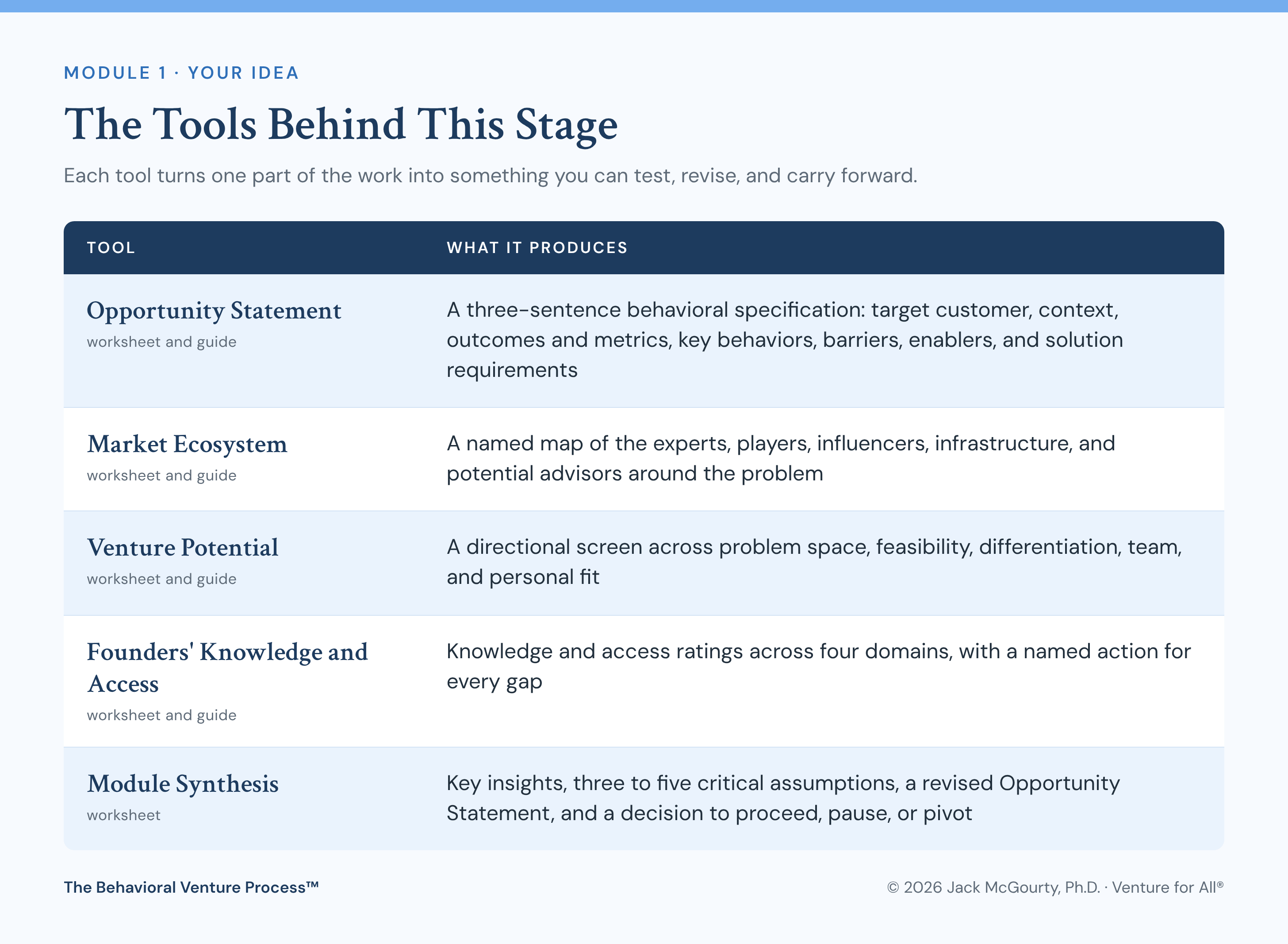
→ Supported by the Opportunity Statement worksheet and guide · The Behavioral Venture Process™
Barriers, Enablers, and What a Solution Must Do
Naming the friction without prescribing the fix
Barriers are the obstacles that keep the key behaviors from happening reliably. The most common mistake is writing a missing product as a barrier. “There is no easy-to-use app for tracking this” describes a gap your product happens to fill. The barrier is the friction underneath: the customer cannot remember to record the information when it occurs, or it arrives in six formats, or recording it takes longer than the task itself. Barriers stated this way are testable. You can ask about them, observe them, and learn whether they are as real as you believe. They also carry more weight than founders expect. A new solution competes with more than the shortcomings of the old one. Customers may prefer a familiar routine, face real switching costs, or worry about losing something they already value. People tend to weigh losses more heavily than equivalent gains, a pattern known as loss aversion, and a preference for the status quo reinforces it. That is why a real barrier can outlast a solution that looks plainly better on paper.
Enablers sit on the other side of the ledger: existing trends, platforms, habits, or infrastructure that make the key behaviors easier when a solution puts them to work. Founders often skip this element. Enablers explain why now: why this opportunity is available today when it was closed five years ago.
Solution requirements close the statement. A requirement is a condition any effective solution must satisfy. A feature is one specific way of satisfying it. “Must cut the time needed to perform the behavior by at least half” is a requirement. “A mobile app with a one-tap interface” is a feature. Exploring founders write requirements in outcome language. Building founders do something harder: they hold every benefit and feature of their existing product against the barriers and behaviors above, and ask where it falls short.
Amara finished her first Opportunity Statement in under two hours, and she had reason to feel confident. She had lived alongside this problem her whole life and had spent months reading research on community health worker systems. Her target customer was a community health worker in rural Ghana, and her statement drew its barriers from that worker’s day as Amara understood it. Households sat long distances apart, and travel was on foot. The worker shared a phone with colleagues or family, and connectivity came and went with the terrain and the power supply. Clinical decisions often happened alone, in a patient’s home, with support hard to reach in the moment. The key behavior was consulting a reliable decision guide before deciding whether to make a referral, during a visit she believed rarely ran past thirty minutes.
Every element was specific. Most of them would still change. A founder’s own vivid experience can quietly stand in for evidence about the customer. Because it is familiar and easy to recall, it can feel more representative than it is, reflecting the availability heuristic. The deeper the experience, the more convincing the substitute. The statement was accurate to Amara’s understanding of the problem, and the work ahead would test whether it was accurate to the health worker’s experience. Those are not the same thing, and only the next stages could show her the difference.
→ Supported by the Opportunity Statement worksheet and guide · The Behavioral Venture Process™
Map the World Around the Problem
Experts, players, influencers, infrastructure, and the people who could help
Before you judge whether an opportunity is viable, you need to see the landscape it sits in. The market ecosystem map covers five categories: the experts and thought leaders who study the problem; the players already addressing the barrier, by any approach; the influencers who shape how the problem is perceived, funded, or regulated; the infrastructure and potential partners any solution would depend on; and the specific mentors and advisors who could accelerate your team’s knowledge or access. Competitive analysis comes later. Here the goal is knowledge.
Specificity decides whether the map is useful. “Major consulting firms” and “government agencies” are categories. A named practice lead, a named regulatory office, a named researcher at a named institution: those are entries. The test is simple. Could you send an email today to each person or organization on your map? If not, keep researching. And the claim that a new idea has no competitors is almost never true. Someone is always addressing the barrier, even indirectly, even badly.
The map has one more job. When it is complete, ask what the landscape as a whole tells you that you did not know when you wrote the statement. A good map should change or sharpen the statement in at least one place.
The Meridian Team had assumed they understood their problem space. Darya, whose background was in regulatory compliance consulting, volunteered to lead the mapping, and what she surfaced over two weeks reshaped the team’s picture. Three organizations were already building AI-assisted compliance tools the team had never encountered. A recently published academic framework for classifying regulatory change complicated their assumptions about how compliance officers categorize risk. A regulatory body in the EU had pending guidelines that would affect the very jurisdictions where their early customers operated. A network of supply chain associations also acted as gatekeepers: their endorsement was nearly a prerequisite for enterprise software adoption in the team’s segment. None of it invalidated the direction. All of it sharpened the direction, and it showed that the original statement described a customer behavior the real compliance ecosystem made nearly impossible.
When Amara came back to her statement after the ecosystem work, she began revising. One of the first changes involved the district health supervisors she had listed as influencers. On the map, it became clear that they decided which tools the health workers in their districts were permitted to use at all.
→ Supported by the Market Ecosystem worksheet and guide · The Behavioral Venture Process™
Is This Worth Pursuing?
A preliminary screen for venture potential
The venture potential screen asks the hard question directly: are the signals strong enough to justify going deeper? It looks at four dimensions. Problem space asks whether dissatisfaction is real, and the strongest signal is active search behavior: customers already seeking and testing alternatives. Feasibility asks whether a solution can be built and delivered, whether the economics can work, and whether regulation could stop you. Differentiation asks whether there is a plausible basis for being meaningfully different from the players on your map. Team asks whether this team can reach the next milestone, a much smaller question than whether it can build a global company. One more question belongs to the founder alone: does this venture fit your life right now, in motivation, timing, financial runway, and the years of commitment it will ask for? A constraint discovered here costs far less than the same constraint discovered six months in.
Exploring founders read these dimensions differently. With no solution yet, the question is whether any viable solution is achievable at all, and differentiation becomes a question of potential: what structural advantages in knowledge, access, or position would the team bring?
The screen rewards candor over confidence. It is an especially important place to record uncertainty, where “I don’t know yet” and “the evidence here is weak” are correct answers. A screen that comes back uniformly positive should prompt a question: am I assessing this opportunity, or am I selling it? Once founders commit to an idea, confirmation bias begins filtering the evidence they notice, and contradicting signals start to look like edge cases. The screen is built to interrupt that filter while interrupting it is still cheap.
Sung-jin arrived at this stage with more structured data than most founders ever assemble. He had spent months running product evaluation at a South Korean consumer electronics company, and he brought two years of customer satisfaction surveys, quarterly sales data, field reports from regional distributors, and a competitive benchmark commissioned from an outside research firm. He expected the screen to confirm what he already knew. The differentiation dimension stopped him. A footnote in the research firm’s report, which he had read mainly for its technical analysis, mentioned two international competitors, one from Germany and one a Singapore-based startup. Both had entered his target segment in the previous eighteen months with products aimed at the exact barrier his statement named, and both had secured distribution with regional chains serving his target customer. The competitive landscape he had been studying no longer existed.
He did not abandon the opportunity. He rebuilt his differentiation analysis, found a customer segment the new entrants were consistently underserving, and revised his statement around it. The screen produced no verdict. It produced a sharper question, which is the most useful thing it can offer at this stage.
→ Supported by the Venture Potential worksheet and guide · The Behavioral Venture Process™
What Your Team Knows and Who You Can Reach
Knowledge, access, and the gap between them
Every founding team carries assumptions about what it knows and whom it can reach. The knowledge and access assessment makes those assumptions visible, so the gap between what the venture requires and what the team has can be planned for instead of discovered at a costly moment.
It separates two things founders tend to blur. Knowledge is whether you understand the problem deeply enough to design a solution that fits. Access is whether you have relationships that let you learn from, and eventually reach, the people who experience it. Knowledge without access is a research project. Access without knowledge is networking without direction.
Ratings cover four domains: the offer, the customer experience, infrastructure and operations, and the profit and financial model. Each is rated Low, Medium, or High, separately for knowledge and for access. The order of work matters. Before rating anything, define what High would look like for this specific venture; a team that rates itself against a generic idea of expertise will almost always over-rate. Then attach a specific action to every Low or Medium: a named person to contact, a question to investigate, a target date. A Low rating is not disqualifying. An unacknowledged Low rating is.
Fatima’s domain knowledge was formidable. She had led complex change initiatives across financial services, healthcare, and government throughout the Gulf region, and she had warm relationships with dozens of senior executives. The assessment exposed a structural problem underneath that picture. Every client relationship she carried was institutional: initiated through the firm, maintained inside paid engagements, governed by the firm’s protocols. When she left, those relationships largely stayed where they were. She had strong access to people who remembered her work favorably, and almost none to the unmediated, exploratory conversations with potential buyers that real discovery requires. As a solo founder, she had no co-founder whose network could cover the gap. The assessment turned an uncomfortable recognition into a plan: specific outreach strategies, a deliberate advisor network, and a run of no-agenda conversations designed to rebuild direct access outside the old institutional frame. That plan became the foundation of her first three months of independent work.
For the Meridian Team, the assessment raised a question the members could not answer among themselves. They brought substantial domain knowledge through Darya’s consulting work and their supply chain experience, but their picture of the compliance officer’s daily workflow was still incomplete. None of them had ever sold software into an IT organization, and none could confidently say who inside a target company would actually approve a tool like theirs.
→ Supported by the Founders’ Knowledge and Access worksheet and guide · The Behavioral Venture Process™
Proceed, Pause, or Pivot
Module 1 ends with a synthesis and a decision. Distill the single most important insight from each piece of work. List the three to five assumptions that, if wrong, would most threaten the venture, because those become the core questions for customer discovery. Write the revised Opportunity Statement, with a record of each version and what prompted it. Then decide. Proceed means the signals are strong enough and the remaining gaps are named. Pause means specific questions must be answered first, with a named plan for answering them. Pivot means something fundamental in the framing is wrong. The worst outcome is a nominal Proceed that papers over real uncertainty, because unresolved questions compound through every module that follows.
The revised statement is where the behavioral thread becomes visible. The key behavior named in Module 1 anchors the business model, shapes customer discovery, and carries forward through market analysis, product, brand, financial modeling, and launch. When a later decision cannot be traced back to it, the thread has broken.
The Behavioral Thread
The Meridian Team, Amara, Sung-jin, Fatima, and Renée all finished Module 1 with Opportunity Statements that looked substantially different from what they had imagined writing. The Meridian Team chose Pause. Their signals were encouraging, but their assumption inventory had surfaced a question they could not answer: did compliance officers hold authority over the tooling decisions their platform required, or did those decisions live in IT procurement? Two weeks of outreach to three compliance professionals gave them the answer. The decision was split between compliance and IT at most of the companies they targeted, with the line falling differently at each one, and the finding reshaped their customer profile before structured customer discovery began. Amara chose Proceed after revising four of her six elements; her first statement reflected her understanding, and her revision came closer to the health worker’s experience. Sung-jin chose Proceed on a sharper differentiation story and a revised statement built around the segment the new entrants had missed. Fatima chose Proceed with her three-month access plan running alongside the work ahead. Renée chose Proceed on the Exploring track, with open-market willingness to pay at the top of her assumption inventory, aware of the risk and not yet aware of how strongly her own instincts would pull her away from it.
The goal of the first draft was never to be correct. The goal was to be specific enough to be wrong in ways you can learn from.
The examples in this article are drawn from observed founder cohorts. Identifying details have been changed, and the fleet venture is a composite.